“The majority lean down with moderate confidence and bearish signals from inventories and technical levels, outweighing modest upside risk from geo-political concerns.”
WTI Crude Oil (front contract): what the analysts said on 13 November 2026
4 of 12 analysts spoke; 3 lean lower and 1 lean higher. 3 of those expect only a small move.
Forecast at a glance
Direction, chance of a quiet market, and expected size are separate questions.
Higher by tomorrow’s close
How much weight to give it: This is the registered benchmark, kept in place while the AI challenger is still being tested; it is not presented as a strong AI call.
The registered benchmark remains the published forecast while the AI challenger is still being tested.Likely range: -2.53% to 2.5% (an 8-in-10 estimate). The odds, average move and range all come from one probability-weighted historical return distribution.
How this verdict was reached — 1 leaned lower, 2 saw little change
Three independent readers look at the same day through deliberately different windows: one reads the debate, one ignores the debate and reads only the numbers, one reads only the news. If they all saw the same evidence they would simply agree with each other, which would tell us nothing. Today they largely agreed — which counts for less, not more, since it may be one line of reasoning arrived at three times.
“WTI remains in a bearish technical structure with price below all major moving averages, RSI still weak at 41.68, and negative momentum from a -13.48% ROC10, despite a recent 1.99% gain.”
“Conflicting news regarding geopolitical tensions and peace talks created opposing pressures on oil prices, leading to an uncertain near-term direction.”
The AI challenger was calculated, then withheld from the public call. Version judge-3.2.0 combined the reachable readers in log-odds space, equally weighted because none had yet earned enough independent graded calls to count for more, and shrank the result back toward this market's history. Confidence calibration stayed off because the prior independent record had not yet earned it. Because that challenger has not yet passed the forward evidence gate, the benchmark guardian published the locked base-rate vector shown above instead. Both vectors remain in the immutable record. Measured reader agreement: 0.911; 3 of 3 answered.
Why the headline percentage isn't just the “higher” bar above. The bar shows all three outcomes, and one of them — barely moved — isn't a direction at all, it's a question about size. Reading “higher 29%” off that bar would suggest we mostly expect the other thing to happen, which isn't what the numbers say. So the call is stated the way the question is actually asked: when this market moves, which way does it go? Of the 55% of days it does move, we put 52% on higher. The chance it barely moves is reported on its own, and grading uses all three numbers untouched.
Why is this benchmark-protected? The challenger is recorded and tested, but the registered benchmark stays public until the challenger passes the pre-declared evidence threshold. This avoids promoting a promising backtest as a proven live improvement.
Starting point before anyone argued: over 319 past stretches like this one, this market rose 29% of the time, fell 26%, and barely moved 45%.
Higher by next week’s close
How much weight to give it: This is the registered benchmark, kept in place while the AI challenger is still being tested; it is not presented as a strong AI call.
The registered benchmark remains the published forecast while the AI challenger is still being tested.Likely range: -5.5% to 6.34% (an 8-in-10 estimate). The odds, average move and range all come from one probability-weighted historical return distribution.
How this verdict was reached — 1 leaned lower, 2 saw little change
Three independent readers look at the same day through deliberately different windows: one reads the debate, one ignores the debate and reads only the numbers, one reads only the news. If they all saw the same evidence they would simply agree with each other, which would tell us nothing. Today they largely agreed — which counts for less, not more, since it may be one line of reasoning arrived at three times.
“Inventory builds and deepening managed money shorts strongly indicate physical oversupply will pressure prices lower in the coming week.”
“WTI is trading below all major moving averages with strong bearish momentum (RSI 41.7, MACD negative) and elevated volatility, while scheduled import/export price data could reinforce downside pressure given recent inventory builds and weak demand signals.”
“Recent news shows conflicting drivers for oil prices, with peace talks pushing prices down and geopolitical tensions (Iran) pushing them up, creating uncertainty and suggesting a higher likelihood of remaining within the flat band.”
The AI challenger was calculated, then withheld from the public call. Version judge-3.2.0 combined the reachable readers in log-odds space, equally weighted because none had yet earned enough independent graded calls to count for more, and shrank the result back toward this market's history. Confidence calibration stayed off because the prior independent record had not yet earned it. Because that challenger has not yet passed the forward evidence gate, the benchmark guardian published the locked base-rate vector shown above instead. Both vectors remain in the immutable record. Measured reader agreement: 0.876; 3 of 3 answered.
Why the headline percentage isn't just the “higher” bar above. The bar shows all three outcomes, and one of them — barely moved — isn't a direction at all, it's a question about size. Reading “higher 29%” off that bar would suggest we mostly expect the other thing to happen, which isn't what the numbers say. So the call is stated the way the question is actually asked: when this market moves, which way does it go? Of the 51% of days it does move, we put 56% on higher. The chance it barely moves is reported on its own, and grading uses all three numbers untouched.
Why is this benchmark-protected? The challenger is recorded and tested, but the registered benchmark stays public until the challenger passes the pre-declared evidence threshold. This avoids promoting a promising backtest as a proven live improvement.
Starting point before anyone argued: over 315 past stretches like this one, this market rose 29% of the time, fell 22%, and barely moved 49%.
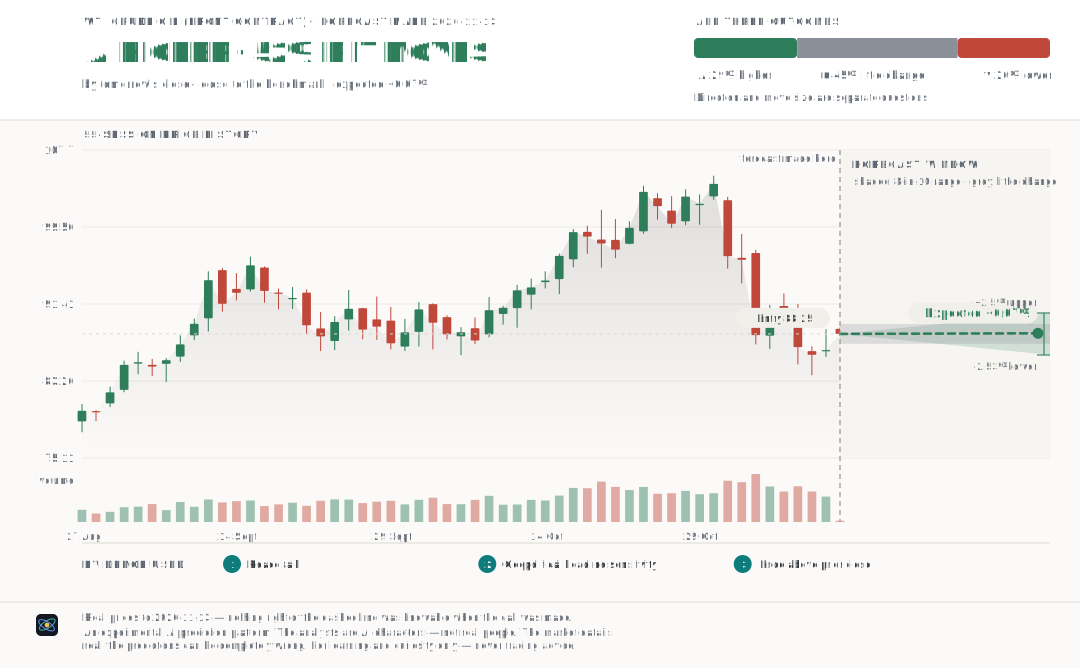
Price context
What the market looked like when this forecast was made.
Published record
The locked forecasts and their grading status.
What we said would happen tomorrow
barely moved The market moved 0.76%; we'd said about 0.07%.
A move smaller than ±1.19% counts as "little changed" — that threshold was locked in before we published, so we can't move the goalposts afterwards. We also said the move would most likely land between -2.53% and 2.5% (right about 8 times in 10 if we're honestly calibrated).
Evidence and publication timing
Evidence cutoff: 2026-11-13T06:34:20.212Z
Decision started: 2026-11-13T06:35:09.682Z
Decision finished: 2026-11-13T06:35:22.682Z
Ledger written: 2026-11-13T06:35:34.088Z
Timestamp status: forecast hash submitted for independent timestamping.
Grading series: pinned_contract. Configuration epoch 20; fingerprint b30268869f6f9ddf.
What we said would happen next week
we were wrong The market moved -4.99%; we'd said about 0.37%.
A move smaller than ±2.96% counts as "little changed" — that threshold was locked in before we published, so we can't move the goalposts afterwards. We also said the move would most likely land between -5.5% and 6.34% (right about 8 times in 10 if we're honestly calibrated).
Evidence and publication timing
Evidence cutoff: 2026-11-13T06:34:20.212Z
Decision started: 2026-11-13T06:35:22.682Z
Decision finished: 2026-11-13T06:35:34.075Z
Ledger written: 2026-11-13T06:35:37.701Z
Timestamp status: forecast hash submitted for independent timestamping.
Grading series: pinned_contract. Configuration epoch 20; fingerprint b30268869f6f9ddf.
Analyst views
The key point from each specialist; open a card’s reasoning only when you want more detail. Next-session and next-week views are kept separate.
About the percentages: they show each fictional AI analyst’s own conviction, not the market forecast and not measured accuracy.
Leaning lower · 3
Evidence points toward a lower price.
WTI Crude Oil will test below 87.16 if the bearish sentiment continues.
Why this analyst thinks that
- News reports suggest that hopes for progress in peace talks in the Middle East and Russia-Ukraine are pressuring oil prices down, with WTI crude futures falling $1.04 earlier in the day.
Ravi reached a view but couldn't put it in publishable words, so only the vote is shown.
Small move expected · leans lower if it breaks
Why this analyst thinks that
- Inventory build of 4.66 million barrels contradicts bullish narrative
- Managed money net short position deepened to -11,818 contracts, indicating bearish sentiment
If price closes below today’s 88.25, especially under the cloud’s lower boundary near 93.5, it would confirm bearish pressure for the next session.
Small move expected · leans lower if it breaks
Why this analyst thinks that
- Price closed higher today at 88.25, up 1.988%, but remains well below the cloud level near 93.5–93.9, indicating bearish equilibrium.
- The Tenkan-Kijun cross is bearish below the cloud, suggesting downward pressure.
- Inverse moderate correlations with major equity indexes like the S&P 500 and Nasdaq 100 hint at external equity weakness supporting oil strength, but this is not strong enough to overcome the bearish cloud context.
- Market news suggests conflicting short-term political optimism and pessimism, increasing uncertainty.
Leaning higher · 1
Evidence points toward a higher price.
Market underprices Strait of Hormuz disruption risk; a close above $90 would confirm risk premium returning, while sustained peace talk optimism pushing below $86.53 would show overreaction.
Small move expected · leans higher if it breaks
Why this analyst thinks that
- Scheduled PPI release could amplify dollar moves (USD basket at 102.34).
- Recent headline sensitivity shows oil reacting sharply to geopolitical rumors.
Leaning lower · 3
Evidence points toward a lower price.
WTI Crude Oil will face significant selling pressure if it closes below 85.00 this week.
Small move expected · leans lower if it breaks
Why this analyst thinks that
- The inverse correlation with major indices like the Dow Jones and S&P 500 has slightly strengthened, suggesting that any downside in these indices could further pressure oil prices.
Ravi reached a view but couldn't put it in publishable words, so only the vote is shown.
Why this analyst thinks that
- Sustained inventory build pattern contradicts seasonal demand expectations
- Stronger dollar (102.34 basket) and inverse equity correlations provide persistent macro headwinds
A weekly close below the cloud boundary near 93.5 would reinforce the bearish trend over the coming week.
Why this analyst thinks that
- Price remains below the Ichimoku cloud (93.535 to 93.875), a bearish equilibrium zone.
- The Tenkan-Kijun bearish cross below the cloud supports a continued downward trend at this horizon.
- The cloud itself is flat/slightly declining, signaling no strong bullish reversal in sight.
- Moderate inverse correlations with equity markets have increased, supporting the idea that oil may weaken if equities rally.
- Recent news about peace talks may reduce geopolitical risk premiums, pressuring prices lower.
Leaning higher · 1
Evidence points toward a higher price.
Market underestimates supply chokepoint risks in Hormuz; a weekly close above $92 would confirm geopolitical premium building, while breaking below $85 would signal complacency on peace talks.
Why this analyst thinks that
- Import/export price data and continued geopolitical friction likely to sustain volatility.
- Strengthening inverse correlation with emerging markets (-0.427 vs -0.22 historical) suggests risk-off flows supporting oil.
4 analysts stayed quiet
- Dmitri Volkov — the volume and money-flow measures he reads were too close to neutral to argue either way
- Silas Reed — the support and resistance levels he reads were too close to neutral to argue either way
- Jonas Weiss — the candle patterns he reads were too close to neutral to argue either way
- Owen Clarke — the value-area measures he reads were too close to neutral to argue either way
Outcome review and lessons
The Master and each participating Persona revisit the result after grading. Correct calls are reviewed too, because being right once does not prove the reasoning.
The Master AI incorrectly predicted an 'up' move for WTI, while the market moved 'down' by 4.99%.
The market moved -4.99% against a locked quiet band of ±2.96%. The pre-registered base-rate forecast scored better on this result.
The forecast was wrong, indicating the combined model's weighting or calibration did not accurately capture market dynamics.
The model's 'up' prediction suggests it overlooked factors driving the significant downward movement.
The provisional lesson is to re-evaluate the model's sensitivity to 'trend_highvol' conditions for WTI.
The system should continue collecting evidence to identify repeated patterns before implementing permanent changes.
Best-scoring Persona views on this result: Ravi Iyer, Hana Sato, Priya Nair. This ordering uses proper probability score, not hindsight confidence.
Read all 8 Persona reviews
Priya Nair
view was incorrect
Predicted little changed; market outcome lower · proper score 0.2778 (lower is better). View profile →
The forecast was incorrect, suggesting the 'flat' stance did not account for the strong downward price action.
The persona likely overlooked factors that led to the significant negative price movement.
The provisional lesson is to improve identification of directional shifts during 'trend_highvol' periods.
The system should continue collecting evidence to identify repeated patterns before implementing permanent changes.
Elena Vasquez
view was incorrect
Predicted little changed; market outcome lower · proper score 0.2778 (lower is better). View profile →
The forecast was incorrect, indicating that the chart structure analysis did not capture the bearish momentum.
The persona likely overlooked structural breakdowns or bearish patterns that led to the sharp decline.
The provisional lesson is to refine pattern recognition for strong directional moves in 'trend_highvol' markets.
The system should continue collecting evidence to identify repeated patterns before implementing permanent changes.
Edgar Blackwood
view was incorrect
Predicted little changed; market outcome lower · proper score 0.2778 (lower is better). View profile →
The forecast was incorrect, suggesting the contrarian view did not align with the market's strong directional move.
The persona likely overlooked underlying drivers that pushed the market significantly lower.
The provisional lesson is to assess when contrarian signals are less effective in 'trend_highvol' environments.
The system should continue collecting evidence to identify repeated patterns before implementing permanent changes.
Maya Chen
view was incorrect
Predicted little changed; market outcome lower · proper score 0.29 (lower is better). View profile →
The forecast was incorrect, indicating that cyclical or seasonal patterns did not prevent the strong downward move.
The persona's reasoning about selling pressure below 85.00 was directionally correct but the 'flat' prediction was not.
The provisional lesson is to ensure the prediction aligns with the stated reasoning and observed market action.
The system should continue collecting evidence to identify repeated patterns before implementing permanent changes.
Ravi Iyer
view was correct
Predicted lower; market outcome lower · proper score 0.0563 (lower is better). View profile →
The forecast was correct, suggesting the analysis of inventory builds and managed money shorts accurately identified bearish pressure.
No overlooked factors are evident, as the prediction aligned with the market outcome.
The provisional lesson is that fundamental supply-demand analysis can be effective in 'trend_highvol' conditions.
The system should continue collecting evidence to identify repeated patterns before implementing permanent changes.
Viktor Ronen
view was incorrect
Predicted higher; market outcome lower · proper score 0.4063 (lower is better). View profile →
The forecast was incorrect, indicating that geopolitical risk factors did not drive an upward price movement.
The persona likely overlooked factors that led to the market's significant downward move, despite geopolitical concerns.
The provisional lesson is to re-evaluate the immediate impact of geopolitical risks versus other market drivers.
The system should continue collecting evidence to identify repeated patterns before implementing permanent changes.
Hana Sato
view was correct
Predicted lower; market outcome lower · proper score 0.1563 (lower is better). View profile →
The forecast was correct, suggesting the Ichimoku analysis accurately identified the bearish trend.
No overlooked factors are evident, as the prediction aligned with the market outcome.
The provisional lesson is that Ichimoku signals can effectively capture directional moves in 'trend_highvol' markets.
The system should continue collecting evidence to identify repeated patterns before implementing permanent changes.
Tomas Lindqvist
view was incorrect
Predicted little changed; market outcome lower · proper score 0.2778 (lower is better). View profile →
The forecast was incorrect, indicating that the risk management perspective did not anticipate the strong downward move.
The persona likely overlooked factors that led to the significant negative price movement.
The provisional lesson is to improve identification of directional shifts during 'trend_highvol' periods.
The system should continue collecting evidence to identify repeated patterns before implementing permanent changes.
These reviews are transparent commentary. They affect no past score. A proposed lesson changes future knowledge only after the same weakness is confirmed across enough independent graded forecasts.
The forecast for WTI was 'up' but the market was 'flat', resulting in an incorrect verdict.
The market moved 0.76% against a locked quiet band of ±1.19%.
The market moved 0.76%, which was within the 1.19% no-change band, leading to a 'flat' outcome.
The 'up' prediction did not account for the market's tendency to remain within the no-change band.
A narrow miss indicates the market's actual movement was close to the 'flat' threshold.
The system should continue to collect evidence to identify patterns in 'trend_highvol' conditions.
Best-scoring Persona views on this result: Ravi Iyer, Viktor Ronen, Hana Sato. This ordering uses proper probability score, not hindsight confidence.
Read all 8 Persona reviews
Priya Nair
view was correct
Predicted little changed; market outcome little changed · proper score 0.1111 (lower is better). View profile →
The market moved 0.76%, which fell within the 1.19% no-change band, confirming the 'flat' prediction.
No factors appear to have been overlooked as the prediction was correct.
A correct prediction, especially in 'trend_highvol' conditions, warrants further review for consistent performance.
Continue to monitor performance in similar market conditions to confirm consistent accuracy.
Elena Vasquez
view was correct
Predicted little changed; market outcome little changed · proper score 0.1111 (lower is better). View profile →
The market moved 0.76%, which fell within the 1.19% no-change band, confirming the 'flat' prediction.
No factors appear to have been overlooked as the prediction was correct.
A correct prediction, especially in 'trend_highvol' conditions, warrants further review for consistent performance.
Continue to monitor performance in similar market conditions to confirm consistent accuracy.
Edgar Blackwood
view was correct
Predicted little changed; market outcome little changed · proper score 0.1111 (lower is better). View profile →
The market moved 0.76%, which fell within the 1.19% no-change band, confirming the 'flat' prediction.
No factors appear to have been overlooked as the prediction was correct.
A correct prediction, especially in 'trend_highvol' conditions, warrants further review for consistent performance.
Continue to monitor performance in similar market conditions to confirm consistent accuracy.
Maya Chen
view was incorrect
Predicted lower; market outcome little changed · proper score 0.1391 (lower is better). View profile →
The market moved 0.76%, which was within the 1.19% no-change band, resulting in a 'flat' outcome.
The prediction of bearish sentiment leading to a test below 87.16 did not materialize.
The market's tendency to remain within the no-change band was not adequately considered.
Review the model's sensitivity to 'bearish sentiment' in relation to the no-change band.
Ravi Iyer
view was correct
Predicted little changed; market outcome little changed · proper score 0.04 (lower is better). View profile →
The market moved 0.76%, which fell within the 1.19% no-change band, confirming the 'flat' prediction.
No factors appear to have been overlooked as the prediction was correct.
The reasoning about contained price action due to inventories and short bets was consistent with the outcome.
Continue to monitor the impact of inventory builds and speculative positioning on WTI price action.
Viktor Ronen
view was correct
Predicted little changed; market outcome little changed · proper score 0.09 (lower is better). View profile →
The market moved 0.76%, which fell within the 1.19% no-change band, confirming the 'flat' prediction.
No factors appear to have been overlooked as the prediction was correct.
The market remaining flat suggests neither significant disruption risk nor peace talk overreaction occurred.
Continue to assess the balance of geopolitical risks and peace talk optimism in WTI forecasts.
Hana Sato
view was correct
Predicted little changed; market outcome little changed · proper score 0.09 (lower is better). View profile →
The market moved 0.76%, which fell within the 1.19% no-change band, confirming the 'flat' prediction.
No factors appear to have been overlooked as the prediction was correct.
The market did not close below 88.25 or the cloud's lower boundary, aligning with the 'flat' outcome.
Continue to monitor Ichimoku signals, especially cloud boundaries, in 'trend_highvol' conditions.
Tomas Lindqvist
view was correct
Predicted little changed; market outcome little changed · proper score 0.1111 (lower is better). View profile →
The market moved 0.76%, which fell within the 1.19% no-change band, confirming the 'flat' prediction.
No factors appear to have been overlooked as the prediction was correct.
A correct prediction, especially in 'trend_highvol' conditions, warrants further review for consistent performance.
Continue to monitor performance in similar market conditions to confirm consistent accuracy.
These reviews are transparent commentary. They affect no past score. A proposed lesson changes future knowledge only after the same weakness is confirmed across enough independent graded forecasts.