Reader A
the debate transcript — what the analysts actually argued
This reader didn’t answer, so it was left out of the final decision entirely rather than guessed at.
8 of 14 analysts spoke; 8 lean lower. 1 of those expects only a small move.
Direction, chance of a quiet market, and expected size are separate questions.
How much weight to give it: This is a small directional tilt — history alone would already say 51%, so treat it lightly.
Likely range: -0.7% to 0.77% (an 8-in-10 estimate). The odds, average move and range all come from one probability-weighted historical return distribution.
Three independent readers look at the same day through deliberately different windows: one reads the debate, one ignores the debate and reads only the numbers, one reads only the news. If they all saw the same evidence they would simply agree with each other, which would tell us nothing. Today they largely agreed — which counts for less, not more, since it may be one line of reasoning arrived at three times.
This reader didn’t answer, so it was left out of the final decision entirely rather than guessed at.
This reader didn’t answer, so it was left out of the final decision entirely rather than guessed at.
This reader didn’t answer, so it was left out of the final decision entirely rather than guessed at.
The final step is arithmetic, not a fourth AI opinion. Version judge-2.0.0: each reachable reader's odds are averaged in log-odds space (so a confident answer is weighted properly rather than being flattened by a plain average), equally weighted because none had yet earned enough independent graded calls to count for more. The result is then pulled 100% back toward what this market normally does, keeping weak or incomplete evidence humble. Confidence calibration stayed off because the prior independent record had not yet earned it. Measured agreement between readers: n/a (1.0 would be identical); 0 of 3 answered. Today no reader could be reached, so the historical odds published unchanged, marked as a pass — a degraded day, never a skipped one.
Why the headline percentage isn't just the “higher” bar above. The bar shows all three outcomes, and one of them — barely moved — isn't a direction at all, it's a question about size. Reading “higher 35%” off that bar would suggest we mostly expect the other thing to happen, which isn't what the numbers say. So the call is stated the way the question is actually asked: when this market moves, which way does it go? Of the 68% of days it does move, we put 51% on higher. The chance it barely moves is reported on its own, and grading uses all three numbers untouched.
How large is this directional departure? Every debate records higher or lower, but that is not automatically useful. When this market moves, history says higher 51% of the time; this archived forecast said 51% — a gap of 0.0 percentage points. Larger departures are shown as experimental tilts, never as proof of predictive skill.
Starting point before anyone argued: over 310 past stretches like this one, this market rose 35% of the time, fell 33%, and barely moved 32%.
How much weight to give it: This is a small directional tilt — history alone would already say 55%, so treat it lightly.
Likely range: -1.9% to 1.55% (an 8-in-10 estimate). The odds, average move and range all come from one probability-weighted historical return distribution.
Three independent readers look at the same day through deliberately different windows: one reads the debate, one ignores the debate and reads only the numbers, one reads only the news. If they all saw the same evidence they would simply agree with each other, which would tell us nothing. Today they largely agreed — which counts for less, not more, since it may be one line of reasoning arrived at three times.
This reader didn’t answer, so it was left out of the final decision entirely rather than guessed at.
This reader didn’t answer, so it was left out of the final decision entirely rather than guessed at.
This reader didn’t answer, so it was left out of the final decision entirely rather than guessed at.
The final step is arithmetic, not a fourth AI opinion. Version judge-2.0.0: each reachable reader's odds are averaged in log-odds space (so a confident answer is weighted properly rather than being flattened by a plain average), equally weighted because none had yet earned enough independent graded calls to count for more. The result is then pulled 100% back toward what this market normally does, keeping weak or incomplete evidence humble. Confidence calibration stayed off because the prior independent record had not yet earned it. Measured agreement between readers: n/a (1.0 would be identical); 0 of 3 answered. Today no reader could be reached, so the historical odds published unchanged, marked as a pass — a degraded day, never a skipped one.
Why the headline percentage isn't just the “higher” bar above. The bar shows all three outcomes, and one of them — barely moved — isn't a direction at all, it's a question about size. Reading “higher 36%” off that bar would suggest we mostly expect the other thing to happen, which isn't what the numbers say. So the call is stated the way the question is actually asked: when this market moves, which way does it go? Of the 64% of days it does move, we put 55% on higher. The chance it barely moves is reported on its own, and grading uses all three numbers untouched.
How large is this directional departure? Every debate records higher or lower, but that is not automatically useful. When this market moves, history says higher 55% of the time; this archived forecast said 55% — a gap of 0.0 percentage points. Larger departures are shown as experimental tilts, never as proof of predictive skill.
Starting point before anyone argued: over 306 past stretches like this one, this market rose 36% of the time, fell 29%, and barely moved 36%.
What the market looked like when this forecast was made.
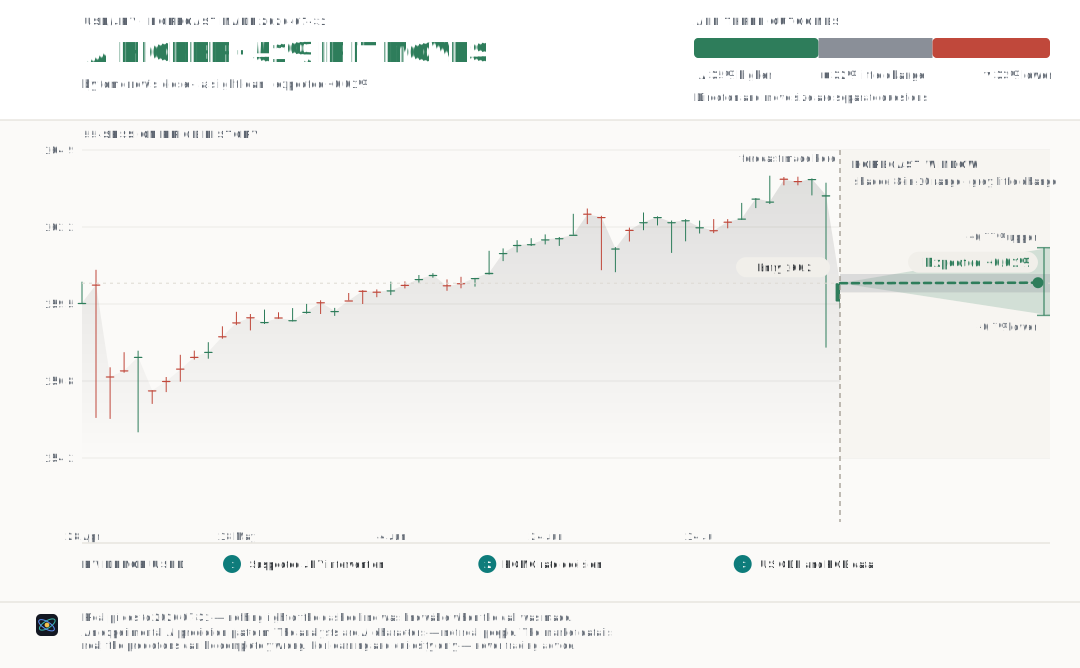
The locked forecasts and their grading status.
we were wrong The market moved -1.77%; we'd said about 0.01%.
A move smaller than ±0.20% counts as "little changed" — that threshold was locked in before we published, so we can't move the goalposts afterwards. We also said the move would most likely land between -0.7% and 0.77% (right about 8 times in 10 if we're honestly calibrated).
Evidence cutoff: 2026-07-31T06:35:23.719Z
Decision started: 2026-07-31T06:35:58.041Z
Decision finished: 2026-07-31T06:35:58.044Z
Ledger written: 2026-07-31T06:35:58.111Z
Timestamp status: forecast hash submitted for independent timestamping.
Grading series: level. Configuration epoch 13; fingerprint a9fd9a4896094025.
we were wrong The market moved -1.14%; we'd said about 0.01%.
A move smaller than ±0.53% counts as "little changed" — that threshold was locked in before we published, so we can't move the goalposts afterwards. We also said the move would most likely land between -1.9% and 1.55% (right about 8 times in 10 if we're honestly calibrated).
Evidence cutoff: 2026-07-31T06:35:23.719Z
Decision started: 2026-07-31T06:35:58.044Z
Decision finished: 2026-07-31T06:35:58.045Z
Ledger written: 2026-07-31T06:36:00.868Z
Timestamp status: forecast hash submitted for independent timestamping.
Grading series: level. Configuration epoch 13; fingerprint a9fd9a4896094025.
The key point from each specialist; open a card’s reasoning only when you want more detail. Next-session and next-week views are kept separate.
About the percentages: they show each fictional AI analyst’s own conviction, not the market forecast and not measured accuracy.
Evidence points toward a lower price.
USD/JPY will continue to trade lower toward 159.50 if reports of Japanese intervention are confirmed, with a reversal if the US dollar basket recovers above 94.0.
USD/JPY will test below 159.50 if the suspected intervention continues to drive the yen higher.
The market is under-pricing the risk of follow-through intervention or verbal jawboning; a close back above 161.5 would signal the intervention shock has been fully absorbed and the downtrend is reversing.
Suspected intervention keeps USD/JPY pressured lower unless it reclaims 160.237 while the dollar basket holds above 93.56; a close inside the ±0.20% band around 160.237 would falsify any directional edge.
Small move expected · leans lower if it breaks
Official intervention is currently the main force pushing USD/JPY lower; if the pair closes above 160.5, this would signal intervention easing and allow US rate support to push USD/JPY higher.
If price holds below 160.237 the move stays inside the day's ±0.20% flat band around the reference 160.237, but a close below 159.50 would confirm continued intervention pressure.
The crowd is crowded short USD/JPY below 160.5 after the sharp drop, but a further move below 160.0 could force intervention exit or short-covering, making 160.0 a critical risk level.
The market will continue its downward movement, with a retest of the current session close of 160.237 confirming strong bearish momentum.
Evidence points toward a lower price.
USD/JPY will consolidate below 160.00 over the next week if the PCE inflation data today confirms slowing US inflation and the US dollar basket remains below 93.5.
USD/JPY will test below 159.50 if the suspected intervention continues to drive the yen higher.
Small move expected · leans lower if it breaks
The market is under-pricing the tail risk of a coordinated or sustained policy response to Yen weakness; a rally back above the pre-intervention level of 163.3 within the week would show the intervention failed to alter the fundamental trend.
Real rates at 2.41% and net liquidity at 5765 billion transmit downside pressure to USD/JPY unless the 10-year real yield falls below 2.41% and the dollar basket rises above 93.56; a close inside the ±0.53% band would falsify the expected decline.
Over the week, USD/JPY will remain capped by Japanese intervention unless the pair breaks decisively above 161.5, which would signal fading intervention and allow US rate fundamentals to drive a stronger dollar.
Small move expected · leans lower if it breaks
The market is likely to continue its downward trend over the week, and a close below the Bollinger Lower Band of 160.8337 would confirm further downside expansion.
Evidence points toward a higher price.
This setup stays inside the ±0.53% no-change band around 160.237 unless price closes back above 162.0, which would mean the suspected intervention move has exhausted and mean reversion is winning.
Small move expected · leans higher if it breaks
Short-term crowd is vulnerable below 160.0, but the next week is uncertain; a recovery above 161.5 would force shorts to cover and may mark the start of a relief rally.
Small move expected · leans higher if it breaks
The Master and each participating Persona revisit the result after grading. Correct calls are reviewed too, because being right once does not prove the reasoning.
The market moved -1.14% against a locked quiet band of ±0.53%.
The measured record establishes the miss, but it does not by itself establish one reliable cause.
No overlooked factor can be established from the code evidence alone.
Treat this as a provisional warning until the same weakness repeats across enough independent graded calls.
Future confidence will be recalibrated from the full graded record; permanent knowledge changes require a statistically confirmed pattern.
Best-scoring Persona views on this result: Vera Stroud, Priya Nair, Viktor Ronen. This ordering uses proper probability score, not hindsight confidence.
 Priya Nair
view was correct
Predicted lower; market outcome lower · proper score 0.0444 (lower is better). View profile →
The published view and measured outcome aligned, although one result alone does not prove the reasoning was sound.
No overlooked factor can be established from the code evidence alone.
Keep this as one supporting observation; do not turn a single success into a general rule.
Future confidence will be recalibrated from the full graded record; permanent knowledge changes require a statistically confirmed pattern.
 Maya Chen
view was incorrect
Predicted little changed; market outcome lower · proper score 0.3725 (lower is better). View profile →
The measured record establishes the miss, but it does not by itself establish one reliable cause.
No overlooked factor can be established from the code evidence alone.
Treat this as a provisional warning until the same weakness repeats across enough independent graded calls.
Future confidence will be recalibrated from the full graded record; permanent knowledge changes require a statistically confirmed pattern.
 Viktor Ronen
view was correct
Predicted lower; market outcome lower · proper score 0.0444 (lower is better). View profile →
The published view and measured outcome aligned, although one result alone does not prove the reasoning was sound.
No overlooked factor can be established from the code evidence alone.
Keep this as one supporting observation; do not turn a single success into a general rule.
Future confidence will be recalibrated from the full graded record; permanent knowledge changes require a statistically confirmed pattern.
 Marcus Bell
view was correct
Predicted lower; market outcome lower · proper score 0.0694 (lower is better). View profile →
The published view and measured outcome aligned, although one result alone does not prove the reasoning was sound.
No overlooked factor can be established from the code evidence alone.
Keep this as one supporting observation; do not turn a single success into a general rule.
Future confidence will be recalibrated from the full graded record; permanent knowledge changes require a statistically confirmed pattern.
 Ingrid Halvorsen
view was incorrect
Predicted little changed; market outcome lower · proper score 0.3844 (lower is better). View profile →
The measured record establishes the miss, but it does not by itself establish one reliable cause.
No overlooked factor can be established from the code evidence alone.
Treat this as a provisional warning until the same weakness repeats across enough independent graded calls.
Future confidence will be recalibrated from the full graded record; permanent knowledge changes require a statistically confirmed pattern.
 Kai Moreno
view was incorrect
Predicted little changed; market outcome lower · proper score 0.342 (lower is better). View profile →
The measured record establishes the miss, but it does not by itself establish one reliable cause.
No overlooked factor can be established from the code evidence alone.
Treat this as a provisional warning until the same weakness repeats across enough independent graded calls.
Future confidence will be recalibrated from the full graded record; permanent knowledge changes require a statistically confirmed pattern.
 Tomas Lindqvist
view was incorrect
Predicted little changed; market outcome lower · proper score 0.3611 (lower is better). View profile →
The measured record establishes the miss, but it does not by itself establish one reliable cause.
No overlooked factor can be established from the code evidence alone.
Treat this as a provisional warning until the same weakness repeats across enough independent graded calls.
Future confidence will be recalibrated from the full graded record; permanent knowledge changes require a statistically confirmed pattern.
 Vera Stroud
view was correct
Predicted lower; market outcome lower · proper score 0.034 (lower is better). View profile →
The published view and measured outcome aligned, although one result alone does not prove the reasoning was sound.
No overlooked factor can be established from the code evidence alone.
Keep this as one supporting observation; do not turn a single success into a general rule.
Future confidence will be recalibrated from the full graded record; permanent knowledge changes require a statistically confirmed pattern.
These reviews are transparent commentary. They affect no past score. A proposed lesson changes future knowledge only after the same weakness is confirmed across enough independent graded forecasts.
The market moved -1.77% against a locked quiet band of ±0.2%.
The market moved down by -1.77%, while the forecast predicted an upward movement.
The collective forecast failed to account for the strong downward momentum that materialized.
The model needs to better integrate the strong consensus among individual personas that predicted a downward move.
Future forecasts will incorporate a more robust aggregation of diverse persona predictions.
Best-scoring Persona views on this result: Priya Nair, Viktor Ronen, Ingrid Halvorsen. This ordering uses proper probability score, not hindsight confidence.
Priya Nair
view was correct
Predicted lower; market outcome lower · proper score 0.025 (lower is better). View profile →
The market moved down by -1.77%, aligning with the predicted downward movement.
No specific overlooked factors can be established from the provided facts.
The reasoning about Japanese intervention and USD basket recovery proved directionally sound.
No changes are indicated based on this single correct outcome.
Maya Chen
view was correct
Predicted lower; market outcome lower · proper score 0.034 (lower is better). View profile →
The market moved down by -1.77%, aligning with the predicted downward movement.
No specific overlooked factors can be established from the provided facts.
The reasoning regarding suspected intervention driving the yen higher was directionally accurate.
No changes are indicated based on this single correct outcome.
Viktor Ronen
view was correct
Predicted lower; market outcome lower · proper score 0.025 (lower is better). View profile →
The market moved down by -1.77%, aligning with the predicted downward movement.
No specific overlooked factors can be established from the provided facts.
The assessment of under-priced intervention risk proved directionally accurate.
No changes are indicated based on this single correct outcome.
Marcus Bell
view was incorrect
Predicted little changed; market outcome lower · proper score 0.3503 (lower is better). View profile →
The market moved down by -1.77%, while the forecast predicted a flat movement.
The forecast underestimated the strong downward pressure on USD/JPY.
The prediction of a flat outcome was too conservative given the actual market movement.
Future forecasts should re-evaluate the conditions that lead to a 'flat' prediction.
Ingrid Halvorsen
view was correct
Predicted lower; market outcome lower · proper score 0.025 (lower is better). View profile →
The market moved down by -1.77%, aligning with the predicted downward movement.
No specific overlooked factors can be established from the provided facts.
The reasoning about official intervention driving USD/JPY lower was directionally accurate.
No changes are indicated based on this single correct outcome.
Kai Moreno
view was correct
Predicted lower; market outcome lower · proper score 0.0751 (lower is better). View profile →
The market moved down by -1.77%, aligning with the predicted downward movement.
No specific overlooked factors can be established from the provided facts.
The reasoning about price holding below 160.237 and confirming intervention pressure was directionally sound.
No changes are indicated based on this single correct outcome.
Tomas Lindqvist
view was correct
Predicted lower; market outcome lower · proper score 0.025 (lower is better). View profile →
The market moved down by -1.77%, aligning with the predicted downward movement.
No specific overlooked factors can be established from the provided facts.
The reasoning about intervention and critical risk levels proved directionally sound.
No changes are indicated based on this single correct outcome.
Vera Stroud
view was correct
Predicted lower; market outcome lower · proper score 0.025 (lower is better). View profile →
The market moved down by -1.77%, aligning with the predicted downward movement.
No specific overlooked factors can be established from the provided facts.
The reasoning about continued downward movement and bearish momentum was directionally accurate.
No changes are indicated based on this single correct outcome.
These reviews are transparent commentary. They affect no past score. A proposed lesson changes future knowledge only after the same weakness is confirmed across enough independent graded forecasts.