Reader A
the debate transcript — what the analysts actually argued
This reader didn’t answer, so it was left out of the final decision entirely rather than guessed at.
4 of 11 analysts spoke; 3 lean lower and 1 lean higher. 1 of those expects only a small move.
Direction, chance of a quiet market, and expected size are separate questions.
How much weight to give it: This is a small directional tilt — history alone would already say 54%, so treat it lightly.
Likely range: -1.79% to 1.86% (an 8-in-10 estimate). The odds, average move and range all come from one probability-weighted historical return distribution.
Three independent readers look at the same day through deliberately different windows: one reads the debate, one ignores the debate and reads only the numbers, one reads only the news. If they all saw the same evidence they would simply agree with each other, which would tell us nothing. Today they largely agreed — which counts for less, not more, since it may be one line of reasoning arrived at three times.
This reader didn’t answer, so it was left out of the final decision entirely rather than guessed at.
This reader didn’t answer, so it was left out of the final decision entirely rather than guessed at.
This reader didn’t answer, so it was left out of the final decision entirely rather than guessed at.
The final step is arithmetic, not a fourth AI opinion. Version judge-2.0.0: each reachable reader's odds are averaged in log-odds space (so a confident answer is weighted properly rather than being flattened by a plain average), weighted by the track record each reader had earned before this forecast. The result is then pulled 100% back toward what this market normally does, keeping weak or incomplete evidence humble. Confidence calibration stayed off because the prior independent record had not yet earned it. Measured agreement between readers: n/a (1.0 would be identical); 0 of 3 answered. Today no reader could be reached, so the historical odds published unchanged, marked as a pass — a degraded day, never a skipped one.
Why the headline percentage isn't just the “higher” bar above. The bar shows all three outcomes, and one of them — barely moved — isn't a direction at all, it's a question about size. Reading “higher 37%” off that bar would suggest we mostly expect the other thing to happen, which isn't what the numbers say. So the call is stated the way the question is actually asked: when this market moves, which way does it go? Of the 69% of days it does move, we put 54% on higher. The chance it barely moves is reported on its own, and grading uses all three numbers untouched.
How large is this directional departure? Every debate records higher or lower, but that is not automatically useful. When this market moves, history says higher 54% of the time; this archived forecast said 54% — a gap of 0.0 percentage points. Larger departures are shown as experimental tilts, never as proof of predictive skill.
Starting point before anyone argued: over 319 past stretches like this one, this market rose 37% of the time, fell 32%, and barely moved 31%.
How much weight to give it: This is a small directional tilt — history alone would already say 58%, so treat it lightly.
Likely range: -3.61% to 4.08% (an 8-in-10 estimate). The odds, average move and range all come from one probability-weighted historical return distribution.
Three independent readers look at the same day through deliberately different windows: one reads the debate, one ignores the debate and reads only the numbers, one reads only the news. If they all saw the same evidence they would simply agree with each other, which would tell us nothing. Today they largely agreed — which counts for less, not more, since it may be one line of reasoning arrived at three times.
This reader didn’t answer, so it was left out of the final decision entirely rather than guessed at.
This reader didn’t answer, so it was left out of the final decision entirely rather than guessed at.
This reader didn’t answer, so it was left out of the final decision entirely rather than guessed at.
The final step is arithmetic, not a fourth AI opinion. Version judge-2.0.0: each reachable reader's odds are averaged in log-odds space (so a confident answer is weighted properly rather than being flattened by a plain average), weighted by the track record each reader had earned before this forecast. The result is then pulled 100% back toward what this market normally does, keeping weak or incomplete evidence humble. Confidence calibration stayed off because the prior independent record had not yet earned it. Measured agreement between readers: n/a (1.0 would be identical); 0 of 3 answered. Today no reader could be reached, so the historical odds published unchanged, marked as a pass — a degraded day, never a skipped one.
Why the headline percentage isn't just the “higher” bar above. The bar shows all three outcomes, and one of them — barely moved — isn't a direction at all, it's a question about size. Reading “higher 41%” off that bar would suggest we mostly expect the other thing to happen, which isn't what the numbers say. So the call is stated the way the question is actually asked: when this market moves, which way does it go? Of the 72% of days it does move, we put 58% on higher. The chance it barely moves is reported on its own, and grading uses all three numbers untouched.
How large is this directional departure? Every debate records higher or lower, but that is not automatically useful. When this market moves, history says higher 58% of the time; this archived forecast said 58% — a gap of 0.0 percentage points. Larger departures are shown as experimental tilts, never as proof of predictive skill.
Starting point before anyone argued: over 315 past stretches like this one, this market rose 41% of the time, fell 30%, and barely moved 28%.
What the market looked like when this forecast was made.
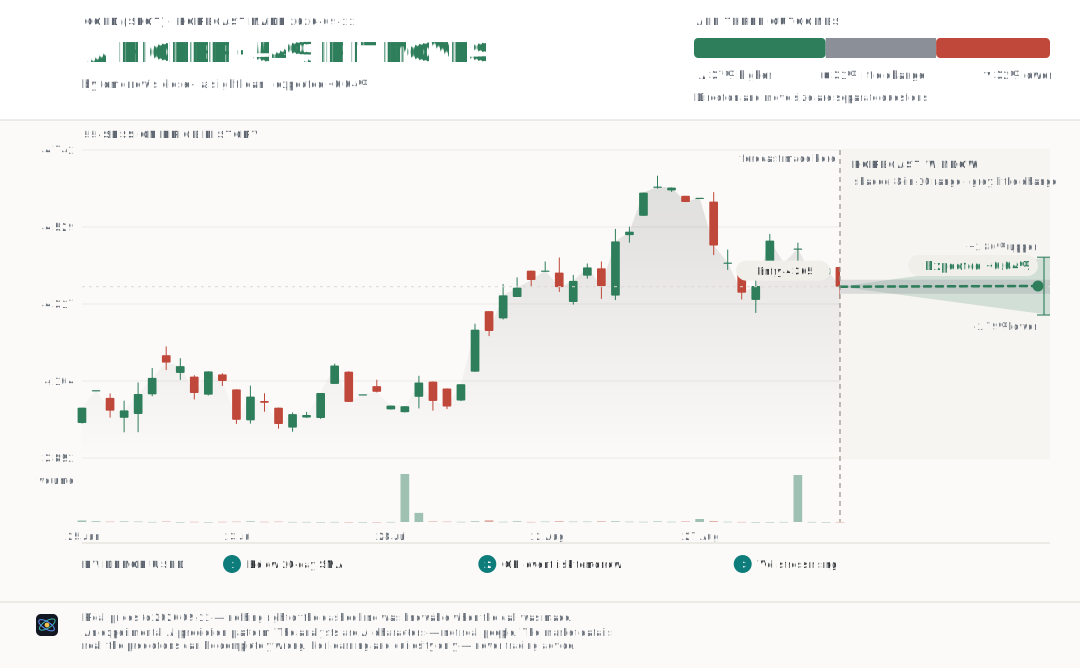
The locked forecasts and their grading status.
we were right The market moved 0.58%; we'd said about 0.04%.
A move smaller than ±0.44% counts as "little changed" — that threshold was locked in before we published, so we can't move the goalposts afterwards. We also said the move would most likely land between -1.79% and 1.86% (right about 8 times in 10 if we're honestly calibrated).
Evidence cutoff: 2026-09-11T06:31:28.939Z
Decision started: 2026-09-11T06:32:58.864Z
Decision finished: 2026-09-11T06:32:58.866Z
Ledger written: 2026-09-11T06:32:58.940Z
Timestamp status: forecast hash submitted for independent timestamping.
Grading series: yahoo futures proxy while the live spot history builds to the required 252 sessions. Configuration epoch 13; fingerprint a9fd9a4896094025.
barely moved The market moved -0.92%; we'd said about 0.22%.
A move smaller than ±1.18% counts as "little changed" — that threshold was locked in before we published, so we can't move the goalposts afterwards. We also said the move would most likely land between -3.61% and 4.08% (right about 8 times in 10 if we're honestly calibrated).
Evidence cutoff: 2026-09-11T06:31:28.939Z
Decision started: 2026-09-11T06:32:58.866Z
Decision finished: 2026-09-11T06:32:58.867Z
Ledger written: 2026-09-11T06:33:00.887Z
Timestamp status: forecast hash submitted for independent timestamping.
Grading series: yahoo futures proxy while the live spot history builds to the required 252 sessions. Configuration epoch 13; fingerprint a9fd9a4896094025.
The key point from each specialist; open a card’s reasoning only when you want more detail. Next-session and next-week views are kept separate.
About the percentages: they show each fictional AI analyst’s own conviction, not the market forecast and not measured accuracy.
Excluded from the final decision.
Small move expected · leans higher if it breaks
 ▲ Higher
Small move expected · leans higher if it breaks
Small move expected · leans higher if it breaks
Small move expected · leans higher if it breaks
Evidence points toward a lower price.
If gold fails to reclaim the 20-day SMA at 4473.5, it could test toward the 50-day SMA at 4268.0.
Clara reached a view but couldn't put it in publishable words, so only the vote is shown.
If gold closes below the 50-day average near 4268, it would confirm short-term bearish momentum for the next session.
Evidence points toward a higher price.
The market is underpricing the potential for a dovish CPI surprise to trigger a short squeeze; a close above yesterday's close of 4416 would confirm the sell-off was overdone, while a break below the current session's low would signal the bearish dollar and rate narrative is dominant.
Small move expected · leans higher if it breaks
Excluded from the final decision.
Small move expected · leans higher if it breaks
▲ Higher
Small move expected · leans higher if it breaks
Small move expected · leans higher if it breaks
Small move expected · leans higher if it breaks
Evidence points toward a lower price.
A weekly close below the 50-day SMA at 4268.0 would confirm the breakdown from the 200-day level at 4527.3.
Clara reached a view but couldn't put it in publishable words, so only the vote is shown.
If gold fails to reclaim the 20-day average at 4473.5 within the week, it would suggest a continuation of medium-term weakness.
Small move expected · leans lower if it breaks
Evidence points toward a higher price.
The market is underpricing the tail risk of a hawkish Fed shock combined with simmering credit stress; gold will hold above its 200-day average if the short-term volatility ratio stays above 0.9, but a close below 4364.5 would show the market is pricing a pure disinflationary policy path.
The Master and each participating Persona revisit the result after grading. Correct calls are reviewed too, because being right once does not prove the reasoning.
The market moved 0.58% against a locked quiet band of ±0.44%.
The market moved up, aligning with the forecast, though the move was narrowly outside the no-change band.
The panel split indicates a majority of personas were on the losing side, suggesting a consensus miss.
A correct outcome does not validate the underlying reasoning, especially with a divided panel.
No immediate change is indicated; continued monitoring of panel consensus divergence is warranted.
Best-scoring Persona views on this result: Priya Nair, Maya Chen, Marcus Bell. This ordering uses proper probability score, not hindsight confidence.
 Theo Brandt
view was incorrect
Predicted lower; market outcome higher · proper score 0.4674 (lower is better). View profile →
The market moved contrary to the prediction, failing to test the 50-day SMA as expected.
The market did not follow the technical levels cited in the reasoning.
Reliance on specific SMA levels for direction may be insufficient in certain market conditions.
Re-evaluate the predictive power of SMA reclamation and testing in range-bound, mid-volatility markets.
 Priya Nair
view was incorrect
Predicted little changed; market outcome higher · proper score 0.2778 (lower is better). View profile →
The market experienced a directional move, contradicting the flat prediction.
No reasoning was provided, so specific overlooked factors cannot be identified.
A flat prediction was not supported by market action, indicating a missed directional signal.
Provide reasoning for flat stances to allow for outcome review and learning.
Maya Chen
view was incorrect
Predicted little changed; market outcome higher · proper score 0.2778 (lower is better). View profile →
The market experienced a directional move, contradicting the flat prediction.
No reasoning was provided, so specific overlooked factors cannot be identified.
A flat prediction was not supported by market action, indicating a missed directional signal.
Provide reasoning for flat stances to allow for outcome review and learning.
 Viktor Ronen
view was incorrect
Predicted little changed; market outcome higher · proper score 0.3303 (lower is better). View profile →
The market moved directionally up, contrary to the flat prediction.
The market did not remain flat, suggesting the CPI surprise or short squeeze dynamics were misjudged.
The market's reaction to potential CPI surprises or short squeezes needs further calibration.
Refine the assessment of how CPI surprises and short squeezes influence gold's short-term direction.
 Marcus Bell
view was incorrect
Predicted little changed; market outcome higher · proper score 0.2778 (lower is better). View profile →
The market experienced a directional move, contradicting the flat prediction.
No reasoning was provided, so specific overlooked factors cannot be identified.
A flat prediction was not supported by market action, indicating a missed directional signal.
Provide reasoning for flat stances to allow for outcome review and learning.
 Clara Voss
view was incorrect
Predicted lower; market outcome higher · proper score 0.6062 (lower is better). View profile →
The market moved contrary to the prediction, failing to test below 4300.6.
The conditions of the 10-year real yield and dollar basket did not lead to the predicted gold movement.
The relationship between real yields, the dollar, and gold's price action requires re-evaluation.
Re-examine the thresholds and directional influence of real yields and the dollar on gold prices.
 Tomas Lindqvist
view was incorrect
Predicted little changed; market outcome higher · proper score 0.2778 (lower is better). View profile →
The market experienced a directional move, contradicting the flat prediction.
No reasoning was provided, so specific overlooked factors cannot be identified.
A flat prediction was not supported by market action, indicating a missed directional signal.
Provide reasoning for flat stances to allow for outcome review and learning.
 Ada Lin
view was incorrect
Predicted lower; market outcome higher · proper score 0.6062 (lower is better). View profile →
The market moved contrary to the prediction, not confirming bearish momentum.
The market did not close below the 50-day average as a trigger for bearish momentum.
Reliance on a specific moving average break for short-term direction may be insufficient.
Re-evaluate the predictive power of the 50-day average for confirming short-term momentum.
These reviews are transparent commentary. They affect no past score. A proposed lesson changes future knowledge only after the same weakness is confirmed across enough independent graded forecasts.
The market moved -0.92% against a locked quiet band of ±1.18%.
The market's 'flat' movement suggests the 'up' prediction was not supported by prevailing conditions.
The forecast may have overlooked factors contributing to the market's 'range_midvol' state.
A provisional lesson is to better account for 'range_midvol' market conditions.
Future forecasts should more thoroughly integrate 'range_midvol' market states into the prediction model.
Best-scoring Persona views on this result: Ada Lin, Priya Nair, Maya Chen. This ordering uses proper probability score, not hindsight confidence.
Theo Brandt
view was incorrect
Predicted lower; market outcome little changed · proper score 0.164 (lower is better). View profile →
The market did not confirm the breakdown Theo Brandt anticipated.
The market's 'flat' movement suggests that the specified SMA levels were not decisive.
A provisional lesson is that SMA breakdowns are not always confirmed.
Theo Brandt should re-evaluate the predictive power of SMA breakdowns in similar conditions.
Priya Nair
view was correct
Predicted little changed; market outcome little changed · proper score 0.1111 (lower is better). View profile →
The market's 'flat' movement aligned with Priya Nair's prediction.
No specific reasoning was provided, so no overlooked factors can be identified.
A provisional lesson is that a 'flat' prediction can be accurate in 'range_midvol' conditions.
Priya Nair should continue to assess conditions that lead to 'flat' market outcomes.
Maya Chen
view was correct
Predicted little changed; market outcome little changed · proper score 0.1111 (lower is better). View profile →
The market's 'flat' movement aligned with Maya Chen's prediction.
No specific reasoning was provided, so no overlooked factors can be identified.
A provisional lesson is that a 'flat' prediction can be accurate in 'range_midvol' conditions.
Maya Chen should continue to assess conditions that lead to 'flat' market outcomes.
Viktor Ronen
view was incorrect
Predicted higher; market outcome little changed · proper score 0.2 (lower is better). View profile →
The market did not move 'up', indicating that the predicted tail risks did not materialize as expected.
The market's 'flat' movement suggests that the specified volatility ratio and price levels were not decisive.
A provisional lesson is that geopolitical tail risks do not always translate to 'up' moves.
Viktor Ronen should re-evaluate the impact of tail risks on gold in 'range_midvol' markets.
Marcus Bell
view was correct
Predicted little changed; market outcome little changed · proper score 0.1111 (lower is better). View profile →
The market's 'flat' movement aligned with Marcus Bell's prediction.
No specific reasoning was provided, so no overlooked factors can be identified.
A provisional lesson is that a 'flat' prediction can be accurate in 'range_midvol' conditions.
Marcus Bell should continue to assess conditions that lead to 'flat' market outcomes.
Clara Voss
view was incorrect
Predicted lower; market outcome little changed · proper score 0.2361 (lower is better). View profile →
The market did not move 'down', indicating the specified price level was not breached.
The market's 'flat' movement suggests that the specified price level was not a decisive factor.
A provisional lesson is that a specific price level does not always dictate market direction.
Clara Voss should re-evaluate the significance of specific price levels in 'range_midvol' markets.
Tomas Lindqvist
view was correct
Predicted little changed; market outcome little changed · proper score 0.1111 (lower is better). View profile →
The market's 'flat' movement aligned with Tomas Lindqvist's prediction.
No specific reasoning was provided, so no overlooked factors can be identified.
A provisional lesson is that a 'flat' prediction can be accurate in 'range_midvol' conditions.
Tomas Lindqvist should continue to assess conditions that lead to 'flat' market outcomes.
Ada Lin
view was correct
Predicted little changed; market outcome little changed · proper score 0.0336 (lower is better). View profile →
The market's 'flat' movement aligned with Ada Lin's prediction.
The reasoning provided was conditional, so no specific overlooked factors can be identified.
A provisional lesson is that a 'flat' prediction can be accurate in 'range_midvol' conditions.
Ada Lin should continue to assess conditions that lead to 'flat' market outcomes.
These reviews are transparent commentary. They affect no past score. A proposed lesson changes future knowledge only after the same weakness is confirmed across enough independent graded forecasts.