Reader A
reads the debate transcript — what the analysts actually argued
15%40% quiet45%
“Four of five analysts lean down with moderate confidence citing key support levels near 1.3294–1.3366 that if broken, signal further downside pressure.”
5 of 15 analysts spoke; 4 lean lower and 1 lean higher. 4 of those expect only a small move.
Direction, chance of a quiet market, and expected size are separate questions.
How much weight to give it: This is the registered benchmark, kept in place while the AI challenger is still being tested; it is not presented as a strong AI call.
The registered benchmark remains the published forecast while the AI challenger is still being tested.Likely range: -0.49% to 0.54% (an 8-in-10 estimate). The odds, average move and range all come from one probability-weighted historical return distribution.
Three independent readers look at the same day through deliberately different windows: one reads the debate, one ignores the debate and reads only the numbers, one reads only the news. If they all saw the same evidence they would simply agree with each other, which would tell us nothing. Today they largely agreed — which counts for less, not more, since it may be one line of reasoning arrived at three times.
“Four of five analysts lean down with moderate confidence citing key support levels near 1.3294–1.3366 that if broken, signal further downside pressure.”
“No significant deviation from base rates due to FOMC blackout period suppressing directional signals and mixed technical indicators providing no clear directional bias.”
“The British Pound retreated by 0.16% against the US Dollar on Friday due to US business strength, suggesting continued downward pressure.”
The AI challenger was calculated, then withheld from the public call. Version judge-3.1.0 combined the reachable readers in log-odds space, equally weighted because none had yet earned enough independent graded calls to count for more, and shrank the result back toward this market's history. Confidence calibration stayed off because the prior independent record had not yet earned it. Because that challenger has not yet passed the forward evidence gate, the benchmark guardian published the locked base-rate vector shown above instead. Both vectors remain in the immutable record. Measured reader agreement: 0.895; 3 of 3 answered.
Why the headline percentage isn't just the “lower” bar above. The bar shows all three outcomes, and one of them — barely moved — isn't a direction at all, it's a question about size. Reading “lower 29%” off that bar would suggest we mostly expect the other thing to happen, which isn't what the numbers say. So the call is stated the way the question is actually asked: when this market moves, which way does it go? Of the 58% of days it does move, we put 50% on lower. The chance it barely moves is reported on its own, and grading uses all three numbers untouched.
Why is this benchmark-protected? The challenger is recorded and tested, but the registered benchmark stays public until the challenger passes the pre-declared evidence threshold. This avoids promoting a promising backtest as a proven live improvement.
Starting point before anyone argued: over 319 past stretches like this one, this market rose 29% of the time, fell 29%, and barely moved 42%.
How much weight to give it: This is the registered benchmark, kept in place while the AI challenger is still being tested; it is not presented as a strong AI call.
The registered benchmark remains the published forecast while the AI challenger is still being tested.Likely range: -1.06% to 1.03% (an 8-in-10 estimate). The odds, average move and range all come from one probability-weighted historical return distribution.
Three independent readers look at the same day through deliberately different windows: one reads the debate, one ignores the debate and reads only the numbers, one reads only the news. If they all saw the same evidence they would simply agree with each other, which would tell us nothing. Today they largely agreed — which counts for less, not more, since it may be one line of reasoning arrived at three times.
“The majority lean down with moderate confidence and key technical and macro factors point to downside risks near 1.3135.”
“The upcoming FOMC meeting and key US data releases (GDP, PCE) create significant downside risk for GBP/USD as a strong dollar environment is likely to persist.”
“The British Pound retreated by 0.16% against the US Dollar on Friday due to US business strength, with 'ActionForex' indicating a potential downside if 1.3294 support breaks.”
The AI challenger was calculated, then withheld from the public call. Version judge-3.1.0 combined the reachable readers in log-odds space, equally weighted because none had yet earned enough independent graded calls to count for more, and shrank the result back toward this market's history. Confidence calibration stayed off because the prior independent record had not yet earned it. Because that challenger has not yet passed the forward evidence gate, the benchmark guardian published the locked base-rate vector shown above instead. Both vectors remain in the immutable record. Measured reader agreement: 0.972; 3 of 3 answered.
Why the headline percentage isn't just the “lower” bar above. The bar shows all three outcomes, and one of them — barely moved — isn't a direction at all, it's a question about size. Reading “lower 34%” off that bar would suggest we mostly expect the other thing to happen, which isn't what the numbers say. So the call is stated the way the question is actually asked: when this market moves, which way does it go? Of the 67% of days it does move, we put 50% on lower. The chance it barely moves is reported on its own, and grading uses all three numbers untouched.
Why is this benchmark-protected? The challenger is recorded and tested, but the registered benchmark stays public until the challenger passes the pre-declared evidence threshold. This avoids promoting a promising backtest as a proven live improvement.
Starting point before anyone argued: over 315 past stretches like this one, this market rose 33% of the time, fell 34%, and barely moved 33%.
What the market looked like when this forecast was made.
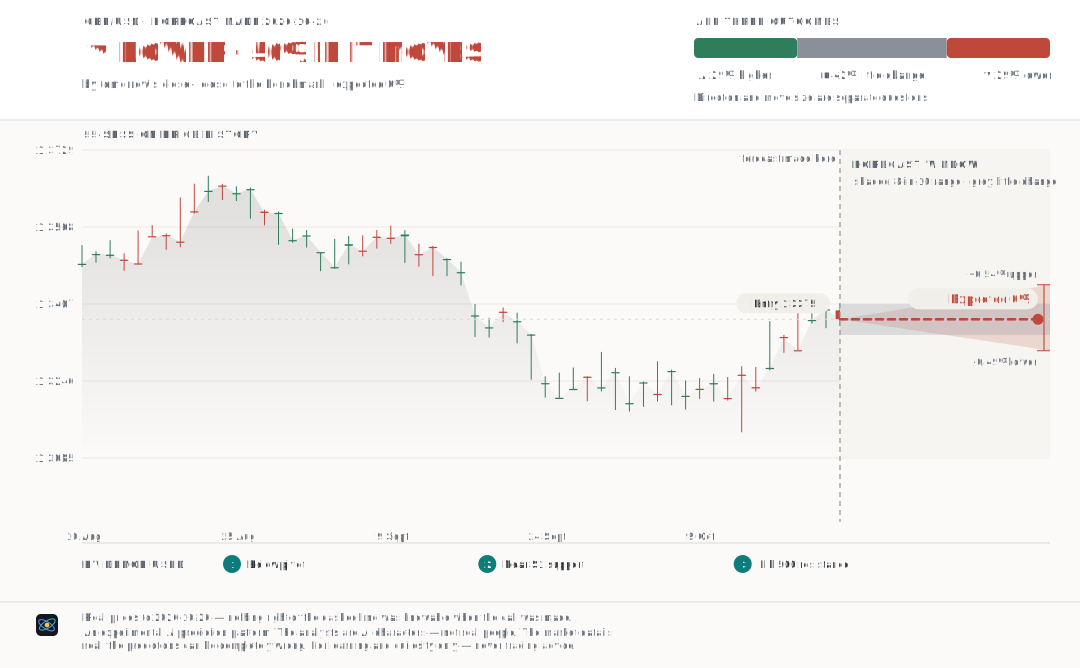
The locked forecasts and their grading status.
barely moved The market moved 0.02%; we'd said about 0%.
A move smaller than ±0.24% counts as "little changed" — that threshold was locked in before we published, so we can't move the goalposts afterwards. We also said the move would most likely land between -0.49% and 0.54% (right about 8 times in 10 if we're honestly calibrated).
Evidence cutoff: 2026-10-24T08:26:47.337Z
Decision started: 2026-10-24T08:27:52.882Z
Decision finished: 2026-10-24T08:28:12.128Z
Ledger written: 2026-10-24T08:28:34.962Z
Timestamp status: forecast hash submitted for independent timestamping.
Grading series: level. Configuration epoch 17; fingerprint 4867b280dbff940c.
barely moved The market moved 0.03%; we'd said about 0.01%.
A move smaller than ±0.37% counts as "little changed" — that threshold was locked in before we published, so we can't move the goalposts afterwards. We also said the move would most likely land between -1.06% and 1.03% (right about 8 times in 10 if we're honestly calibrated).
Evidence cutoff: 2026-10-24T08:26:47.337Z
Decision started: 2026-10-24T08:28:12.128Z
Decision finished: 2026-10-24T08:28:34.940Z
Ledger written: 2026-10-24T08:28:37.648Z
Timestamp status: forecast hash submitted for independent timestamping.
Grading series: level. Configuration epoch 17; fingerprint 4867b280dbff940c.
The key point from each specialist; open a card’s reasoning only when you want more detail. Next-session and next-week views are kept separate.
About the percentages: they show each fictional AI analyst’s own conviction, not the market forecast and not measured accuracy.
Evidence points toward a lower price.

This market is likely to remain within its typical daily move unless it closes below the S1 support at 1.3355, which would indicate further weakness.
Small move expected · leans lower if it breaks
If GBP/USD closes below 1.3366, it would confirm the downward lean.
Small move expected · leans lower if it breaks
The market is underpricing sterling vulnerability to USD strength during FOMC blackout; a close below 1.3294 would signal breakdown toward 1.3135.
Small move expected · leans lower if it breaks
GBP/USD is pressured by sustained US rate levels and dollar strength; a break below 1.3294 would confirm further downside, while a rebound above 1.3418 would challenge this view.
Excluded from the final decision.
Small move expected · leans higher if it breaks
Small move expected · leans higher if it breaks
Small move expected · leans higher if it breaks
Evidence points toward a higher price.
The price is likely to remain within its typical daily range, staying inside the ±0.24% no-change band unless it closes above the upper Bollinger Band at 1.3385.
Small move expected · leans higher if it breaks
Evidence points toward a lower price.
The market will likely consolidate lower unless it can decisively break above the Fibonacci 50% retracement level at 1.3407, which would indicate renewed buying interest.
If GBP/USD breaks below 1.3294, it would signal a retest of the 1.3135 low.
Sustained US monetary policy restrictiveness and dollar strength suggest GBP/USD will test lower levels near 1.3135 in the coming week unless US data or policy signals sharply reverse.
Excluded from the final decision.
Small move expected · leans higher if it breaks
Small move expected · leans higher if it breaks
Small move expected · leans higher if it breaks
Evidence points toward a higher price.
The market is overpricing Fed hawkishness; if GBP/USD holds above 1.3294 and breaks 1.3418, it targets 1.3469, invalidating the downside narrative.
The market is expected to remain range-bound given the low volatility regime, staying within the ±0.37% no-change band unless it breaks decisively above the upper Bollinger Band at 1.3385.
Small move expected · leans higher if it breaks
The Master and each participating Persona revisit the result after grading. Correct calls are reviewed too, because being right once does not prove the reasoning.
The market moved 0.02% against a locked quiet band of ±0.24%.
The market remained in a low-volatility range, despite the 'down' prediction.
The collective forecast did not adequately account for the 'range_lowvol' market state and FOMC blackout.
Low volatility and scheduled event blackouts can limit directional moves.
Improve weighting of 'range_lowvol' market states and FOMC blackout conditions in future forecasts.
Best-scoring Persona views on this result: Viktor Ronen, Vera Stroud, Elena Vasquez. This ordering uses proper probability score, not hindsight confidence.
 Priya Nair
view was correct
Predicted little changed; market outcome little changed · proper score 0.1111 (lower is better). View profile →
The market remained 'flat', aligning with the 'flat' prediction.
No specific factors were overlooked as the prediction was correct.
A 'flat' prediction was appropriate given the market conditions.
Continue to monitor market conditions that support 'flat' outcomes.
Elena Vasquez
view was correct
Predicted little changed; market outcome little changed · proper score 0.09 (lower is better). View profile →
The market remained 'flat', aligning with the 'flat' prediction.
No specific factors were overlooked as the prediction was correct.
The market staying within its typical daily move supported the 'flat' prediction.
Continue to assess support and resistance levels in range-bound markets.
 Maya Chen
view was correct
Predicted little changed; market outcome little changed · proper score 0.09 (lower is better). View profile →
The market remained 'flat', aligning with the 'flat' prediction.
No specific factors were overlooked as the prediction was correct.
The market did not close below the specified level, supporting the 'flat' prediction.
Continue to monitor closing levels relative to key thresholds for directional confirmation.
 Viktor Ronen
view was correct
Predicted little changed; market outcome little changed · proper score 0.04 (lower is better). View profile →
The market remained 'flat', aligning with the 'flat' prediction.
No specific factors were overlooked as the prediction was correct.
The market did not break down as a result of perceived sterling vulnerability.
Refine assessment of geopolitical risks and their immediate market impact during blackouts.
 Marcus Bell
view was correct
Predicted little changed; market outcome little changed · proper score 0.1111 (lower is better). View profile →
The market remained 'flat', aligning with the 'flat' prediction.
No specific factors were overlooked as the prediction was correct.
A 'flat' prediction was appropriate given the market conditions.
Continue to monitor market conditions that support 'flat' outcomes.
 Ingrid Halvorsen
view was incorrect
Predicted lower; market outcome little changed · proper score 0.2266 (lower is better). View profile →
The market remained 'flat', despite the prediction of 'down' movement.
The forecast may have overemphasized sustained US rate levels and dollar strength.
Market conditions like 'range_lowvol' can limit directional moves, even with strong fundamental drivers.
Adjust weighting for 'range_lowvol' market states and FOMC blackout conditions in future forecasts.
 Tomas Lindqvist
view was correct
Predicted little changed; market outcome little changed · proper score 0.1111 (lower is better). View profile →
The market remained 'flat', aligning with the 'flat' prediction.
No specific factors were overlooked as the prediction was correct.
A 'flat' prediction was appropriate given the market conditions.
Continue to monitor market conditions that support 'flat' outcomes.
 Vera Stroud
view was correct
Predicted little changed; market outcome little changed · proper score 0.0506 (lower is better). View profile →
The market remained 'flat', aligning with the 'flat' prediction.
No specific factors were overlooked as the prediction was correct.
The market stayed within its typical daily range, supporting the 'flat' prediction.
Continue to assess volatility bands and their influence on market movement.
These reviews are transparent commentary. They affect no past score. A proposed lesson changes future knowledge only after the same weakness is confirmed across enough independent graded forecasts.
The market moved 0.03% against a locked quiet band of ±0.37%.
The market remained 'flat' within the no-change band, despite a 'down' prediction.
The forecast did not account for the market's 'range_lowvol' state, which favored a 'flat' outcome.
Low volatility and range-bound conditions can limit directional moves, even with scheduled events.
Consider the 'market_state_at_the_time' more heavily when forecasting directional moves.
Best-scoring Persona views on this result: Vera Stroud, Priya Nair, Marcus Bell. This ordering uses proper probability score, not hindsight confidence.
Priya Nair
view was correct
Predicted little changed; market outcome little changed · proper score 0.1111 (lower is better). View profile →
The market remained 'flat' within the no-change band, aligning with the prediction.
No specific factors appear to have been overlooked, as the prediction was correct.
A 'flat' prediction was appropriate given the market's actual movement.
Continue to monitor central bank signals and their impact on market direction.
Elena Vasquez
view was incorrect
Predicted lower; market outcome little changed · proper score 0.1766 (lower is better). View profile →
The market remained 'flat' within the no-change band, contrary to the 'down' prediction.
The market's 'range_lowvol' state and failure to break key levels were overlooked.
Technical levels may not be decisive in a low volatility, range-bound market.
Integrate market state conditions more deeply into technical analysis for directional forecasts.
Maya Chen
view was incorrect
Predicted lower; market outcome little changed · proper score 0.1563 (lower is better). View profile →
The market remained 'flat' within the no-change band, contrary to the 'down' prediction.
The market's 'range_lowvol' state and lack of momentum for a breakdown were overlooked.
Seasonal patterns or cycles may be less influential in a low volatility environment.
Assess the prevailing market state before relying solely on cyclical or seasonal indicators.
Viktor Ronen
view was incorrect
Predicted higher; market outcome little changed · proper score 0.1766 (lower is better). View profile →
The market remained 'flat' within the no-change band, contrary to the 'up' prediction.
The market's 'range_lowvol' state and lack of upward momentum were overlooked.
Geopolitical narratives may not drive price action in a low volatility, range-bound market.
Evaluate the market's underlying volatility and range before asserting strong directional views.
Marcus Bell
view was correct
Predicted little changed; market outcome little changed · proper score 0.1111 (lower is better). View profile →
The market remained 'flat' within the no-change band, aligning with the prediction.
No specific factors appear to have been overlooked, as the prediction was correct.
A 'flat' prediction was appropriate given the market's actual movement.
Continue to assess macroeconomic conditions for their potential to maintain market ranges.
Ingrid Halvorsen
view was incorrect
Predicted lower; market outcome little changed · proper score 0.2 (lower is better). View profile →
The market remained 'flat' within the no-change band, contrary to the 'down' prediction.
The market's 'range_lowvol' state and lack of follow-through on macro themes were overlooked.
Strong macro narratives may not translate to movement in a low volatility, range-bound market.
Incorporate market state and volatility into macro analysis for more nuanced directional calls.
Tomas Lindqvist
view was correct
Predicted little changed; market outcome little changed · proper score 0.1111 (lower is better). View profile →
The market remained 'flat' within the no-change band, aligning with the prediction.
No specific factors appear to have been overlooked, as the prediction was correct.
A 'flat' prediction was appropriate given the market's actual movement.
Continue to monitor risk factors and their potential to keep markets range-bound.
Vera Stroud
view was correct
Predicted little changed; market outcome little changed · proper score 0.0625 (lower is better). View profile →
The market remained 'flat' within the no-change band, aligning with the prediction.
No specific factors appear to have been overlooked, as the prediction was correct.
Low volatility conditions accurately predicted a range-bound market outcome.
Continue to prioritize volatility metrics when assessing potential market movement.
These reviews are transparent commentary. They affect no past score. A proposed lesson changes future knowledge only after the same weakness is confirmed across enough independent graded forecasts.