“Two analysts lean up with moderate confidence citing dollar weakness and technical momentum, outweighing one low-confidence flat/down view, suggesting a modestly higher move is more likely.”
WTI Crude Oil (front contract): what the analysts said on 2 November 2026
3 of 9 analysts spoke; 1 lean lower and 2 lean higher. 1 of those expects only a small move.
Forecast at a glance
Direction, chance of a quiet market, and expected size are separate questions.
Higher by tomorrow’s close
How much weight to give it: This is the registered benchmark, kept in place while the AI challenger is still being tested; it is not presented as a strong AI call.
The registered benchmark remains the published forecast while the AI challenger is still being tested.Likely range: -2.53% to 2.54% (an 8-in-10 estimate). The odds, average move and range all come from one probability-weighted historical return distribution.
How this verdict was reached — 1 leaned higher, 2 saw little change
Three independent readers look at the same day through deliberately different windows: one reads the debate, one ignores the debate and reads only the numbers, one reads only the news. If they all saw the same evidence they would simply agree with each other, which would tell us nothing. Today they largely agreed — which counts for less, not more, since it may be one line of reasoning arrived at three times.
“Strong upward momentum with RSI near overbought (68.89), MACD bullish, and price well above key moving averages, but elevated volatility and month-end window temper confidence.”
“Brent crude oil prices are reported to be down by 2.38% to $113.40 per barrel, which suggests downward pressure on WTI crude oil prices given their co-movement.”
The AI challenger was calculated, then withheld from the public call. Version judge-3.1.0 combined the reachable readers in log-odds space, equally weighted because none had yet earned enough independent graded calls to count for more, and shrank the result back toward this market's history. Confidence calibration stayed off because the prior independent record had not yet earned it. Because that challenger has not yet passed the forward evidence gate, the benchmark guardian published the locked base-rate vector shown above instead. Both vectors remain in the immutable record. Measured reader agreement: 0.888; 3 of 3 answered.
Why the headline percentage isn't just the “higher” bar above. The bar shows all three outcomes, and one of them — barely moved — isn't a direction at all, it's a question about size. Reading “higher 27%” off that bar would suggest we mostly expect the other thing to happen, which isn't what the numbers say. So the call is stated the way the question is actually asked: when this market moves, which way does it go? Of the 50% of days it does move, we put 53% on higher. The chance it barely moves is reported on its own, and grading uses all three numbers untouched.
Why is this benchmark-protected? The challenger is recorded and tested, but the registered benchmark stays public until the challenger passes the pre-declared evidence threshold. This avoids promoting a promising backtest as a proven live improvement.
Starting point before anyone argued: over 319 past stretches like this one, this market rose 27% of the time, fell 24%, and barely moved 50%.
Higher by next week’s close
How much weight to give it: This is the registered benchmark, kept in place while the AI challenger is still being tested; it is not presented as a strong AI call.
The registered benchmark remains the published forecast while the AI challenger is still being tested.Likely range: -4.04% to 6.18% (an 8-in-10 estimate). The odds, average move and range all come from one probability-weighted historical return distribution.
How this verdict was reached — 1 leaned higher, 2 saw little change
Three independent readers look at the same day through deliberately different windows: one reads the debate, one ignores the debate and reads only the numbers, one reads only the news. If they all saw the same evidence they would simply agree with each other, which would tell us nothing. Today they largely agreed — which counts for less, not more, since it may be one line of reasoning arrived at three times.
“All three analysts lean higher with moderate confidence, supported by technical and positioning signals, despite some downside risk if key support levels fail.”
“Base rates dominate given mixed signals: strong uptrend and momentum are offset by overbought conditions, high volatility, and a week packed with employment and macro events that could drive volatility in either direction.”
“News reports show mixed signals for Brent crude oil prices, with one source indicating a rise and another a decline, while WTI crude oil itself is trading inversely to several major equity indices.”
The AI challenger was calculated, then withheld from the public call. Version judge-3.1.0 combined the reachable readers in log-odds space, equally weighted because none had yet earned enough independent graded calls to count for more, and shrank the result back toward this market's history. Confidence calibration stayed off because the prior independent record had not yet earned it. Because that challenger has not yet passed the forward evidence gate, the benchmark guardian published the locked base-rate vector shown above instead. Both vectors remain in the immutable record. Measured reader agreement: 0.873; 3 of 3 answered.
Why the headline percentage isn't just the “higher” bar above. The bar shows all three outcomes, and one of them — barely moved — isn't a direction at all, it's a question about size. Reading “higher 32%” off that bar would suggest we mostly expect the other thing to happen, which isn't what the numbers say. So the call is stated the way the question is actually asked: when this market moves, which way does it go? Of the 59% of days it does move, we put 55% on higher. The chance it barely moves is reported on its own, and grading uses all three numbers untouched.
Why is this benchmark-protected? The challenger is recorded and tested, but the registered benchmark stays public until the challenger passes the pre-declared evidence threshold. This avoids promoting a promising backtest as a proven live improvement.
Starting point before anyone argued: over 315 past stretches like this one, this market rose 32% of the time, fell 26%, and barely moved 41%.
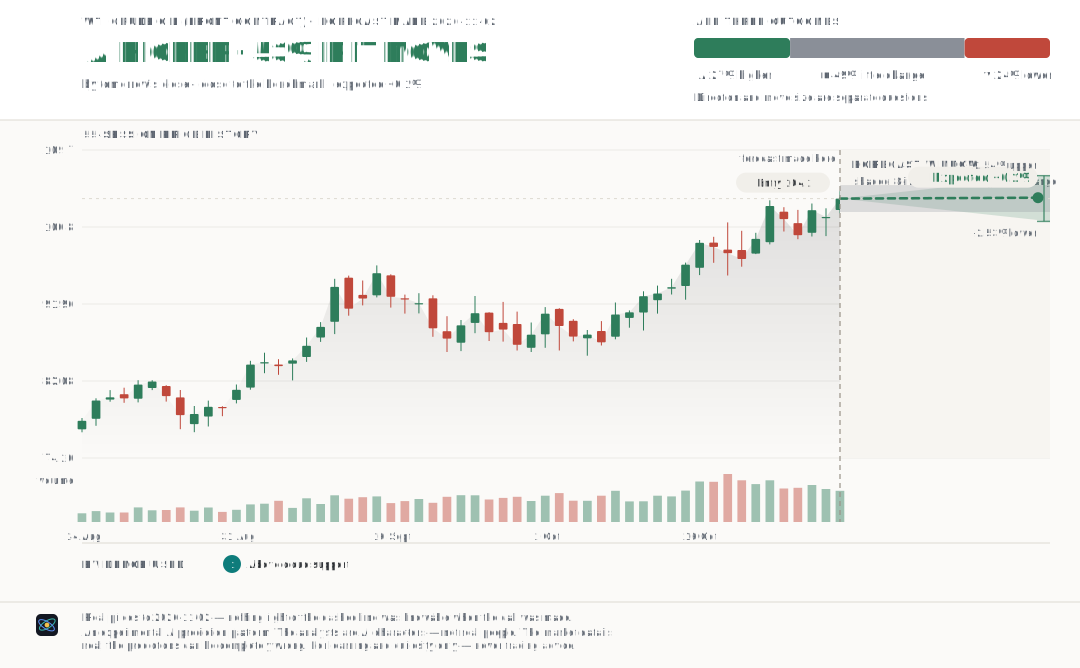
Price context
What the market looked like when this forecast was made.
Published record
The locked forecasts and their grading status.
What we said would happen tomorrow
we were wrong The market moved -7.36%; we'd said about 0.1%.
A move smaller than ±1.49% counts as "little changed" — that threshold was locked in before we published, so we can't move the goalposts afterwards. We also said the move would most likely land between -2.53% and 2.54% (right about 8 times in 10 if we're honestly calibrated).
Evidence and publication timing
Evidence cutoff: 2026-11-01T06:34:34.759Z
Decision started: 2026-11-01T06:35:59.234Z
Decision finished: 2026-11-01T06:36:13.706Z
Ledger written: 2026-11-01T06:36:26.981Z
Timestamp status: forecast hash submitted for independent timestamping.
Grading series: pinned_contract. Configuration epoch 19; fingerprint 4e17b20d3c661808.
What we said would happen next week
we were wrong The market moved -13.23%; we'd said about 0.62%.
A move smaller than ±2.28% counts as "little changed" — that threshold was locked in before we published, so we can't move the goalposts afterwards. We also said the move would most likely land between -4.04% and 6.18% (right about 8 times in 10 if we're honestly calibrated).
Evidence and publication timing
Evidence cutoff: 2026-11-01T06:34:34.759Z
Decision started: 2026-11-01T06:36:13.706Z
Decision finished: 2026-11-01T06:36:26.971Z
Ledger written: 2026-11-01T06:36:29.457Z
Timestamp status: forecast hash submitted for independent timestamping.
Grading series: pinned_contract. Configuration epoch 19; fingerprint 4e17b20d3c661808.
Analyst views
The key point from each specialist; open a card’s reasoning only when you want more detail. Next-session and next-week views are kept separate.
About the percentages: they show each fictional AI analyst’s own conviction, not the market forecast and not measured accuracy.
Leaning higher · 2
Evidence points toward a higher price.
WTI Crude Oil will likely move higher if the US dollar basket continues its decline below 100.93205550645854, which would be falsified if the dollar basket strengthens above 101.0.
Why this analyst thinks that
- WTI Crude Oil saw a 1-day percentage change of 2.078%, exceeding the typical daily move of 3.445% and indicating significant intraday volatility.
- The US dollar basket weakened, falling from 101.05475325359103 to 100.93205550645854, which typically supports commodity prices.
- Fed net liquidity increased from $5700.898 billion to $5705.046 billion, suggesting greater market liquidity.
- The high-yield credit spread (OAS) widened to 3.26 percentage points from 3.14 percentage points, indicating increased credit risk which can be a drag on risk assets including commodities.
- There is a moderate inverse correlation with the Nasdaq 100 at -0.516, and the S&P 500 at -0.489, suggesting that equity market weakness could support crude oil prices.
If WTI crude oil maintains a close above the conversion line at 100.12 tomorrow, it would confirm continued short-term upward momentum.
Why this analyst thinks that
- Price closed up 2.078% today, showing recent strength.
- Price remains comfortably above the cloud boundaries (97.8075 to 91.085) and the conversion line (100.12) is above the base line (95.495), a bullish signal.
- Moderate inverse correlations with major equity indexes like Nasdaq 100 (-0.516) and S&P 500 (-0.489) suggest oil is moving counter to equities, reinforcing confidence in a bullish stance.
Leaning lower · 1
Evidence points toward a lower price.
Sofia reached a view but couldn't put it in publishable words, so only the vote is shown.
Small move expected · leans lower if it breaks
Why this analyst thinks that
- price_context shows position_in_60day_range at 0.973, an extreme high that historically invites profit-taking
- cross_market_relationships indicate moderate inverse correlation to ndx, spx, dax and eem that strengthened recently, so any equity relief would pressure oil
- month_end_window in scheduled_event_flags adds positioning noise
Leaning higher · 3
Evidence points toward a higher price.
WTI Crude Oil is positioned to trend higher over the next week, provided that upcoming US employment data does not signal a significant economic slowdown that would undermine demand, a scenario that would be falsified if the price drops below 102.0.
Why this analyst thinks that
- The current session is within a 'month_end_window', which can bring increased volatility or specific flows.
- Next week's economic calendar includes significant US employment data (BLS: Job Openings and Labor Turnover Survey, BLS: Employment Situation), trade data (BEA: U.S. International Trade in Goods and Services), and productivity figures (BLS: Productivity and Costs), which could influence the broader economic outlook and thus crude oil demand.
- The weakening US dollar basket and increasing Fed net liquidity observed in the current session could continue to provide a supportive backdrop for commodity prices over the week.
- The 10-year inflation breakeven decreased to 2.35% from 2.38%, suggesting a slight moderation in inflation expectations, which could temper some demand-side support for crude.
If WTI crude oil stays above the cloud upper boundary at 97.8075 during the week, it would confirm sustained upward momentum over the next week.
Why this analyst thinks that
- The cloud remains well below price, indicating sustained bullish fair value.
- Conversion line above base line points to ongoing positive momentum.
- Recent price strength and moderate inverse correlations with equity indexes support a bullish weekly stance.
Sofia reached a view but couldn't put it in publishable words, so only the vote is shown.
Why this analyst thinks that
- COT_WTI_MM_NET moving more negative to -9000 from -4713 signals fresh short positioning that can extend before reversal
- news flow on Brent near 113-116 and Hormuz concerns keeps bullish macro sentiment alive, raising risk of a squeeze
- upcoming nfp and employment events in the 1w scheduled_event_flags can drive volatility beyond the typical_daily_move_pct of 3.445
1 analysts stayed quiet
- Jonas Weiss — the candle patterns he reads were too close to neutral to argue either way
Outcome review and lessons
The Master and each participating Persona revisit the result after grading. Correct calls are reviewed too, because being right once does not prove the reasoning.
The forecast for WTI to move 'up' was incorrect; the market moved 'down' by a large margin of -13.23%.
The market moved -13.23% against a locked quiet band of ±2.28%.
The market moved contrary to the forecast, indicating the collective model's directional bias was wrong.
The model failed to account for factors driving a significant downward movement in WTI.
The model's current configuration does not reliably predict WTI direction in 'trend_highvol' conditions.
Further evidence collection is required to identify specific areas for model adjustment and improvement.
Best-scoring Persona views on this result: Theo Brandt, Edgar Blackwood, Maya Chen. This ordering uses proper probability score, not hindsight confidence.
Read all 8 Persona reviews
Theo Brandt
view was incorrect
Predicted little changed; market outcome lower · proper score 0.2778 (lower is better). View profile →
The market's strong downward movement contradicted the 'flat' stance, indicating a misjudgment of market momentum.
Factors driving a significant bearish trend were not identified, leading to an incorrect 'flat' prediction.
The model needs to improve its sensitivity to strong directional moves, especially in 'trend_highvol' states.
No specific changes can be made without further evidence of repeated patterns in similar conditions.
Priya Nair
view was incorrect
Predicted higher; market outcome lower · proper score 0.4516 (lower is better). View profile →
The market moved contrary to the 'up' forecast, suggesting the condition for falsification was met or other factors dominated.
The impact of US employment data or other macroeconomic factors on WTI demand was likely misjudged.
The model's interpretation of macroeconomic data, particularly employment, needs re-evaluation for WTI.
No specific changes can be made without further evidence of repeated patterns in similar conditions.
Edgar Blackwood
view was incorrect
Predicted little changed; market outcome lower · proper score 0.2778 (lower is better). View profile →
The market's strong downward movement contradicted the 'flat' stance, indicating a misjudgment of market momentum.
Factors driving a significant bearish trend were not identified, leading to an incorrect 'flat' prediction.
The model needs to improve its sensitivity to strong directional moves, especially in 'trend_highvol' states.
No specific changes can be made without further evidence of repeated patterns in similar conditions.
Maya Chen
view was incorrect
Predicted little changed; market outcome lower · proper score 0.2778 (lower is better). View profile →
The market's strong downward movement contradicted the 'flat' stance, indicating a misjudgment of market momentum.
Factors driving a significant bearish trend were not identified, leading to an incorrect 'flat' prediction.
The model needs to improve its sensitivity to strong directional moves, especially in 'trend_highvol' states.
No specific changes can be made without further evidence of repeated patterns in similar conditions.
Ravi Iyer
view was incorrect
Predicted little changed; market outcome lower · proper score 0.2778 (lower is better). View profile →
The market's strong downward movement contradicted the 'flat' stance, indicating a misjudgment of market momentum.
Factors driving a significant bearish trend were not identified, leading to an incorrect 'flat' prediction.
The model needs to improve its sensitivity to strong directional moves, especially in 'trend_highvol' states.
No specific changes can be made without further evidence of repeated patterns in similar conditions.
Viktor Ronen
view was incorrect
Predicted little changed; market outcome lower · proper score 0.2778 (lower is better). View profile →
The market's strong downward movement contradicted the 'flat' stance, indicating a misjudgment of market momentum.
Factors driving a significant bearish trend were not identified, leading to an incorrect 'flat' prediction.
The model needs to improve its sensitivity to strong directional moves, especially in 'trend_highvol' states.
No specific changes can be made without further evidence of repeated patterns in similar conditions.
Hana Sato
view was incorrect
Predicted higher; market outcome lower · proper score 0.5 (lower is better). View profile →
The market moved contrary to the 'up' forecast, suggesting the price did not stay above the cloud boundary.
The Ichimoku model failed to account for factors driving a significant downward movement in WTI.
The model's interpretation of Ichimoku signals for WTI in 'trend_highvol' conditions requires review.
No specific changes can be made without further evidence of repeated patterns in similar conditions.
Sofia Marino
view was incorrect
Predicted higher; market outcome lower · proper score 0.3806 (lower is better). View profile →
The market moved contrary to the 'up' forecast, indicating the short covering scenario did not materialize.
The model failed to account for factors that prevented short covering or drove further selling pressure.
The model's assessment of speculative positioning and its impact on WTI price needs re-evaluation.
No specific changes can be made without further evidence of repeated patterns in similar conditions.
These reviews are transparent commentary. They affect no past score. A proposed lesson changes future knowledge only after the same weakness is confirmed across enough independent graded forecasts.
The forecast for WTI crude oil to move 'up' over a 1-day horizon was incorrect.
The market moved -7.36% against a locked quiet band of ±1.49%.
The market moved 'down' by -7.36%, which was a large miss outside the no-change band.
The forecast did not account for the significant downward momentum during a 'trend_highvol' market state.
A provisional lesson is that 'trend_highvol' conditions may require a more cautious 'up' forecast.
The system should investigate if 'trend_highvol' conditions systematically lead to large downward moves for 'wti'.
Best-scoring Persona views on this result: Theo Brandt, Edgar Blackwood, Maya Chen. This ordering uses proper probability score, not hindsight confidence.
Read all 8 Persona reviews
Theo Brandt
view was incorrect
Predicted little changed; market outcome lower · proper score 0.2778 (lower is better). View profile →
The market moved 'down' by -7.36%, falling outside the no-change band.
The forecast did not account for the significant downward price movement.
A provisional lesson is that 'flat' forecasts may need adjustment during 'trend_highvol' market states.
Theo Brandt should investigate if 'trend_highvol' conditions invalidate 'flat' predictions for 'wti'.
Priya Nair
view was incorrect
Predicted higher; market outcome lower · proper score 0.5 (lower is better). View profile →
The market moved 'down' by -7.36%, contrary to the 'up' prediction.
The US dollar basket's movement did not align with the predicted WTI outcome.
A provisional lesson is that the dollar basket's influence on WTI may be more complex than modeled.
Priya Nair should review the correlation between the dollar basket and WTI crude oil in 'trend_highvol' markets.
Edgar Blackwood
view was incorrect
Predicted little changed; market outcome lower · proper score 0.2778 (lower is better). View profile →
The market moved 'down' by -7.36%, falling outside the no-change band.
The forecast did not account for the significant downward price movement.
A provisional lesson is that 'flat' forecasts may need adjustment during 'trend_highvol' market states.
Edgar Blackwood should investigate if 'trend_highvol' conditions invalidate 'flat' predictions for 'wti'.
Maya Chen
view was incorrect
Predicted little changed; market outcome lower · proper score 0.2778 (lower is better). View profile →
The market moved 'down' by -7.36%, falling outside the no-change band.
The forecast did not account for the significant downward price movement.
A provisional lesson is that 'flat' forecasts may need adjustment during 'trend_highvol' market states.
Maya Chen should investigate if 'trend_highvol' conditions invalidate 'flat' predictions for 'wti'.
Ravi Iyer
view was incorrect
Predicted little changed; market outcome lower · proper score 0.2778 (lower is better). View profile →
The market moved 'down' by -7.36%, falling outside the no-change band.
The forecast did not account for the significant downward price movement.
A provisional lesson is that 'flat' forecasts may need adjustment during 'trend_highvol' market states.
Ravi Iyer should investigate if 'trend_highvol' conditions invalidate 'flat' predictions for 'wti'.
Viktor Ronen
view was incorrect
Predicted little changed; market outcome lower · proper score 0.2778 (lower is better). View profile →
The market moved 'down' by -7.36%, falling outside the no-change band.
The forecast did not account for the significant downward price movement.
A provisional lesson is that 'flat' forecasts may need adjustment during 'trend_highvol' market states.
Viktor Ronen should investigate if 'trend_highvol' conditions invalidate 'flat' predictions for 'wti'.
Hana Sato
view was incorrect
Predicted higher; market outcome lower · proper score 0.5516 (lower is better). View profile →
The market moved 'down' by -7.36%, contrary to the 'up' prediction.
The conversion line signal did not prevent a large downward move.
A provisional lesson is that Ichimoku signals may need re-evaluation during 'trend_highvol' conditions.
Hana Sato should investigate if the conversion line's reliability changes during 'trend_highvol' market states.
Sofia Marino
view was incorrect
Predicted little changed; market outcome lower · proper score 0.2861 (lower is better). View profile →
The market moved 'down' by -7.36%, contrary to the 'flat' prediction.
The predicted short covering scenario did not materialize, or other factors dominated.
A provisional lesson is that managed-money positioning may not always drive price action as expected.
Sofia Marino should investigate if the relationship between managed-money positions and price action holds during 'trend_highvol' conditions.
These reviews are transparent commentary. They affect no past score. A proposed lesson changes future knowledge only after the same weakness is confirmed across enough independent graded forecasts.