“All six analysts lean higher with moderate to high confidence, supported by technical and geopolitical factors signaling bullish control and supply tightness.”
WTI Crude Oil (front contract): what the analysts said on 29 October 2026
6 of 9 analysts spoke; 6 lean higher.
Forecast at a glance
Direction, chance of a quiet market, and expected size are separate questions.
Higher by tomorrow’s close
How much weight to give it: This is the registered benchmark, kept in place while the AI challenger is still being tested; it is not presented as a strong AI call.
The registered benchmark remains the published forecast while the AI challenger is still being tested.Likely range: -2.38% to 2.45% (an 8-in-10 estimate). The odds, average move and range all come from one probability-weighted historical return distribution.
How this verdict was reached — 2 leaned higher, 1 leaned lower
Three independent readers look at the same day through deliberately different windows: one reads the debate, one ignores the debate and reads only the numbers, one reads only the news. If they all saw the same evidence they would simply agree with each other, which would tell us nothing. Today they genuinely disagreed.
“WTI is overbought (RSI 66.8, 86th percentile) and near 60-day highs after a strong rally, suggesting a high risk of a pullback, especially with month-end window dressing and significant FOMC event risk likely causing profit-taking.”
“Geopolitical tensions in the Middle East, including reported U.S. warnings to Gulf countries and Houthi attacks on Saudi facilities, combined with falling U.S. crude inventories, strongly suggest upward pressure on oil prices.”
The AI challenger was calculated, then withheld from the public call. Version judge-3.1.0 combined the reachable readers in log-odds space, equally weighted because none had yet earned enough independent graded calls to count for more, and shrank the result back toward this market's history. Confidence calibration stayed off because the prior independent record had not yet earned it. Because that challenger has not yet passed the forward evidence gate, the benchmark guardian published the locked base-rate vector shown above instead. Both vectors remain in the immutable record. Measured reader agreement: 0.835; 3 of 3 answered.
Why the headline percentage isn't just the “higher” bar above. The bar shows all three outcomes, and one of them — barely moved — isn't a direction at all, it's a question about size. Reading “higher 33%” off that bar would suggest we mostly expect the other thing to happen, which isn't what the numbers say. So the call is stated the way the question is actually asked: when this market moves, which way does it go? Of the 62% of days it does move, we put 54% on higher. The chance it barely moves is reported on its own, and grading uses all three numbers untouched.
Why is this benchmark-protected? The challenger is recorded and tested, but the registered benchmark stays public until the challenger passes the pre-declared evidence threshold. This avoids promoting a promising backtest as a proven live improvement.
Starting point before anyone argued: over 319 past stretches like this one, this market rose 33% of the time, fell 29%, and barely moved 38%.
Higher by next week’s close
How much weight to give it: This is the registered benchmark, kept in place while the AI challenger is still being tested; it is not presented as a strong AI call.
The registered benchmark remains the published forecast while the AI challenger is still being tested.Likely range: -4.04% to 6.18% (an 8-in-10 estimate). The odds, average move and range all come from one probability-weighted historical return distribution.
How this verdict was reached — 2 leaned higher, 1 saw little change
Three independent readers look at the same day through deliberately different windows: one reads the debate, one ignores the debate and reads only the numbers, one reads only the news. If they all saw the same evidence they would simply agree with each other, which would tell us nothing. Today they largely agreed — which counts for less, not more, since it may be one line of reasoning arrived at three times.
“All six analysts lean higher with moderate confidence, supported by technical, fundamental, and geopolitical factors indicating sustained upside momentum for WTI Crude Oil.”
“Strong momentum indicators (RSI 66.8, MACD bullish, golden cross) and high volatility (ATR14 at 97th percentile) suggest continued upward pressure, though event risks (FOMC, GDP, trade data) may increase short-term noise.”
“Geopolitical tensions in the Middle East, including reported U.S. warnings to Gulf countries about Iran strikes and attacks on Saudi infrastructure, are driving oil prices higher, supported by falling U.S. crude inventories.”
The AI challenger was calculated, then withheld from the public call. Version judge-3.1.0 combined the reachable readers in log-odds space, equally weighted because none had yet earned enough independent graded calls to count for more, and shrank the result back toward this market's history. Confidence calibration stayed off because the prior independent record had not yet earned it. Because that challenger has not yet passed the forward evidence gate, the benchmark guardian published the locked base-rate vector shown above instead. Both vectors remain in the immutable record. Measured reader agreement: 0.862; 3 of 3 answered.
Why the headline percentage isn't just the “higher” bar above. The bar shows all three outcomes, and one of them — barely moved — isn't a direction at all, it's a question about size. Reading “higher 32%” off that bar would suggest we mostly expect the other thing to happen, which isn't what the numbers say. So the call is stated the way the question is actually asked: when this market moves, which way does it go? Of the 58% of days it does move, we put 56% on higher. The chance it barely moves is reported on its own, and grading uses all three numbers untouched.
Why is this benchmark-protected? The challenger is recorded and tested, but the registered benchmark stays public until the challenger passes the pre-declared evidence threshold. This avoids promoting a promising backtest as a proven live improvement.
Starting point before anyone argued: over 315 past stretches like this one, this market rose 32% of the time, fell 26%, and barely moved 42%.
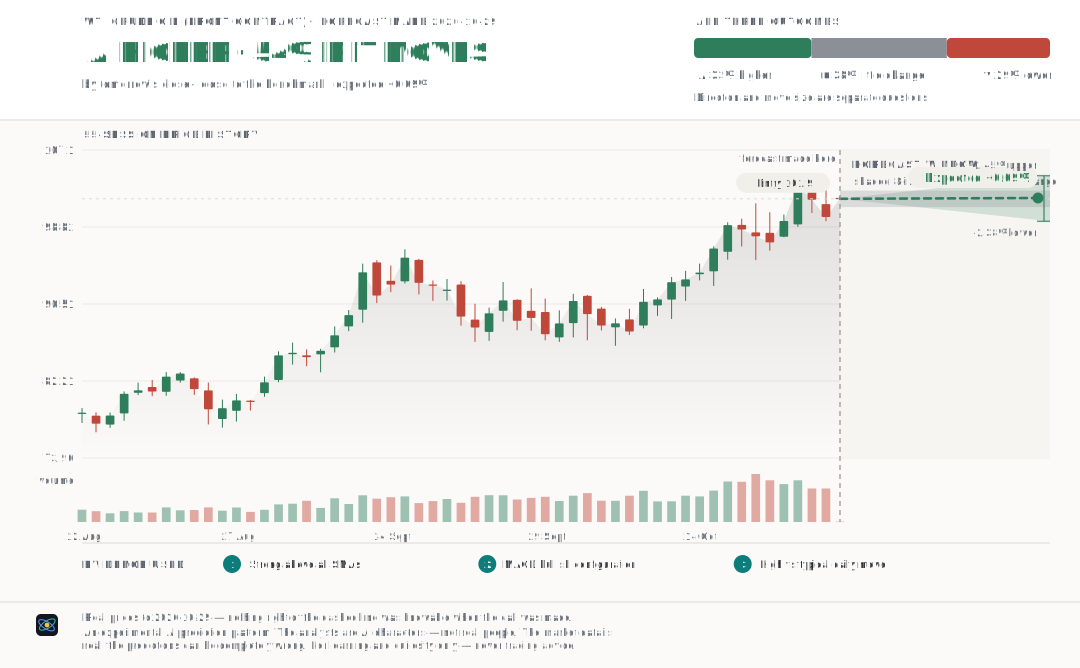
Price context
What the market looked like when this forecast was made.
Published record
The locked forecasts and their grading status.
What we said would happen tomorrow
barely moved The market moved 0.14%; we'd said about 0.09%.
A move smaller than ±0.87% counts as "little changed" — that threshold was locked in before we published, so we can't move the goalposts afterwards. We also said the move would most likely land between -2.38% and 2.45% (right about 8 times in 10 if we're honestly calibrated).
Evidence and publication timing
Evidence cutoff: 2026-10-29T06:34:20.166Z
Decision started: 2026-10-29T06:35:05.259Z
Decision finished: 2026-10-29T06:35:24.656Z
Ledger written: 2026-10-29T06:35:38.740Z
Timestamp status: forecast hash submitted for independent timestamping.
Grading series: pinned_contract. Configuration epoch 17; fingerprint 4867b280dbff940c.
What we said would happen next week
we were wrong The market moved -13.49%; we'd said about 0.61%.
A move smaller than ±2.31% counts as "little changed" — that threshold was locked in before we published, so we can't move the goalposts afterwards. We also said the move would most likely land between -4.04% and 6.18% (right about 8 times in 10 if we're honestly calibrated).
Evidence and publication timing
Evidence cutoff: 2026-10-29T06:34:20.166Z
Decision started: 2026-10-29T06:35:24.656Z
Decision finished: 2026-10-29T06:35:38.723Z
Ledger written: 2026-10-29T06:35:41.698Z
Timestamp status: forecast hash submitted for independent timestamping.
Grading series: pinned_contract. Configuration epoch 17; fingerprint 4867b280dbff940c.
Analyst views
The key point from each specialist; open a card’s reasoning only when you want more detail. Next-session and next-week views are kept separate.
About the percentages: they show each fictional AI analyst’s own conviction, not the market forecast and not measured accuracy.
Leaning higher · 6
Evidence points toward a higher price.
Price should hold above the 20-day SMA at 95.07 if the inverse correlation with Nasdaq 100 remains near -0.55 while Middle East tensions persist.
Why this analyst thinks that
- Price sits 1.91 ATRs above its 20-day moving average at 95.07, showing strong momentum.
- MACD histogram positive at 0.48 with MACD above signal line, confirming upward trend strength.
- Geopolitical supply risks from Middle East tensions supporting prices.
WTI Crude Oil will continue its upward trajectory if the FOMC statement avoids a hawkish surprise that strengthens the dollar further, otherwise, a move below the previous close of 99.9 could falsify this view.
Why this analyst thinks that
- Market news indicates rising oil prices due to geopolitical tensions in the Middle East and a decrease in US crude oil inventories of 1.9 million barrels, suggesting upward price pressure.
- The instrument closed up 1.962%, which is a significant move for a single day.
- The FOMC rate decision scheduled for today could introduce volatility or a directional impulse depending on the outcome and forward guidance.
Maya reached a view but couldn't put it in publishable words, so only the vote is shown.
Why this analyst thinks that
- U.S. reportedly telling Gulf countries to prepare for Iran strikes, which could prolong Middle East conflict and support oil prices
- U.S. oil inventories fell by 1.9 million barrels last week, indicating tighter supply
- Attack on a Saudi refinery reigniting Saudi supply fears, pushing oil prices higher
Ravi reached a view but couldn't put it in publishable words, so only the vote is shown.
Why this analyst thinks that
- Geopolitical headlines driving risk premium after reported US-Gulf coordination on Iran contingency planning
- Spot Cushing price at $109.72 shows physical tightness despite futures trading lower
The market is underpricing Iran conflict escalation risk; a close below 99.9 would show the geopolitical premium is fading faster than supply fears are mounting.
Why this analyst thinks that
- FOMC meeting today adds policy uncertainty that could pressure risk assets and strengthen inverse correlations.
- My historical failure pattern shows consistent underperformance when taking bearish stances (mean skill score -0.16).
WTI crude above the cloud top at 97.27 signals bullish control; a close below this level would weaken the up stance.
Why this analyst thinks that
- Price has risen strongly by 1.962% on the last session, moving well above the cloud top at 97.27.
- The Tenkan-Kijun is bullish, supporting short-term momentum.
- Moderate inverse correlations with major equity indices suggest some risk-off flows boosting oil.
- News of geopolitical tensions and supply concerns support upward pressure.
Leaning higher · 6
Evidence points toward a higher price.
WTI will test resistance above 105 if it maintains position above the 50-day SMA at 90.18 while high-yield credit spreads remain below 3.3%.
Why this analyst thinks that
- Golden cross configuration remains intact with price 31.98% above 200-day SMA at 77.18.
- Strong momentum shown by price trading 3.29 ATRs above 50-day moving average at 90.18.
- Persistent geopolitical supply risks likely to maintain upward pressure.
WTI Crude Oil will maintain its upward momentum over the next week unless upcoming US economic data, specifically GDP or PCE, signals a significant slowdown in demand or the US dollar basket moves substantially above 102.0.
Why this analyst thinks that
- Ongoing geopolitical concerns about Middle East supply disruptions continue to provide a bullish backdrop for oil prices.
- The observed decrease in US crude oil inventories further supports a tighter supply outlook.
- Upcoming economic calendar events including GDP, PCE, and employment data for the US could influence demand expectations and the US dollar's strength, which shows an inverse correlation with WTI Crude Oil.
- The current correlation with major equity indices like the Nasdaq 100 (-0.549) and S&P 500 (-0.481) suggests that any sustained weakness in equities could be a tailwind for oil, assuming the inverse relationship holds.
Maya reached a view but couldn't put it in publishable words, so only the vote is shown.
Why this analyst thinks that
- Potential prolonged conflict in the Middle East as U.S. prepares for Iran strikes, which could support oil prices over the week
- Continued decrease in U.S. oil inventories, suggesting tighter supply conditions
Ravi reached a view but couldn't put it in publishable words, so only the vote is shown.
Why this analyst thinks that
- Sustained inventory draws (1.9 million barrel decrease) contradicting seasonal build expectations
- FOMC meeting and major economic data releases (GDP, PCE) could amplify dollar-driven moves given -0.481 correlation to SPX
The market is underestimating sustained Middle East supply disruptions; a break below 97.5 would signal that inventory draws and conflict risks are being outweighed by demand destruction.
Why this analyst thinks that
- Heavy economic calendar includes employment data and trade figures that could amplify demand-side concerns.
- Volatility term structure ratio of 0.81 shows some stress premium but not extreme backwardation.
Sustained closes above the cloud top at 97.27 over the week would confirm a bullish trajectory for WTI crude.
Why this analyst thinks that
- The price remains well above the Ichimoku cloud range (97.27–90.55), indicating sustained bullish fair value.
- Bullish Tenkan-Kijun alignment supports continuation of upward trends over the week.
- Geopolitical risk and supply constraints are likely to keep upward pressure on prices.
- Moderate inverse correlations with equity markets confirm oil’s role as a safe haven in current conditions.
1 analysts stayed quiet
- Jonas Weiss — the candle patterns he reads were too close to neutral to argue either way
Outcome review and lessons
The Master and each participating Persona revisit the result after grading. Correct calls are reviewed too, because being right once does not prove the reasoning.
The forecast for WTI to move 'up' was incorrect; the market ended 'flat'.
The market moved 0.14% against a locked quiet band of ±0.87%.
The market's actual move of 0.14% was within the 0.87% no-change band.
The collective forecast did not account for the market remaining within the no-change band.
A 'flat' outcome can occur even with a 'trend_highvol' market state.
The system should investigate why the 'up' consensus failed to capture the 'flat' outcome.
Best-scoring Persona views on this result: Edgar Blackwood, Tomas Lindqvist, Ravi Iyer. This ordering uses proper probability score, not hindsight confidence.
Read all 8 Persona reviews
Theo Brandt
view was incorrect
Predicted higher; market outcome little changed · proper score 0.244 (lower is better). View profile →
The market's 0.14% move was within the 0.87% no-change band.
The forecast did not account for WTI remaining within the no-change band.
The inverse correlation with Nasdaq 100 and Middle East tensions did not drive an 'up' move.
Theo Brandt should review how the 20-day SMA and correlations interact with 'flat' outcomes.
Priya Nair
view was incorrect
Predicted higher; market outcome little changed · proper score 0.2266 (lower is better). View profile →
The market's 0.14% move was within the 0.87% no-change band.
The forecast did not account for WTI remaining within the no-change band.
The FOMC statement and dollar strength did not lead to an 'up' move in WTI.
Priya Nair should investigate how FOMC statements influence 'flat' outcomes in WTI.
Edgar Blackwood
view was correct
Predicted little changed; market outcome little changed · proper score 0.1111 (lower is better). View profile →
The market's 0.14% move was within the 0.87% no-change band.
No specific reasoning was provided, so no overlooked factors can be identified.
A 'flat' forecast can be correct even in a 'trend_highvol' market state.
Edgar Blackwood should continue to analyze market conditions for 'flat' outcomes.
Maya Chen
view was incorrect
Predicted higher; market outcome little changed · proper score 0.2266 (lower is better). View profile →
The market's 0.14% move was within the 0.87% no-change band.
The forecast did not account for WTI remaining within the no-change band.
Geopolitical tensions did not lead to WTI clearing 102.73.
Maya Chen should review how geopolitical tensions interact with 'flat' outcomes.
Ravi Iyer
view was incorrect
Predicted higher; market outcome little changed · proper score 0.1766 (lower is better). View profile →
The market's 0.14% move was within the 0.87% no-change band.
The forecast did not account for WTI remaining within the no-change band.
Physical market tightness and backwardation did not drive an 'up' move.
Ravi Iyer should investigate how physical market indicators interact with 'flat' outcomes.
Viktor Ronen
view was incorrect
Predicted higher; market outcome little changed · proper score 0.2 (lower is better). View profile →
The market's 0.14% move was within the 0.87% no-change band.
The forecast did not account for WTI remaining within the no-change band.
Iran conflict escalation risk did not lead to an 'up' move in WTI.
Viktor Ronen should review how geopolitical risk premiums interact with 'flat' outcomes.
Hana Sato
view was incorrect
Predicted higher; market outcome little changed · proper score 0.244 (lower is better). View profile →
The market's 0.14% move was within the 0.87% no-change band.
The forecast did not account for WTI remaining within the no-change band.
WTI crude above the cloud top did not signal continued bullish control.
Hana Sato should review how Ichimoku signals interact with 'flat' outcomes.
Tomas Lindqvist
view was correct
Predicted little changed; market outcome little changed · proper score 0.1111 (lower is better). View profile →
The market's 0.14% move was within the 0.87% no-change band.
No specific reasoning was provided, so no overlooked factors can be identified.
A 'flat' forecast can be correct even in a 'trend_highvol' market state.
Tomas Lindqvist should continue to analyze market conditions for 'flat' outcomes.
These reviews are transparent commentary. They affect no past score. A proposed lesson changes future knowledge only after the same weakness is confirmed across enough independent graded forecasts.
The forecast for WTI to move 'up' over a 1-week horizon was incorrect, as the market moved 'down' by a large margin.
The market moved -13.49% against a locked quiet band of ±2.31%.
The market moved significantly against the 'up' prediction, resulting in a large miss size.
The forecast did not account for factors leading to a substantial downward movement in WTI.
A provisional lesson is to identify factors that can cause large moves opposite to the forecast direction.
Future iterations should aim to identify and weigh factors that could lead to large downside moves.
Best-scoring Persona views on this result: Edgar Blackwood, Tomas Lindqvist, Maya Chen. This ordering uses proper probability score, not hindsight confidence.
Read all 8 Persona reviews
Theo Brandt
view was incorrect
Predicted higher; market outcome lower · proper score 0.5516 (lower is better). View profile →
The market did not maintain its position above the 50-day SMA, nor did high-yield credit spreads remain below 3.3%.
The forecast overlooked factors that led to WTI breaking below its 50-day SMA and credit spread movements.
A provisional lesson is to re-evaluate the sensitivity of WTI to technical levels and credit spreads.
Future forecasts should refine the thresholds and dependencies of technical and intermarket indicators.
Priya Nair
view was incorrect
Predicted higher; market outcome lower · proper score 0.5 (lower is better). View profile →
WTI did not maintain upward momentum, suggesting US economic data or the US dollar basket moved adversely.
The forecast overlooked the impact of US economic data or US dollar strength on WTI demand.
A provisional lesson is to better integrate the potential for significant shifts from economic data or currency moves.
Future forecasts should explicitly model the impact of GDP, PCE, and USD movements on WTI.
Edgar Blackwood
view was incorrect
Predicted little changed; market outcome lower · proper score 0.2778 (lower is better). View profile →
The market experienced a large directional move, contrary to the 'flat' prediction.
The forecast overlooked factors that led to a substantial downward movement in WTI.
A provisional lesson is to identify conditions where a 'flat' stance might be inappropriate.
Future forecasts should consider a directional bias when market conditions suggest large moves are possible.
Maya Chen
view was incorrect
Predicted higher; market outcome lower · proper score 0.4516 (lower is better). View profile →
WTI did not hold above 104.85, indicating that Middle East supply disruptions were not the dominant factor.
The forecast overlooked other market drivers that outweighed the impact of Middle East supply disruptions.
A provisional lesson is to consider a broader range of factors beyond supply disruptions for WTI movements.
Future forecasts should incorporate additional cyclical or seasonal factors that influence WTI.
Ravi Iyer
view was incorrect
Predicted higher; market outcome lower · proper score 0.5 (lower is better). View profile →
The market's downward move suggests that demand strength from inventory draws was outweighed by other factors.
The forecast overlooked factors that led to a significant decline in WTI despite inventory draws.
A provisional lesson is to consider other demand or supply factors that can override inventory signals.
Future forecasts should broaden the analysis beyond inventory draws to include other market fundamentals.
Viktor Ronen
view was incorrect
Predicted higher; market outcome lower · proper score 0.4516 (lower is better). View profile →
The market broke below 97.5, indicating that demand destruction outweighed inventory draws and conflict risks.
The forecast overlooked the extent of demand destruction or other factors that negated geopolitical risks.
A provisional lesson is to better assess the balance between geopolitical risk and demand-side pressures.
Future forecasts should refine the thresholds for demand destruction overriding geopolitical supply concerns.
Hana Sato
view was incorrect
Predicted higher; market outcome lower · proper score 0.6062 (lower is better). View profile →
WTI did not sustain closes above the cloud top at 97.27, failing to confirm a bullish trajectory.
The forecast overlooked factors that prevented WTI from maintaining its position above the Ichimoku cloud.
A provisional lesson is to identify conditions where Ichimoku signals may be overridden by other market forces.
Future forecasts should consider additional technical or fundamental indicators alongside Ichimoku.
Tomas Lindqvist
view was incorrect
Predicted little changed; market outcome lower · proper score 0.2778 (lower is better). View profile →
The market experienced a large directional move, contrary to the 'flat' prediction.
The forecast overlooked factors that led to a substantial downward movement in WTI.
A provisional lesson is to identify conditions where a 'flat' stance might be inappropriate.
Future forecasts should consider a directional bias when market conditions suggest large moves are possible.
These reviews are transparent commentary. They affect no past score. A proposed lesson changes future knowledge only after the same weakness is confirmed across enough independent graded forecasts.