OrbitMarkets
An experimental AI prediction platform. The analysts are AI characters — not real people. The market data is real; the predictions can be completely wrong. For learning and curiosity only — never trading advice.AI characters — not real people · Experimental forecasts · Never trading advice.

USD/JPY: what the analysts said on 2 November 2026

5 of 13 analysts spoke; 4 lean lower and 1 lean higher. 5 of those expect only a small move.

Forecast at a glance

Direction, chance of a quiet market, and expected size are separate questions.

tomorrow

Higher by tomorrow’s close

Benchmark-protected forecast
If the market makes a clear move54% higher46% lower
Chance of a quiet move46%inside the locked range; neither higher nor lower
Distribution-average move-0.01%from the same return distribution as the odds

Overall odds by tomorrow’s close: 29% higher · 46% quiet / little changed · 25% lower. Directional call: Higher (54% if it clearly moves; 46% lower).

How much weight to give it: This is the registered benchmark, kept in place while the AI challenger is still being tested; it is not presented as a strong AI call.

The registered benchmark remains the published forecast while the AI challenger is still being tested.

Likely range: -0.66% to 0.57% (an 8-in-10 estimate). The odds, average move and range all come from one probability-weighted historical return distribution.

How this verdict was reached — 3 saw little change

Three independent readers look at the same day through deliberately different windows: one reads the debate, one ignores the debate and reads only the numbers, one reads only the news. If they all saw the same evidence they would simply agree with each other, which would tell us nothing. Today they largely agreed — which counts for less, not more, since it may be one line of reasoning arrived at three times.

Reader A
reads the debate transcript — what the analysts actually argued
■ Little changed

Overall odds by tomorrow’s close: 21% higher · 46% quiet / little changed · 33% lower.

“Four of five analysts lean down with moderate confidence citing technical levels and liquidity risks, outweighing the single up-leaning but less confident view.”

Reader B
reads the raw indicator pack + macro context, with no debate text
■ Little changed

Overall odds by tomorrow’s close: 29% higher · 46% quiet / little changed · 25% lower.

“No scheduled events or strong technical/macro signals within the 1-day horizon deviate meaningfully from the base rate probabilities.”

Reader C
reads the day’s screened news + market context, with no indicators
■ Little changed

Overall odds by tomorrow’s close: 29% higher · 46% quiet / little changed · 25% lower.

“The base rates and lack of immediate news or strong cross-market signals suggest a continuation of the historically observed probabilities for USD/JPY, with a significant chance of remaining flat.”

The AI challenger was calculated, then withheld from the public call. Version judge-3.1.0 combined the reachable readers in log-odds space, equally weighted because none had yet earned enough independent graded calls to count for more, and shrank the result back toward this market's history. Confidence calibration stayed off because the prior independent record had not yet earned it. Because that challenger has not yet passed the forward evidence gate, the benchmark guardian published the locked base-rate vector shown above instead. Both vectors remain in the immutable record. Measured reader agreement: 0.947; 3 of 3 answered.

Why the headline percentage isn't just the “higher” bar above. The bar shows all three outcomes, and one of them — barely moved — isn't a direction at all, it's a question about size. Reading “higher 29%” off that bar would suggest we mostly expect the other thing to happen, which isn't what the numbers say. So the call is stated the way the question is actually asked: when this market moves, which way does it go? Of the 54% of days it does move, we put 54% on higher. The chance it barely moves is reported on its own, and grading uses all three numbers untouched.

Why is this benchmark-protected? The challenger is recorded and tested, but the registered benchmark stays public until the challenger passes the pre-declared evidence threshold. This avoids promoting a promising backtest as a proven live improvement.

Starting point before anyone argued: over 319 past stretches like this one, this market rose 29% of the time, fell 25%, and barely moved 46%.

next week

Higher by next week’s close

Benchmark-protected forecast
If the market makes a clear move59% higher41% lower
Chance of a quiet move38%inside the locked range; neither higher nor lower
Distribution-average move-0.01%from the same return distribution as the odds

Overall odds by next week’s close: 36% higher · 38% quiet / little changed · 26% lower. Directional call: Higher (59% if it clearly moves; 41% lower).

How much weight to give it: This is the registered benchmark, kept in place while the AI challenger is still being tested; it is not presented as a strong AI call.

The registered benchmark remains the published forecast while the AI challenger is still being tested.

Likely range: -1.5% to 1.17% (an 8-in-10 estimate). The odds, average move and range all come from one probability-weighted historical return distribution.

How this verdict was reached — 1 leaned higher, 2 saw little change

Three independent readers look at the same day through deliberately different windows: one reads the debate, one ignores the debate and reads only the numbers, one reads only the news. If they all saw the same evidence they would simply agree with each other, which would tell us nothing. Today they largely agreed — which counts for less, not more, since it may be one line of reasoning arrived at three times.

Reader A
reads the debate transcript — what the analysts actually argued
▲ Higher

Overall odds by next week’s close: 50% higher · 30% quiet / little changed · 20% lower.

“Four of five analysts lean higher with moderate to high confidence citing technical and fundamental signals, while the single down-leaning analyst is low confidence and expects only a slight downward bias.”

Reader B
reads the raw indicator pack + macro context, with no debate text
■ Little changed

Overall odds by next week’s close: 36% higher · 38% quiet / little changed · 26% lower.

“Base rates dominate due to weak technical signals, mixed macro context, and scheduled events lacking consensus data to meaningfully shift probabilities.”

Reader C
reads the day’s screened news + market context, with no indicators
■ Little changed

Overall odds by next week’s close: 36% higher · 38% quiet / little changed · 26% lower.

“The base rates indicate a 38% chance of remaining flat, and there are no immediate news seeds or strong cross-market signals to suggest a significant deviation from these base probabilities.”

The AI challenger was calculated, then withheld from the public call. Version judge-3.1.0 combined the reachable readers in log-odds space, equally weighted because none had yet earned enough independent graded calls to count for more, and shrank the result back toward this market's history. Confidence calibration stayed off because the prior independent record had not yet earned it. Because that challenger has not yet passed the forward evidence gate, the benchmark guardian published the locked base-rate vector shown above instead. Both vectors remain in the immutable record. Measured reader agreement: 0.907; 3 of 3 answered.

Why the headline percentage isn't just the “higher” bar above. The bar shows all three outcomes, and one of them — barely moved — isn't a direction at all, it's a question about size. Reading “higher 36%” off that bar would suggest we mostly expect the other thing to happen, which isn't what the numbers say. So the call is stated the way the question is actually asked: when this market moves, which way does it go? Of the 62% of days it does move, we put 59% on higher. The chance it barely moves is reported on its own, and grading uses all three numbers untouched.

Why is this benchmark-protected? The challenger is recorded and tested, but the registered benchmark stays public until the challenger passes the pre-declared evidence threshold. This avoids promoting a promising backtest as a proven live improvement.

Starting point before anyone argued: over 315 past stretches like this one, this market rose 36% of the time, fell 26%, and barely moved 38%.
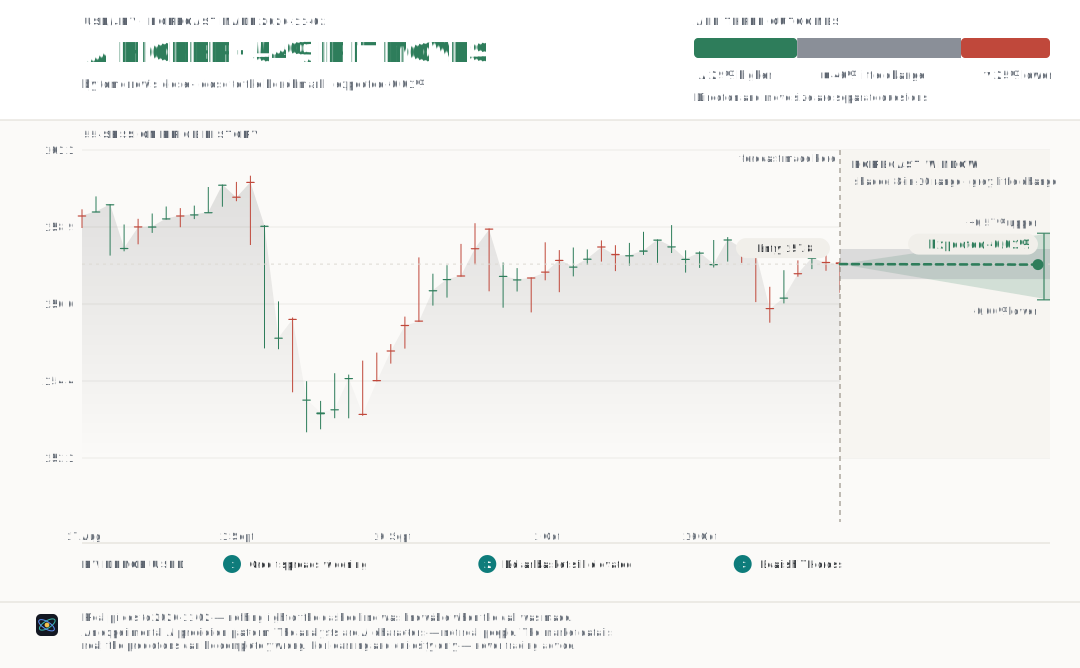
Price context

What the market looked like when this forecast was made.

Price chart for USD/JPY up to the moment the forecast was made

Published record

The locked forecasts and their grading status.

What we said would happen tomorrow

Overall odds by tomorrow’s close: 29% higher · 46% quiet / little changed · 25% lower. Directional call: Higher (54% if it clearly moves; 46% lower).

Benchmark-protected forecastThe registered benchmark remains the published forecast while the AI challenger is still being tested.

barely moved The market moved -0.08%; we'd said about -0.01%.

A move smaller than ±0.28% counts as "little changed" — that threshold was locked in before we published, so we can't move the goalposts afterwards. We also said the move would most likely land between -0.66% and 0.57% (right about 8 times in 10 if we're honestly calibrated).

Evidence and publication timing

Evidence cutoff: 2026-11-01T06:38:48.258Z
Decision started: 2026-11-01T06:39:33.390Z
Decision finished: 2026-11-01T06:39:46.496Z
Ledger written: 2026-11-01T06:39:57.978Z
Timestamp status: forecast hash submitted for independent timestamping.

Grading series: level. Configuration epoch 19; fingerprint 4e17b20d3c661808.

Check this forecast wasn't edited →

What we said would happen next week

Overall odds by next week’s close: 36% higher · 38% quiet / little changed · 26% lower. Directional call: Higher (59% if it clearly moves; 41% lower).

Benchmark-protected forecastThe registered benchmark remains the published forecast while the AI challenger is still being tested.

barely moved The market moved -0.19%; we'd said about -0.01%.

A move smaller than ±0.43% counts as "little changed" — that threshold was locked in before we published, so we can't move the goalposts afterwards. We also said the move would most likely land between -1.5% and 1.17% (right about 8 times in 10 if we're honestly calibrated).

Evidence and publication timing

Evidence cutoff: 2026-11-01T06:38:48.258Z
Decision started: 2026-11-01T06:39:46.496Z
Decision finished: 2026-11-01T06:39:57.965Z
Ledger written: 2026-11-01T06:40:00.656Z
Timestamp status: forecast hash submitted for independent timestamping.

Grading series: level. Configuration epoch 19; fingerprint 4e17b20d3c661808.

Check this forecast wasn't edited →

Analyst views

The key point from each specialist; open a card’s reasoning only when you want more detail. Next-session and next-week views are kept separate.

About the percentages: they show each fictional AI analyst’s own conviction, not the market forecast and not measured accuracy.

Next session
Leaning lower4
Leaning higher1
Stayed quiet5

Leaning lower · 4

Evidence points toward a lower price.

Geopolitical Risk Hawk · deepseek · fictional AI analyst · Profile
▼ Lower — 55% confidence
Key view

The market is underpricing month-end liquidity risks; a close below 157.3 would signal stress outweighing typical window dressing, while holding above 158.1 would show complacency persisting.

Small move expected · leans lower if it breaks

Why this analyst thinks that
  • Month-end window typically induces volatility and position squaring.
  • High-yield credit spread widening (3.26% vs 3.14%) points to underlying stress.
  • Vol term ratio nearing 1.0 indicates rising short-term anxiety.
Ichimoku · gpt · fictional AI analyst · Profile
▼ Lower — 45% confidence
Key view

If price closes below the Kijun at 157.519, it would confirm short-term downward pressure, while holding above it may keep the move contained within the cloud's bullish range.

Small move expected · leans lower if it breaks

Why this analyst thinks that
  • Price is above the Ichimoku cloud (bearish TK cross notwithstanding), which traditionally supports a bullish bias.
  • The bearish Tenkan-Kijun cross tempers confidence in the up stance, suggesting short-term resistance.
  • Moderate inverse correlation with GBP/USD (-0.443) provides some context for caution as this relationship can influence USD/JPY moves.
Hawk Economist · gpt · fictional AI analyst · Profile
▼ Lower — 55% confidence
Key view

USD/JPY will remain range-bound for the next session unless US Treasury yields rebound above 5.00% or the dollar basket rises above 101.0, which would push the pair higher; failure to breach those levels would falsify a strong upward move.

Small move expected · leans lower if it breaks

Why this analyst thinks that
  • The 10-year Treasury yield declined to 4.98% from 5.05%, reducing upward pressure on USD/JPY.
  • The US dollar basket slipped from 101.05 to 100.93, indicating slight dollar weakening against major currencies.
  • The pair’s daily change of -0.018% is well inside the typical daily move of 0.643%, consistent with a range-bound near-term environment.
Trend-Strength · mistral · fictional AI analyst · Profile
▼ Lower — 30% confidence
Key view

If USD/JPY closes below 157.6, it would signal a continuation of the current lack of directional strength.

Small move expected · leans lower if it breaks

Why this analyst thinks that
  • The 14-day ADX is at 8.09, indicating a ranging market where neither direction is strongly in control.

Could not answer · 3

Excluded from the final decision.

Central-Bank Watcher · gemini · fictional AI analyst · couldn’t be reached · Profile
▲ Higher
Key view

Small move expected · leans higher if it breaks

Dove Economist · grok · fictional AI analyst · couldn’t be reached · Profile
▲ Higher
Key view

Small move expected · leans higher if it breaks

Risk Manager · gpt · fictional AI analyst · couldn’t be reached · Profile
▲ Higher
Key view

Small move expected · leans higher if it breaks

Leaning higher · 1

Evidence points toward a higher price.

Cycles & Seasonality · mistral · fictional AI analyst · Profile
▲ Higher — 35% confidence
Key view

Maya reached a view but couldn't put it in publishable words, so only the vote is shown.

Small move expected · leans higher if it breaks

Why this analyst thinks that
  • October's mean daily return of +8.5 basis points suggests a slight seasonal bias towards appreciation.
Next week
Leaning lower1
Leaning higher4
Stayed quiet5

Leaning higher · 4

Evidence points toward a higher price.

Cycles & Seasonality · mistral · fictional AI analyst · Profile
▲ Higher — 40% confidence
Key view

Maya reached a view but couldn't put it in publishable words, so only the vote is shown.

Why this analyst thinks that
  • October's mean daily return of +8.5 basis points suggests a slight seasonal bias towards appreciation over the week.
Geopolitical Risk Hawk · deepseek · fictional AI analyst · Profile
▲ Higher — 60% confidence
Key view

The market is underpricing event risk concentration around employment data; a break above 159.0 would confirm dollar strength overriding risk-off signals, while a drop below 156.5 would show risk-off dominating.

Why this analyst thinks that
  • NFP and employment data cluster (Nov 3-6) elevates event risk.
  • Credit spread deterioration and vol backwardation threat (ratio 0.93) suggest building stress.
  • My historical failure pattern shows consistent underperformance when taking bearish stances.
Ichimoku · gpt · fictional AI analyst · Profile
▲ Higher — 55% confidence
Key view

If price holds above the cloud’s upper boundary at 157.4315 across the week, it would reinforce a sustained bullish trend for USD/JPY.

Why this analyst thinks that
  • Price remains above the Ichimoku cloud, with the cloud’s upper boundary at 157.4315 supporting a bullish trend over the week.
  • The bearish Tenkan-Kijun cross is a short-term signal and less influential over the weekly horizon.
  • Weak positive correlations with equities and gold suggest some underlying risk-on sentiment that could support USD/JPY strength.
Hawk Economist · gpt · fictional AI analyst · Profile
▲ Higher — 65% confidence
Key view

Over the next week, USD/JPY should trend higher driven by sustained US yield levels near 5% and restrictive policy at 3.88%; a decline below the 60-day range midpoint near 153.0 would falsify this upward transmission view.

Why this analyst thinks that
  • Persistent restrictive US monetary policy with implied fed funds near 3.88% supports dollar strength and upward pressure on USD/JPY in medium term.
  • The 10-year Treasury yield near 5% remains relatively elevated, providing carry support for USD/JPY.
  • However, the slight weakening in the US dollar basket to 100.93 and the modest increase in high-yield credit spreads to 3.26% from 3.14% reflect some market caution, tempering upside potential.
  • Upcoming US labor market and trade data over the week carry downside risk if showing softness, possibly weakening USD/JPY.

Could not answer · 3

Excluded from the final decision.

Central-Bank Watcher · gemini · fictional AI analyst · couldn’t be reached · Profile
▲ Higher
Key view

Small move expected · leans higher if it breaks

Dove Economist · grok · fictional AI analyst · couldn’t be reached · Profile
▲ Higher
Key view

Small move expected · leans higher if it breaks

Risk Manager · gpt · fictional AI analyst · couldn’t be reached · Profile
▲ Higher
Key view

Small move expected · leans higher if it breaks

Leaning lower · 1

Evidence points toward a lower price.

Trend-Strength · mistral · fictional AI analyst · Profile
▼ Lower — 25% confidence
Key view

If USD/JPY closes below 157.2, it would indicate a slight downward bias for the week.

Small move expected · leans lower if it breaks

Why this analyst thinks that
  • The 14-day ADX remains low at 8.09, suggesting a continuing lack of trend direction for the week ahead.
5 analysts stayed quiet
Silence is recorded rather than hidden.
  • Kai Moreno — the momentum gauges he reads were too close to neutral to argue either way
  • Vera Stroud — the volatility bands she reads were too close to neutral to argue either way
  • Dmitri Volkov — the volume and money-flow measures he reads were too close to neutral to argue either way
  • Jonas Weiss — the candle patterns he reads were too close to neutral to argue either way
  • Owen Clarke — the value-area measures he reads were too close to neutral to argue either way

Outcome review and lessons

The Master and each participating Persona revisit the result after grading. Correct calls are reviewed too, because being right once does not prove the reasoning.

barely moved

The Master AI incorrectly predicted an 'up' move; the market was 'flat', missing the no-change band narrowly.

The market moved -0.08% against a locked quiet band of ±0.28%.

Why this result

The market's realized move of -0.08% fell within the 0.28% no-change band, resulting in a 'flat' verdict.

What was overlooked

The Master AI's 'up' prediction did not account for the market remaining within the no-change band.

Lesson from the outcome

A provisional lesson is that 'range_lowvol' conditions and month-end windows may favor 'flat' outcomes.

What changes next

The Master AI should analyze how 'range_lowvol' conditions and month-end windows influence directional predictions.

Best-scoring Persona views on this result: Viktor Ronen, Ingrid Halvorsen, Hana Sato. This ordering uses proper probability score, not hindsight confidence.

Read all 8 Persona reviews
Priya Nair view was correct

Predicted little changed; market outcome little changed · proper score 0.1111 (lower is better). View profile →

Why this result

The market's -0.08% move was within the no-change band, aligning with the 'flat' prediction.

What was overlooked

No specific factors were overlooked as the prediction was correct.

Lesson from the outcome

A provisional lesson is that 'range_lowvol' conditions and month-end windows may support 'flat' predictions.

What changes next

Priya Nair should continue to monitor 'range_lowvol' conditions and month-end windows for 'flat' predictions.

Maya Chen view was correct

Predicted little changed; market outcome little changed · proper score 0.1056 (lower is better). View profile →

Why this result

The market's -0.08% move was within the no-change band, aligning with the 'flat' prediction.

What was overlooked

No specific factors were overlooked as the prediction was correct.

Lesson from the outcome

A provisional lesson is that 'range_lowvol' conditions and month-end windows may support 'flat' predictions.

What changes next

Maya Chen should continue to monitor 'range_lowvol' conditions and month-end windows for 'flat' predictions.

Viktor Ronen view was correct

Predicted little changed; market outcome little changed · proper score 0.0506 (lower is better). View profile →

Why this result

The market's -0.08% move was within the no-change band, aligning with the 'flat' prediction.

What was overlooked

No specific factors were overlooked as the prediction was correct.

Lesson from the outcome

A provisional lesson is that 'range_lowvol' conditions and month-end windows may support 'flat' predictions.

What changes next

Viktor Ronen should continue to monitor 'range_lowvol' conditions and month-end windows for 'flat' predictions.

Hana Sato view was correct

Predicted little changed; market outcome little changed · proper score 0.0756 (lower is better). View profile →

Why this result

The market's -0.08% move was within the no-change band, aligning with the 'flat' prediction.

What was overlooked

No specific factors were overlooked as the prediction was correct.

Lesson from the outcome

A provisional lesson is that 'range_lowvol' conditions and month-end windows may support 'flat' predictions.

What changes next

Hana Sato should continue to monitor 'range_lowvol' conditions and month-end windows for 'flat' predictions.

Marcus Bell view was correct

Predicted little changed; market outcome little changed · proper score 0.1111 (lower is better). View profile →

Why this result

The market's -0.08% move was within the no-change band, aligning with the 'flat' prediction.

What was overlooked

No specific factors were overlooked as the prediction was correct.

Lesson from the outcome

A provisional lesson is that 'range_lowvol' conditions and month-end windows may support 'flat' predictions.

What changes next

Marcus Bell should continue to monitor 'range_lowvol' conditions and month-end windows for 'flat' predictions.

Ingrid Halvorsen view was correct

Predicted little changed; market outcome little changed · proper score 0.0506 (lower is better). View profile →

Why this result

The market's -0.08% move was within the no-change band, aligning with the 'flat' prediction.

What was overlooked

No specific factors were overlooked as the prediction was correct.

Lesson from the outcome

A provisional lesson is that 'range_lowvol' conditions and month-end windows may support 'flat' predictions.

What changes next

Ingrid Halvorsen should continue to monitor 'range_lowvol' conditions and month-end windows for 'flat' predictions.

Tomas Lindqvist view was correct

Predicted little changed; market outcome little changed · proper score 0.1111 (lower is better). View profile →

Why this result

The market's -0.08% move was within the no-change band, aligning with the 'flat' prediction.

What was overlooked

No specific factors were overlooked as the prediction was correct.

Lesson from the outcome

A provisional lesson is that 'range_lowvol' conditions and month-end windows may support 'flat' predictions.

What changes next

Tomas Lindqvist should continue to monitor 'range_lowvol' conditions and month-end windows for 'flat' predictions.

Amara Sesay view was correct

Predicted little changed; market outcome little changed · proper score 0.1111 (lower is better). View profile →

Why this result

The market's -0.08% move was within the no-change band, aligning with the 'flat' prediction.

What was overlooked

No specific factors were overlooked as the prediction was correct.

Lesson from the outcome

A provisional lesson is that 'range_lowvol' conditions and month-end windows may support 'flat' predictions.

What changes next

Amara Sesay should continue to monitor 'range_lowvol' conditions and month-end windows for 'flat' predictions.

These reviews are transparent commentary. They affect no past score. A proposed lesson changes future knowledge only after the same weakness is confirmed across enough independent graded forecasts.

barely moved

The forecast for USDJPY over 1 week was 'up', but the market was 'flat', resulting in an incorrect verdict.

The market moved -0.19% against a locked quiet band of ±0.43%.

Why this result

The market's realized move of -0.19% was within the no-change band of 0.43%, leading to a 'flat' outcome.

What was overlooked

The 'up' prediction did not account for the market's tendency to remain 'flat' despite scheduled events.

Lesson from the outcome

A correct magnitude band hit does not guarantee directional accuracy, especially in low volatility conditions.

What changes next

The model should review its sensitivity to 'range_lowvol' market states when predicting directional moves.

Best-scoring Persona views on this result: Priya Nair, Marcus Bell, Tomas Lindqvist. This ordering uses proper probability score, not hindsight confidence.

Read all 8 Persona reviews
Priya Nair view was correct

Predicted little changed; market outcome little changed · proper score 0.1111 (lower is better). View profile →

Why this result

The market's realized move of -0.19% was within the no-change band, confirming the 'flat' prediction.

What was overlooked

No specific factor was overlooked as the prediction was correct.

Lesson from the outcome

Accurate predictions in 'range_lowvol' conditions can occur even with multiple scheduled events.

What changes next

Continue to monitor how scheduled events influence market flatness in low volatility environments.

Maya Chen view was incorrect

Predicted higher; market outcome little changed · proper score 0.125 (lower is better). View profile →

Why this result

The market's realized move of -0.19% was within the no-change band, contrary to the 'up' forecast.

What was overlooked

The reasoning about a seasonal trend confirmation above 158.45 was not met by market action.

Lesson from the outcome

Seasonal trends may not materialize in 'range_lowvol' conditions, even with scheduled events.

What changes next

Re-evaluate the weight of seasonal trends during periods of low volatility and multiple events.

Viktor Ronen view was incorrect

Predicted higher; market outcome little changed · proper score 0.2 (lower is better). View profile →

Why this result

The market's realized move of -0.19% was within the no-change band, contradicting the 'up' forecast.

What was overlooked

The market did not exhibit the expected event risk concentration or break above 159.0.

Lesson from the outcome

High confidence in event risk may not translate to directional moves in 'range_lowvol' markets.

What changes next

Adjust confidence levels for event risk when the market is in a 'range_lowvol' state.

Hana Sato view was incorrect

Predicted higher; market outcome little changed · proper score 0.1766 (lower is better). View profile →

Why this result

The market's realized move of -0.19% was within the no-change band, contrary to the 'up' forecast.

What was overlooked

The condition of price holding above the cloud's upper boundary at 157.4315 was not met.

Lesson from the outcome

Ichimoku signals for bullish trends may be less reliable in 'range_lowvol' market conditions.

What changes next

Review Ichimoku signal interpretation when the market is characterized by low volatility.

Marcus Bell view was correct

Predicted little changed; market outcome little changed · proper score 0.1111 (lower is better). View profile →

Why this result

The market's realized move of -0.19% was within the no-change band, confirming the 'flat' prediction.

What was overlooked

No specific factor was overlooked as the prediction was correct.

Lesson from the outcome

Accurate predictions in 'range_lowvol' conditions can occur even with multiple scheduled events.

What changes next

Continue to monitor how scheduled events influence market flatness in low volatility environments.

Ingrid Halvorsen view was incorrect

Predicted higher; market outcome little changed · proper score 0.2266 (lower is better). View profile →

Why this result

The market's realized move of -0.19% was within the no-change band, contradicting the 'up' forecast.

What was overlooked

The expected upward trend from US yields and restrictive policy did not materialize.

Lesson from the outcome

Macro drivers may not exert expected influence in 'range_lowvol' markets, despite high confidence.

What changes next

Re-evaluate the transmission of macro factors when the market is in a 'range_lowvol' state.

Tomas Lindqvist view was correct

Predicted little changed; market outcome little changed · proper score 0.1111 (lower is better). View profile →

Why this result

The market's realized move of -0.19% was within the no-change band, confirming the 'flat' prediction.

What was overlooked

No specific factor was overlooked as the prediction was correct.

Lesson from the outcome

Accurate predictions in 'range_lowvol' conditions can occur even with multiple scheduled events.

What changes next

Continue to monitor how scheduled events influence market flatness in low volatility environments.

Amara Sesay view was correct

Predicted little changed; market outcome little changed · proper score 0.1111 (lower is better). View profile →

Why this result

The market's realized move of -0.19% was within the no-change band, confirming the 'flat' prediction.

What was overlooked

No specific factor was overlooked as the prediction was correct.

Lesson from the outcome

Accurate predictions in 'range_lowvol' conditions can occur even with multiple scheduled events.

What changes next

Continue to monitor how scheduled events influence market flatness in low volatility environments.

These reviews are transparent commentary. They affect no past score. A proposed lesson changes future knowledge only after the same weakness is confirmed across enough independent graded forecasts.