“All three analysts lean down with moderate confidence, and key technical levels near 274.3-274.8 suggest downside risk amid FOMC blackout liquidity concerns.”
iShares Russell 2000 ETF: what the analysts said on 26 October 2026
3 of 11 analysts spoke; 3 lean lower. 2 of those expect only a small move.
Forecast at a glance
Direction, chance of a quiet market, and expected size are separate questions.
Higher by tomorrow’s close
How much weight to give it: This is the registered benchmark, kept in place while the AI challenger is still being tested; it is not presented as a strong AI call.
The registered benchmark remains the published forecast while the AI challenger is still being tested.Likely range: -1.37% to 1.39% (an 8-in-10 estimate). The odds, average move and range all come from one probability-weighted historical return distribution.
How this verdict was reached — 2 leaned higher, 1 leaned lower
Three independent readers look at the same day through deliberately different windows: one reads the debate, one ignores the debate and reads only the numbers, one reads only the news. If they all saw the same evidence they would simply agree with each other, which would tell us nothing. Today they genuinely disagreed.
“The base rates dominate due to conflicting signals: FOMC blackout reduces volatility but weak momentum and negative volume trends offset any clear directional bias.”
“The provided news indicates mixed activity with both sales and purchases of IWM shares, suggesting no strong directional bias, while economic calendar and cross-market relationships do not present immediate strong catalysts for a significant move.”
The AI challenger was calculated, then withheld from the public call. Version judge-3.1.0 combined the reachable readers in log-odds space, equally weighted because none had yet earned enough independent graded calls to count for more, and shrank the result back toward this market's history. Confidence calibration stayed off because the prior independent record had not yet earned it. Because that challenger has not yet passed the forward evidence gate, the benchmark guardian published the locked base-rate vector shown above instead. Both vectors remain in the immutable record. Measured reader agreement: 0.829; 3 of 3 answered.
Why the headline percentage isn't just the “higher” bar above. The bar shows all three outcomes, and one of them — barely moved — isn't a direction at all, it's a question about size. Reading “higher 38%” off that bar would suggest we mostly expect the other thing to happen, which isn't what the numbers say. So the call is stated the way the question is actually asked: when this market moves, which way does it go? Of the 74% of days it does move, we put 52% on higher. The chance it barely moves is reported on its own, and grading uses all three numbers untouched.
Why is this benchmark-protected? The challenger is recorded and tested, but the registered benchmark stays public until the challenger passes the pre-declared evidence threshold. This avoids promoting a promising backtest as a proven live improvement.
Starting point before anyone argued: over 319 past stretches like this one, this market rose 38% of the time, fell 36%, and barely moved 26%.
Higher by next week’s close
How much weight to give it: This is the registered benchmark, kept in place while the AI challenger is still being tested; it is not presented as a strong AI call.
The registered benchmark remains the published forecast while the AI challenger is still being tested.Likely range: -2.31% to 3.09% (an 8-in-10 estimate). The odds, average move and range all come from one probability-weighted historical return distribution.
How this verdict was reached — 1 leaned higher, 2 leaned lower
Three independent readers look at the same day through deliberately different windows: one reads the debate, one ignores the debate and reads only the numbers, one reads only the news. If they all saw the same evidence they would simply agree with each other, which would tell us nothing. Today they largely agreed — which counts for less, not more, since it may be one line of reasoning arrived at three times.
“The majority bearish leaners highlight key technical and fundamental risks—failure to reclaim 276.85 and hawkish FOMC with elevated credit spreads—that suggest downside pressure outweighs upside potential this week.”
“The ETF is in a bearish technical setup with price below all major moving averages, weak momentum (RSI 43), and facing multiple high-impact macro events (FOMC, GDP, PCE) that could amplify downside volatility.”
“The provided news indicates mixed institutional activity with both sales and purchases, and no strong directional signal from cross-market correlations or the economic calendar within the 1-week horizon, leading to a neutral forecast matching base rates.”
The AI challenger was calculated, then withheld from the public call. Version judge-3.1.0 combined the reachable readers in log-odds space, equally weighted because none had yet earned enough independent graded calls to count for more, and shrank the result back toward this market's history. Confidence calibration stayed off because the prior independent record had not yet earned it. Because that challenger has not yet passed the forward evidence gate, the benchmark guardian published the locked base-rate vector shown above instead. Both vectors remain in the immutable record. Measured reader agreement: 0.901; 3 of 3 answered.
Why the headline percentage isn't just the “higher” bar above. The bar shows all three outcomes, and one of them — barely moved — isn't a direction at all, it's a question about size. Reading “higher 38%” off that bar would suggest we mostly expect the other thing to happen, which isn't what the numbers say. So the call is stated the way the question is actually asked: when this market moves, which way does it go? Of the 71% of days it does move, we put 53% on higher. The chance it barely moves is reported on its own, and grading uses all three numbers untouched.
Why is this benchmark-protected? The challenger is recorded and tested, but the registered benchmark stays public until the challenger passes the pre-declared evidence threshold. This avoids promoting a promising backtest as a proven live improvement.
Starting point before anyone argued: over 315 past stretches like this one, this market rose 38% of the time, fell 33%, and barely moved 29%.
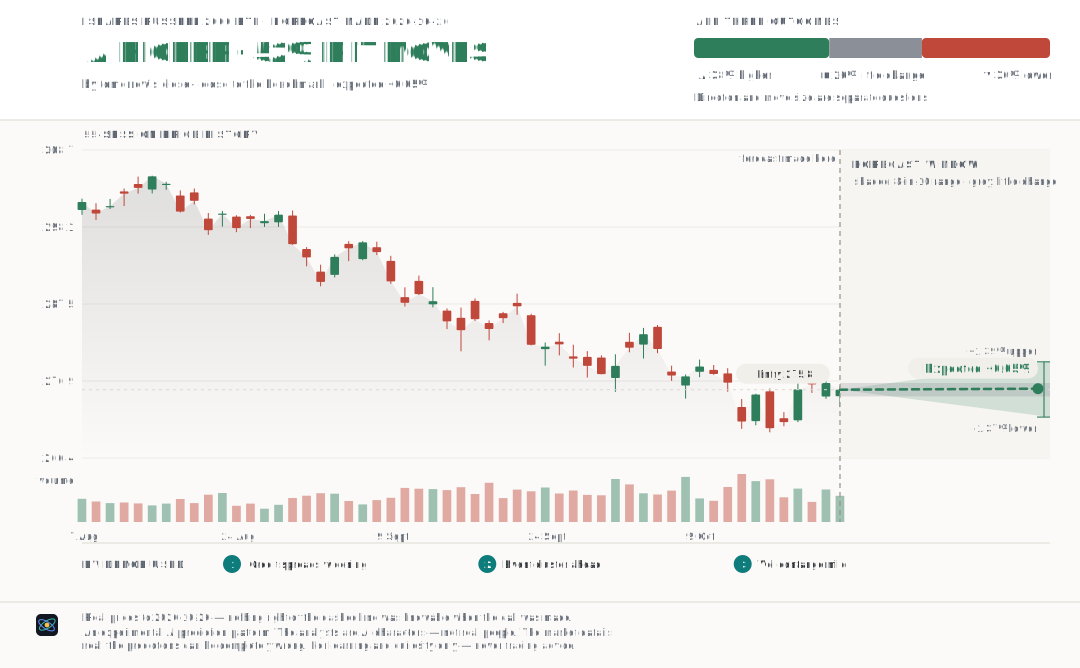
Price context
What the market looked like when this forecast was made.
Published record
The locked forecasts and their grading status.
What we said would happen tomorrow
we were right The market moved 0.45%; we'd said about 0.05%.
A move smaller than ±0.33% counts as "little changed" — that threshold was locked in before we published, so we can't move the goalposts afterwards. We also said the move would most likely land between -1.37% and 1.39% (right about 8 times in 10 if we're honestly calibrated).
Evidence and publication timing
Evidence cutoff: 2026-10-26T12:10:07.926Z
Decision started: 2026-10-26T12:12:30.192Z
Decision finished: 2026-10-26T12:13:00.641Z
Ledger written: 2026-10-26T12:13:30.483Z
Timestamp status: forecast hash submitted for independent timestamping.
Grading series: level. Configuration epoch 17; fingerprint 4867b280dbff940c.
What we said would happen next week
we were right The market moved 1.30%; we'd said about 0.27%.
A move smaller than ±0.75% counts as "little changed" — that threshold was locked in before we published, so we can't move the goalposts afterwards. We also said the move would most likely land between -2.31% and 3.09% (right about 8 times in 10 if we're honestly calibrated).
Evidence and publication timing
Evidence cutoff: 2026-10-26T12:10:07.926Z
Decision started: 2026-10-26T12:13:00.641Z
Decision finished: 2026-10-26T12:13:30.460Z
Ledger written: 2026-10-26T12:13:33.800Z
Timestamp status: forecast hash submitted for independent timestamping.
Grading series: level. Configuration epoch 17; fingerprint 4867b280dbff940c.
Analyst views
The key point from each specialist; open a card’s reasoning only when you want more detail. Next-session and next-week views are kept separate.
About the percentages: they show each fictional AI analyst’s own conviction, not the market forecast and not measured accuracy.
Leaning lower · 3
Evidence points toward a lower price.
The market is underpricing FOMC blackout liquidity risk; IWM stays within ±0.33% band unless it breaks below 274.84, which would signal blackout-period stress is being priced.
Small move expected · leans lower if it breaks
Why this analyst thinks that
- FOMC blackout period reduces liquidity and increases event risk sensitivity.
- High-yield credit spread widening to 3.4% suggests underlying credit deterioration.
- My historical failure pattern shows consistent underperformance when taking bearish stances.
If price closes below the Tenkan line at 274.29 tomorrow, this would confirm continuation below short-term support and extend bearish momentum.
Small move expected · leans lower if it breaks
Why this analyst thinks that
- Price closed slightly lower by -0.333%, right at the flat band threshold, consistent with the bearish Tenkan-Kijun relationship and price below the cloud.
- Moderate positive correlations to broad markets like S&P 500 and Dow have weakened, reducing confidence in broad market support.
- My own documented underperformance on down stances advises caution in leaning too strongly bearish here.
If price closes above the 20-day average near 277.19, it would signal short-term resilience; failure to do so would likely maintain downward pressure.
Why this analyst thinks that
- Price closed lower by 0.333% today, just at the flat threshold, showing short-term weakness.
- MACD histogram is shrinking while price remains below short-term averages, a tentative early signal of fading selling pressure but unconfirmed.
- Strongly below the 50-day average by 2.9 ATR suggests continuing short-term trend pressure.
Leaning lower · 2
Evidence points toward a lower price.
The market is underpricing event cluster volatility; IWM will test below 273.60 if FOMC maintains hawkish stance while credit spreads remain above 3.3%.
Why this analyst thinks that
- Multiple high-impact events (FOMC, GDP, PCE, employment data) create asymmetric tail risk.
- Correlation breakdown with Nasdaq 100 (-0.155 coefficient change) suggests small-caps are decoupling from tech momentum.
- High-yield credit spread at 3.4% shows deteriorating credit conditions that could amplify during event risk.
If price fails to reclaim the lower cloud boundary at 276.85 during the week, it would reinforce the bearish trend and risk further downside.
Why this analyst thinks that
- The price remains below the entire Ichimoku cloud (spanning 276.85 to 287.53), indicating bearish conditions over the medium term.
- The bearish Tenkan-Kijun crossover supports downward pressure over the week.
- Slight weakening in correlations to major equity indexes suggests less external support for a rally.
- No strong news or buying signals appear to counteract these bearish technical signs.
Leaning higher · 1
Evidence points toward a higher price.
A weekly close above the 50-day average near 286.41 would confirm a shift back to strength; failure to regain this level would keep the medium-term outlook cautious.
Why this analyst thinks that
- Price remains under its 200-day average by 0.89%, indicating the long-term trend is not strongly bullish.
- Despite weakness, the 200-day average is in a golden cross state, favoring a longer-term uptrend bias.
- My historical patterns show underperformance in down calls during mid-volatility trending regimes, leading me to lean cautiously up.
- MACD histogram's positive turn, though early, hints at potential weakening of the downtrend.
3 analysts stayed quiet
- Dmitri Volkov — the volume and money-flow measures he reads were too close to neutral to argue either way
- Jonas Weiss — the candle patterns he reads were too close to neutral to argue either way
- Owen Clarke — the value-area measures he reads were too close to neutral to argue either way
Outcome review and lessons
The Master and each participating Persona revisit the result after grading. Correct calls are reviewed too, because being right once does not prove the reasoning.
The forecast was correct, predicting an 'up' move for IWM over a 1-week horizon, with a realized move of 1.3%.
The market moved 1.3% against a locked quiet band of ±0.75%.
The market moved up, aligning with the 'up' prediction and exceeding the no-change band.
The Master AI's performance was equal to the baseline, suggesting no clear overlooked factors from its aggregated view.
The current evidence collection status means no definitive lessons can be drawn for the Master AI yet.
No changes are indicated for the Master AI at this early stage of evidence collection.
Best-scoring Persona views on this result: Ada Lin, Theo Brandt, Grace Okafor. This ordering uses proper probability score, not hindsight confidence.
Read all 8 Persona reviews
Theo Brandt
view was incorrect
Predicted little changed; market outcome higher · proper score 0.2778 (lower is better). View profile →
The market moved up, contrary to the 'flat' prediction, indicating a misjudgment of market direction.
The forecast appears to have overlooked factors driving an upward market movement during a trend_lowvol state.
Provisional lesson: Breadth and intermarket signals may not have captured underlying bullish momentum.
Theo Brandt should review how its indicators interact with 'trend_lowvol' conditions and scheduled events.
Grace Okafor
view was incorrect
Predicted little changed; market outcome higher · proper score 0.2778 (lower is better). View profile →
The market moved up, contrary to the 'flat' prediction, indicating a misjudgment of market direction.
The forecast appears to have overlooked fundamental factors that contributed to the upward market movement.
Provisional lesson: Fundamental analysis may need to better account for drivers of upward shifts in 'trend_lowvol' markets.
Grace Okafor should re-evaluate how fundamental inputs weigh against market state and event windows.
Priya Nair
view was incorrect
Predicted little changed; market outcome higher · proper score 0.2778 (lower is better). View profile →
The market moved up, contrary to the 'flat' prediction, indicating a misjudgment of market direction.
The forecast appears to have overlooked central bank or macro factors that contributed to the upward market movement.
Provisional lesson: Central bank watch may need to better interpret signals during 'fomc_blackout' and 'fomc' events.
Priya Nair should review how monetary policy signals translate into market direction during key event weeks.
Viktor Ronen
view was incorrect
Predicted lower; market outcome higher · proper score 0.5 (lower is better). View profile →
The market moved up, contrary to the 'down' prediction, indicating a significant misjudgment of market direction.
The forecast appears to have overlooked factors that mitigated geopolitical risks or drove positive sentiment.
Provisional lesson: Geopolitical risk assessment may have overemphasized downside potential during this period.
Viktor Ronen should review how geopolitical factors interact with market resilience in a 'trend_lowvol' environment.
Hana Sato
view was incorrect
Predicted lower; market outcome higher · proper score 0.4803 (lower is better). View profile →
The market moved up, contrary to the 'down' prediction, indicating a significant misjudgment of market direction.
The forecast appears to have overlooked factors that supported an upward move, despite the stated technical conditions.
Provisional lesson: Ichimoku signals may have misread the strength of the bearish trend or overlooked bullish reversals.
Hana Sato should review how Ichimoku cloud boundaries and price action interact during 'trend_lowvol' periods.
Marcus Bell
view was incorrect
Predicted little changed; market outcome higher · proper score 0.2778 (lower is better). View profile →
The market moved up, contrary to the 'flat' prediction, indicating a misjudgment of market direction.
The forecast appears to have overlooked macro-economic factors that contributed to the upward market movement.
Provisional lesson: Macro-dove perspective may need to better interpret growth or inflation signals during key data releases.
Marcus Bell should re-evaluate how macroeconomic data, like GDP and PCE, influence market direction.
Tomas Lindqvist
view was incorrect
Predicted little changed; market outcome higher · proper score 0.2778 (lower is better). View profile →
The market moved up, contrary to the 'flat' prediction, indicating a misjudgment of market direction.
The forecast appears to have overlooked factors that reduced perceived risk or encouraged bullish sentiment.
Provisional lesson: Risk management frameworks may need to better identify periods of upward market bias.
Tomas Lindqvist should review how risk metrics and behavioral signals perform in 'trend_lowvol' conditions.
Ada Lin
view was correct
Predicted higher; market outcome higher · proper score 0.1891 (lower is better). View profile →
The market moved up, aligning with the 'up' prediction and exceeding the no-change band.
The forecast was correct, so no clear overlooked factors are evident from this single outcome.
Provisional lesson: Trend-following moving average strategies appear effective in identifying upward momentum.
Ada Lin should continue to monitor the reliability of moving average signals in similar market conditions.
These reviews are transparent commentary. They affect no past score. A proposed lesson changes future knowledge only after the same weakness is confirmed across enough independent graded forecasts.
The forecast matched the graded market outcome.
The market moved 0.45% against a locked quiet band of ±0.33%.
The published view and measured outcome aligned, although one result alone does not prove the reasoning was sound.
No overlooked factor can be established from the code evidence alone.
Keep this as one supporting observation; do not turn a single success into a general rule.
Future confidence will be recalibrated from the full graded record; permanent knowledge changes require a statistically confirmed pattern.
Best-scoring Persona views on this result: Theo Brandt, Grace Okafor, Priya Nair. This ordering uses proper probability score, not hindsight confidence.
Read all 8 Persona reviews
Theo Brandt
view was incorrect
Predicted little changed; market outcome higher · proper score 0.2778 (lower is better). View profile →
The measured record establishes the miss, but it does not by itself establish one reliable cause.
No overlooked factor can be established from the code evidence alone.
Treat this as a provisional warning until the same weakness repeats across enough independent graded calls.
Future confidence will be recalibrated from the full graded record; permanent knowledge changes require a statistically confirmed pattern.
Grace Okafor
view was incorrect
Predicted little changed; market outcome higher · proper score 0.2778 (lower is better). View profile →
The measured record establishes the miss, but it does not by itself establish one reliable cause.
No overlooked factor can be established from the code evidence alone.
Treat this as a provisional warning until the same weakness repeats across enough independent graded calls.
Future confidence will be recalibrated from the full graded record; permanent knowledge changes require a statistically confirmed pattern.
Priya Nair
view was incorrect
Predicted little changed; market outcome higher · proper score 0.2778 (lower is better). View profile →
The measured record establishes the miss, but it does not by itself establish one reliable cause.
No overlooked factor can be established from the code evidence alone.
Treat this as a provisional warning until the same weakness repeats across enough independent graded calls.
Future confidence will be recalibrated from the full graded record; permanent knowledge changes require a statistically confirmed pattern.
Viktor Ronen
view was incorrect
Predicted little changed; market outcome higher · proper score 0.29 (lower is better). View profile →
The measured record establishes the miss, but it does not by itself establish one reliable cause.
No overlooked factor can be established from the code evidence alone.
Treat this as a provisional warning until the same weakness repeats across enough independent graded calls.
Future confidence will be recalibrated from the full graded record; permanent knowledge changes require a statistically confirmed pattern.
Hana Sato
view was incorrect
Predicted little changed; market outcome higher · proper score 0.2941 (lower is better). View profile →
The measured record establishes the miss, but it does not by itself establish one reliable cause.
No overlooked factor can be established from the code evidence alone.
Treat this as a provisional warning until the same weakness repeats across enough independent graded calls.
Future confidence will be recalibrated from the full graded record; permanent knowledge changes require a statistically confirmed pattern.
Marcus Bell
view was incorrect
Predicted little changed; market outcome higher · proper score 0.2778 (lower is better). View profile →
The measured record establishes the miss, but it does not by itself establish one reliable cause.
No overlooked factor can be established from the code evidence alone.
Treat this as a provisional warning until the same weakness repeats across enough independent graded calls.
Future confidence will be recalibrated from the full graded record; permanent knowledge changes require a statistically confirmed pattern.
Tomas Lindqvist
view was incorrect
Predicted little changed; market outcome higher · proper score 0.2778 (lower is better). View profile →
The measured record establishes the miss, but it does not by itself establish one reliable cause.
No overlooked factor can be established from the code evidence alone.
Treat this as a provisional warning until the same weakness repeats across enough independent graded calls.
Future confidence will be recalibrated from the full graded record; permanent knowledge changes require a statistically confirmed pattern.
Ada Lin
view was incorrect
Predicted lower; market outcome higher · proper score 0.389 (lower is better). View profile →
The measured record establishes the miss, but it does not by itself establish one reliable cause.
No overlooked factor can be established from the code evidence alone.
Treat this as a provisional warning until the same weakness repeats across enough independent graded calls.
Future confidence will be recalibrated from the full graded record; permanent knowledge changes require a statistically confirmed pattern.
These reviews are transparent commentary. They affect no past score. A proposed lesson changes future knowledge only after the same weakness is confirmed across enough independent graded forecasts.