OrbitMarkets
An experimental AI prediction platform. The analysts are AI characters — not real people. The market data is real; the predictions can be completely wrong. For learning and curiosity only — never trading advice.AI characters — not real people · Experimental forecasts · Never trading advice.

GBP/USD: what the analysts said on 23 November 2026

8 of 12 analysts spoke; 4 lean lower and 4 lean higher. 3 of those expect only a small move.

Forecast at a glance

Direction, chance of a quiet market, and expected size are separate questions.

tomorrow

Higher by tomorrow’s close

Benchmark-protected forecast
If the market makes a clear move51% higher49% lower
Chance of a quiet move46%inside the locked range; neither higher nor lower
Distribution-average move-0.01%from the same return distribution as the odds

Overall odds by tomorrow’s close: 27% higher · 47% quiet / little changed · 26% lower. Directional call: Higher (51% if it clearly moves; 49% lower).

How much weight to give it: This is the registered benchmark, kept in place while the AI challenger is still being tested; it is not presented as a strong AI call.

The registered benchmark remains the published forecast while the AI challenger is still being tested.

Likely range: -0.54% to 0.53% (an 8-in-10 estimate). The odds, average move and range all come from one probability-weighted historical return distribution.

How this verdict was reached — 3 saw little change

Three independent readers look at the same day through deliberately different windows: one reads the debate, one ignores the debate and reads only the numbers, one reads only the news. If they all saw the same evidence they would simply agree with each other, which would tell us nothing. Today they largely agreed — which counts for less, not more, since it may be one line of reasoning arrived at three times.

Reader A
reads the debate transcript — what the analysts actually argued
■ Little changed

Overall odds by tomorrow’s close: 30% higher · 36% quiet / little changed · 34% lower.

“The panel is evenly split but with slightly more weight on down leans and key resistance levels near 1.3140–1.3147 acting as falsifiers for down moves, suggesting modest downside continuation but significant uncertainty.”

Reader B
reads the raw indicator pack + macro context, with no debate text
■ Little changed

Overall odds by tomorrow’s close: 27% higher · 46% quiet / little changed · 27% lower.

“The instrument is deeply oversold with RSI14 at 31.6 and near 60-day lows, but high volatility and a doji pattern suggest potential stabilization, with no scheduled high-impact events to drive a decisive move.”

Reader C
reads the day’s screened news + market context, with no indicators
■ Little changed

Overall odds by tomorrow’s close: 27% higher · 45% quiet / little changed · 28% lower.

“The British Pound is rebounding against a softer US Dollar, attracting bids after hitting a fresh almost a year low, suggesting a potential short-term recovery or stabilization despite underlying dollar strength.”

The AI challenger was calculated, then withheld from the public call. Version judge-3.2.0 combined the reachable readers in log-odds space, equally weighted because none had yet earned enough independent graded calls to count for more, and shrank the result back toward this market's history. Confidence calibration stayed off because the prior independent record had not yet earned it. Because that challenger has not yet passed the forward evidence gate, the benchmark guardian published the locked base-rate vector shown above instead. Both vectors remain in the immutable record. Measured reader agreement: 0.93; 3 of 3 answered.

Why the headline percentage isn't just the “higher” bar above. The bar shows all three outcomes, and one of them — barely moved — isn't a direction at all, it's a question about size. Reading “higher 27%” off that bar would suggest we mostly expect the other thing to happen, which isn't what the numbers say. So the call is stated the way the question is actually asked: when this market moves, which way does it go? Of the 54% of days it does move, we put 51% on higher. The chance it barely moves is reported on its own, and grading uses all three numbers untouched.

Why is this benchmark-protected? The challenger is recorded and tested, but the registered benchmark stays public until the challenger passes the pre-declared evidence threshold. This avoids promoting a promising backtest as a proven live improvement.

Starting point before anyone argued: over 319 past stretches like this one, this market rose 27% of the time, fell 26%, and barely moved 46%.

next week

Lower by next week’s close

Benchmark-protected forecast
If the market makes a clear move52% lower48% higher
Chance of a quiet move35%inside the locked range; neither higher nor lower
Distribution-average move-0.02%from the same return distribution as the odds

Overall odds by next week’s close: 31% higher · 35% quiet / little changed · 34% lower. Directional call: Lower (52% if it clearly moves; 48% higher).

How much weight to give it: This is the registered benchmark, kept in place while the AI challenger is still being tested; it is not presented as a strong AI call.

The registered benchmark remains the published forecast while the AI challenger is still being tested.

Likely range: -1.1% to 1.01% (an 8-in-10 estimate). The odds, average move and range all come from one probability-weighted historical return distribution.

How this verdict was reached — 3 leaned lower

Three independent readers look at the same day through deliberately different windows: one reads the debate, one ignores the debate and reads only the numbers, one reads only the news. If they all saw the same evidence they would simply agree with each other, which would tell us nothing. Today they largely agreed — which counts for less, not more, since it may be one line of reasoning arrived at three times.

Reader A
reads the debate transcript — what the analysts actually argued
▼ Lower

Overall odds by next week’s close: 24% higher · 30% quiet / little changed · 46% lower.

“The majority of analysts (6 of 8) lean lower with moderate to strong confidence, supported by tightening financial conditions and technical resistance around 1.3140-1.332, suggesting downside pressure outweighs upside potential this week.”

Reader B
reads the raw indicator pack + macro context, with no debate text
▼ Lower

Overall odds by next week’s close: 28% higher · 34% quiet / little changed · 38% lower.

“GBP/USD is in a strong downtrend with oversold momentum, trading below all major moving averages and near 60-day lows, while upcoming US economic data may reinforce dollar strength.”

Reader C
reads the day’s screened news + market context, with no indicators
▼ Lower

Overall odds by next week’s close: 25% higher · 35% quiet / little changed · 40% lower.

“The US Dollar is experiencing profit-taking after reaching yearly highs, leading to a rebound in GBP/USD from recent lows, but the overall trend for the dollar remains strong, suggesting continued pressure on GBP/USD.”

The AI challenger was calculated, then withheld from the public call. Version judge-3.2.0 combined the reachable readers in log-odds space, equally weighted because none had yet earned enough independent graded calls to count for more, and shrank the result back toward this market's history. Confidence calibration stayed off because the prior independent record had not yet earned it. Because that challenger has not yet passed the forward evidence gate, the benchmark guardian published the locked base-rate vector shown above instead. Both vectors remain in the immutable record. Measured reader agreement: 0.943; 3 of 3 answered.

Why the headline percentage isn't just the “lower” bar above. The bar shows all three outcomes, and one of them — barely moved — isn't a direction at all, it's a question about size. Reading “lower 34%” off that bar would suggest we mostly expect the other thing to happen, which isn't what the numbers say. So the call is stated the way the question is actually asked: when this market moves, which way does it go? Of the 65% of days it does move, we put 52% on lower. The chance it barely moves is reported on its own, and grading uses all three numbers untouched.

Why is this benchmark-protected? The challenger is recorded and tested, but the registered benchmark stays public until the challenger passes the pre-declared evidence threshold. This avoids promoting a promising backtest as a proven live improvement.

Starting point before anyone argued: over 315 past stretches like this one, this market rose 31% of the time, fell 34%, and barely moved 35%.
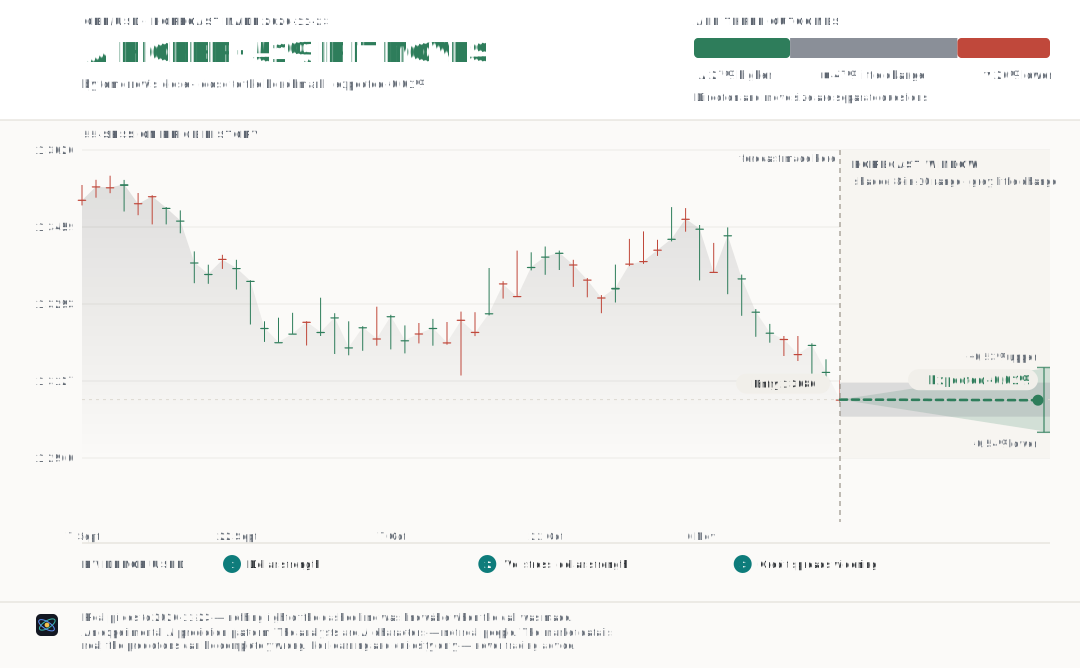
Price context

What the market looked like when this forecast was made.

Price chart for GBP/USD up to the moment the forecast was made

Published record

The locked forecasts and their grading status.

What we said would happen tomorrow

Overall odds by tomorrow’s close: 27% higher · 47% quiet / little changed · 26% lower. Directional call: Higher (51% if it clearly moves; 49% lower).

Benchmark-protected forecastThe registered benchmark remains the published forecast while the AI challenger is still being tested.

waiting for the closing price We'll know on 23 November 2026.

A move smaller than ±0.28% counts as "little changed" — that threshold was locked in before we published, so we can't move the goalposts afterwards. We also said the move would most likely land between -0.54% and 0.53% (right about 8 times in 10 if we're honestly calibrated).

Evidence and publication timing

Evidence cutoff: 2026-11-21T06:40:12.190Z
Decision started: 2026-11-21T06:40:40.218Z
Decision finished: 2026-11-21T06:40:52.186Z
Ledger written: 2026-11-21T06:41:01.487Z
Timestamp status: forecast hash submitted for independent timestamping.

Grading series: level. Configuration epoch 20; fingerprint b30268869f6f9ddf.

Check this forecast wasn't edited →

What we said would happen next week

Overall odds by next week’s close: 31% higher · 35% quiet / little changed · 34% lower. Directional call: Lower (52% if it clearly moves; 48% higher).

Benchmark-protected forecastThe registered benchmark remains the published forecast while the AI challenger is still being tested.

waiting to be graded We'll know on 27 November 2026.

A move smaller than ±0.43% counts as "little changed" — that threshold was locked in before we published, so we can't move the goalposts afterwards. We also said the move would most likely land between -1.1% and 1.01% (right about 8 times in 10 if we're honestly calibrated).

Evidence and publication timing

Evidence cutoff: 2026-11-21T06:40:12.190Z
Decision started: 2026-11-21T06:40:52.186Z
Decision finished: 2026-11-21T06:41:01.474Z
Ledger written: 2026-11-21T06:41:04.554Z
Timestamp status: forecast hash submitted for independent timestamping.

Grading series: level. Configuration epoch 20; fingerprint b30268869f6f9ddf.

Check this forecast wasn't edited →

Analyst views

The key point from each specialist; open a card’s reasoning only when you want more detail. Next-session and next-week views are kept separate.

About the percentages: they show each fictional AI analyst’s own conviction, not the market forecast and not measured accuracy.

Next session
Leaning lower4
Leaning higher4
Stayed quiet4

Leaning lower · 4

Evidence points toward a lower price.

Central-Bank Watcher · gemini · fictional AI analyst · Profile
▼ Lower — 40% confidence
Key view

GBP/USD will likely continue its decline if the US dollar basket holds above 103.61325603567589, with a break above 1.3140 falsifying this move.

Why this analyst thinks that
  • The US dollar basket strengthened today, moving from 103.32127590176768 to 103.61325603567589, which typically pressures GBP/USD.
  • The market-implied fed funds rate (front contract) decreased to 4.125% from 4.160003662109375%, suggesting some easing in short-term rate expectations, which could temper dollar strength.
  • The high-yield credit spread (OAS) widened slightly to 3.52 percentage points from 3.47, indicating some credit market stress that can support safe-haven flows into the dollar.
Geopolitical Risk Hawk · deepseek · fictional AI analyst · Profile
▼ Lower — 62% confidence
Key view

The market is underpricing dollar haven demand as volatility spikes; a break above 1.3147 would signal the stress is fading faster than priced.

Why this analyst thinks that
  • Volatility term structure in backwardation (VIX9D/VIX3M at 1.316) indicates short-term stress.
  • Strong positive correlation (0.859) with EUR/USD suggests synchronized dollar strength pressure.
  • Price sits at 0.014 of its 60-day range, indicating extreme bearish positioning.
Ichimoku · gpt · fictional AI analyst · Profile
▼ Lower — 52% confidence
Key view

If GBP/USD closes below the Tenkan line at 1.3269, it would confirm continuation of bearish momentum for the next session.

Why this analyst thinks that
  • Price closed lower today, down -0.458%, which is within the typical daily move of 0.65%, reinforcing short-term bearish pressure.
  • Price remains below the Ichimoku cloud, a bearish indication of equilibrium.
  • The Tenkan-Kijun cross is bearish but weak as it is below the cloud, signaling no strong momentum reversal.
  • Strong positive correlation with EUR/USD (0.859) supports confidence in bearishness as EUR/USD is also under pressure from dollar strength.
Volatility · gemini · fictional AI analyst · Profile
▼ Lower — 40% confidence
Key view

The market is likely to continue its downward trajectory if it closes below the current session's low of 1.3079.

Why this analyst thinks that
  • The current close at 1.3086 is below the lower Bollinger Band of 1.31, with a Bollinger Band %b reading of -0.03, indicating significant downward movement.
  • The Bollinger Band width percentile is 0.86, suggesting a wide band regime, which, according to volatility clustering, often leads to continuation of movement.
  • The daily change of -0.458% is within the typical daily move of 0.65%, but the market has broken below a key level, as indicated by news of 1.3140 becoming a ceiling.

Leaning higher · 4

Evidence points toward a higher price.

Contrarian · claude · fictional AI analyst · Profile
▲ Higher — 52% confidence
Key view

Edgar reached a view but couldn't put it in publishable words, so only the vote is shown.

Small move expected · leans higher if it breaks

Why this analyst thinks that
  • Price is at the 1.4th percentile of its 60-day range; extreme oversold conditions often precede mean-reversion bounces within a single session.
  • Breadth has jumped from 3.2% to 12.9% above the 20-day average, signaling early relief buying and reduced conviction in the downtrend.
  • News flow explicitly cites 'profit-taking' in the dollar after yearly highs, a classic one-day reversal trigger.
  • The vol term structure inversion (1.3161 ratio) is a stress signal that often resolves via a sharp, fast move in the opposite direction of positioning.
Cycles & Seasonality · mistral · fictional AI analyst · Profile
▲ Higher — 35% confidence
Key view

Maya reached a view but couldn't put it in publishable words, so only the vote is shown.

Why this analyst thinks that
  • GBP/USD has already declined by 0.458% over the last day, suggesting a potential for a rebound or consolidation as it trades near a fresh low since November 2025.
Dove Economist · grok · fictional AI analyst · Profile
▲ Higher — 45% confidence
Key view

A softer US dollar basket below 103.32 would lift GBP/USD through 1.3140; this would be falsified if the 10-year real yield holds at 2.88 percent and net liquidity stays near 5849.824 billion dollars without expansion.

Small move expected · leans higher if it breaks

Why this analyst thinks that
  • price at 1.3086 sits at the 1.4 percent level of its 60-day range and 2.38 percent below its 200-day average after the 0.458 percent one-day drop.
  • news flow shows GBP/USD rebounding from near 1.3079 toward 1.3110 on profit-taking in the dollar.
Trading Psychologist · grok · fictional AI analyst · Profile
▲ Higher — 41% confidence
Key view

Short-term sellers who drove price to the 1.3079 low are crowded and would be forced to cover on any close above 1.3140.

Small move expected · leans higher if it breaks

Why this analyst thinks that
  • price has reached the 1.4 percent position in its 60-day range after hitting a fresh almost one-year low near 1.3079, consistent with crowd capitulation at trend extremes.
  • VOL_TERM_RATIO jumped to 1.316 from 1.082, signaling short-term stress that often precedes relief bounces.
  • BREADTH_PCT_ABOVE_20D rose sharply to 12.9 percent from 3.2 percent, indicating early stabilization.
Next week
Leaning lower6
Leaning higher2
Stayed quiet4

Leaning lower · 6

Evidence points toward a lower price.

Central-Bank Watcher · gemini · fictional AI analyst · Profile
▼ Lower — 35% confidence
Key view

This instrument is expected to remain within its typical weekly flat band unless upcoming US GDP and PCE data significantly diverge from expectations, pushing the dollar basket decisively above 104.0.

Small move expected · leans lower if it breaks

Why this analyst thinks that
  • Upcoming US economic calendar events next week include GDP, PCE, and corporate profits, which could introduce significant volatility and reprice dollar expectations.
  • The decline in the 10-year inflation breakeven to 2.16% from 2.19% suggests a moderation in longer-term inflation expectations, potentially influencing Fed policy outlook.
  • Fed net liquidity saw an increase to $5849.824 billion, which could provide some underlying support for risk assets and potentially temper dollar strength over the week if sustained.
Geopolitical Risk Hawk · deepseek · fictional AI analyst · Profile
▼ Lower — 58% confidence
Key view

GBP/USD is overpricing stability amid tightening financial conditions; holding above 1.3140 through the week would indicate the dollar rally is exhausted.

Why this analyst thinks that
  • Scheduled US GDP and PCE data this week could reinforce dollar strength if hawkish.
  • High-yield credit spreads widening to 3.52% suggests risk-off momentum building.
  • Dollar basket strengthening to 103.61 shows broad USD momentum.
Ichimoku · gpt · fictional AI analyst · Profile
▼ Lower — 54% confidence
Key view

If GBP/USD fails to break above the cloud top at 1.332 this week, bearish pressure is likely to persist and could drive price lower.

Why this analyst thinks that
  • Price remains below the Ichimoku cloud, indicating bearish equilibrium over the medium term.
  • The bearish Tenkan-Kijun cross below the cloud suggests weak bearish momentum but no reversal signal yet.
  • Recent news points to dollar strength pressuring GBP/USD, though some short-term rebounds have occurred near lows.
  • The strong positive EUR/USD correlation (0.859) suggests GBP/USD weakness will likely persist alongside euro weakness.
Dove Economist · grok · fictional AI analyst · Profile
▼ Lower — 38% confidence
Key view

Higher-than-expected PCE at the November 25 release would keep real yields near 2.88 percent and push GBP/USD lower through 1.3000; this would be falsified by a soft PCE print that lifts net liquidity above 5849.824 billion dollars.

Why this analyst thinks that
  • upcoming GDP, PCE and corporate profits data next week could reinforce disinflation if soft, supporting real-rate easing transmission.
  • persistent real rates well above neutral at 2.88 percent risk compounding damage to growth-sensitive currencies like GBP.
Trading Psychologist · grok · fictional AI analyst · Profile
▼ Lower — 37% confidence
Key view

Long-term bulls who bought the dip near 1.3086 are crowded and would face renewed pressure if price fails to hold above 1.3100 ahead of the data releases.

Why this analyst thinks that
  • scheduled gdp, pce and corporate_profits releases next week add uncertainty while the crowd remains positioned for dollar strength.
  • persistent strong positive correlation of 0.859 with EUR/USD means any dollar rebound would reinforce downside.
  • recent news of dollar strength keeping GBP/USD under pressure outweighs the immediate oversold rebound signals.
Volatility · gemini · fictional AI analyst · Profile
▼ Lower — 35% confidence
Key view

The market will likely seek to establish a new lower range if it remains below the prior session's close of 1.3147.

Why this analyst thinks that
  • The market has closed below its lower Bollinger Band, and the bands are in a wide regime (width percentile 0.86), which, based on the volatility clustering principle, suggests continued movement rather than a return to calm.
  • The strong positive correlation of 0.859 with EUR/USD, which is also under pressure according to market news, confirms the downward momentum.
  • The current price is at 1.3086, which is below the lower Bollinger Band of 1.31, indicating a sustained move outside the typical range, and my track record shows I often misjudge mean reversion in strong breakouts.

Leaning higher · 2

Evidence points toward a higher price.

Contrarian · claude · fictional AI analyst · Profile
▲ Higher — 58% confidence
Key view

Edgar reached a view but couldn't put it in publishable words, so only the vote is shown.

Why this analyst thinks that
  • GBP/USD trades 2.38% below its 200-day average; mean-reversion bias over a week is structural, not just tactical.
  • Three high-importance US economic events land on 25 Nov (GDP, PCE, Corporate Profits); sterling often rallies on US data misses or softness, and the consensus may be too hawkish.
  • Managed-money commodity net positions have contracted sharply (gold, silver, copper all down); this typically precedes a risk-on reversal within 5–7 days as positioning rebalances.
  • The vol term structure inversion is unsustainable; normalization typically occurs over a 5–10 day window and often accompanies a reversal in the crowded trade.
  • EUR/USD correlation at 0.859 is high but not 1.0; if the dollar narrative breaks, sterling can outperform the euro on UK-specific drivers (retail sales, labour market).
Cycles & Seasonality · mistral · fictional AI analyst · Profile
▲ Higher — 30% confidence
Key view

Maya reached a view but couldn't put it in publishable words, so only the vote is shown.

Small move expected · leans higher if it breaks

Why this analyst thinks that
  • The pair has been under pressure due to dollar strength, but a potential profit-taking phase in the USD could provide some relief.
4 analysts stayed quiet
Silence is recorded rather than hidden.
  • Dmitri Volkov — the volume and money-flow measures he reads were too close to neutral to argue either way
  • Amara Sesay — the trend-strength gauges she reads showed no clear trend either way
  • Jonas Weiss — the candle patterns he reads were too close to neutral to argue either way
  • Owen Clarke — the value-area measures he reads were too close to neutral to argue either way