OrbitMarkets
An experimental AI prediction platform. The analysts are AI characters — not real people. The market data is real; the predictions can be completely wrong. For learning and curiosity only — never trading advice.AI characters — not real people · Experimental forecasts · Never trading advice.

GBP/USD: what the analysts said on 16 November 2026

8 of 12 analysts spoke; 8 lean lower.

Forecast at a glance

Direction, chance of a quiet market, and expected size are separate questions.

tomorrow

Higher by tomorrow’s close

Benchmark-protected forecast
If the market makes a clear move51% higher49% lower
Chance of a quiet move48%inside the locked range; neither higher nor lower
Distribution-average move-0.01%from the same return distribution as the odds

Overall odds by tomorrow’s close: 26% higher · 48% quiet / little changed · 26% lower. Directional call: Higher (51% if it clearly moves; 49% lower).

How much weight to give it: This is the registered benchmark, kept in place while the AI challenger is still being tested; it is not presented as a strong AI call.

The registered benchmark remains the published forecast while the AI challenger is still being tested.

Likely range: -0.54% to 0.54% (an 8-in-10 estimate). The odds, average move and range all come from one probability-weighted historical return distribution.

How this verdict was reached — 1 leaned lower, 2 saw little change

Three independent readers look at the same day through deliberately different windows: one reads the debate, one ignores the debate and reads only the numbers, one reads only the news. If they all saw the same evidence they would simply agree with each other, which would tell us nothing. Today they largely agreed — which counts for less, not more, since it may be one line of reasoning arrived at three times.

Reader A
reads the debate transcript — what the analysts actually argued
▼ Lower

Overall odds by tomorrow’s close: 10% higher · 40% quiet / little changed · 50% lower.

“All 8 analysts lean down with moderate confidence and multiple technical and macro indicators signal bearish momentum, making downside the most likely direction despite some uncertainty.”

Reader B
reads the raw indicator pack + macro context, with no debate text
■ Little changed

Overall odds by tomorrow’s close: 24% higher · 48% quiet / little changed · 28% lower.

“GBP/USD is in a downtrend with RSI14 at 39.77 and price below all key moving averages, while the dollar basket strengthened and the 10-year Treasury yield rose, supporting further USD strength.”

Reader C
reads the day’s screened news + market context, with no indicators
■ Little changed

Overall odds by tomorrow’s close: 20% higher · 45% quiet / little changed · 35% lower.

“GBP/USD has broken below a significant support arc and robust UK economic data failed to lift the Pound, leading to a sharp reversal despite pressure for the Bank of England to hike rates.”

The AI challenger was calculated, then withheld from the public call. Version judge-3.2.0 combined the reachable readers in log-odds space, equally weighted because none had yet earned enough independent graded calls to count for more, and shrank the result back toward this market's history. Confidence calibration stayed off because the prior independent record had not yet earned it. Because that challenger has not yet passed the forward evidence gate, the benchmark guardian published the locked base-rate vector shown above instead. Both vectors remain in the immutable record. Measured reader agreement: 0.853; 3 of 3 answered.

Why the headline percentage isn't just the “higher” bar above. The bar shows all three outcomes, and one of them — barely moved — isn't a direction at all, it's a question about size. Reading “higher 26%” off that bar would suggest we mostly expect the other thing to happen, which isn't what the numbers say. So the call is stated the way the question is actually asked: when this market moves, which way does it go? Of the 52% of days it does move, we put 51% on higher. The chance it barely moves is reported on its own, and grading uses all three numbers untouched.

Why is this benchmark-protected? The challenger is recorded and tested, but the registered benchmark stays public until the challenger passes the pre-declared evidence threshold. This avoids promoting a promising backtest as a proven live improvement.

Starting point before anyone argued: over 319 past stretches like this one, this market rose 26% of the time, fell 26%, and barely moved 48%.
next week

Lower by next week’s close

Benchmark-protected forecast
If the market makes a clear move51% lower49% higher
Chance of a quiet move37%inside the locked range; neither higher nor lower
Distribution-average move-0.01%from the same return distribution as the odds

Overall odds by next week’s close: 31% higher · 37% quiet / little changed · 32% lower. Directional call: Lower (51% if it clearly moves; 49% higher).

How much weight to give it: This is the registered benchmark, kept in place while the AI challenger is still being tested; it is not presented as a strong AI call.

The registered benchmark remains the published forecast while the AI challenger is still being tested.

Likely range: -1.08% to 1.01% (an 8-in-10 estimate). The odds, average move and range all come from one probability-weighted historical return distribution.

How this verdict was reached — 2 leaned lower, 1 saw little change

Three independent readers look at the same day through deliberately different windows: one reads the debate, one ignores the debate and reads only the numbers, one reads only the news. If they all saw the same evidence they would simply agree with each other, which would tell us nothing. Today they largely agreed — which counts for less, not more, since it may be one line of reasoning arrived at three times.

Reader A
reads the debate transcript — what the analysts actually argued
▼ Lower

Overall odds by next week’s close: 12% higher · 37% quiet / little changed · 51% lower.

“All 8 analysts lean lower with moderate confidence citing resistance levels and hawkish US rates, strongly favoring a downside bias despite some uncertainty.”

Reader B
reads the raw indicator pack + macro context, with no debate text
■ Little changed

Overall odds by next week’s close: 29% higher · 37% quiet / little changed · 34% lower.

“Bearish technical momentum with RSI14 at 39.77 and price below all major SMAs supports a slight downward bias.”

Reader C
reads the day’s screened news + market context, with no indicators
▼ Lower

Overall odds by next week’s close: 25% higher · 30% quiet / little changed · 45% lower.

“GBP/USD has broken below a key support arc, indicating a confirmed breakdown according to technical analysis, despite strong UK economic data that would typically support the pound.”

The AI challenger was calculated, then withheld from the public call. Version judge-3.2.0 combined the reachable readers in log-odds space, equally weighted because none had yet earned enough independent graded calls to count for more, and shrank the result back toward this market's history. Confidence calibration stayed off because the prior independent record had not yet earned it. Because that challenger has not yet passed the forward evidence gate, the benchmark guardian published the locked base-rate vector shown above instead. Both vectors remain in the immutable record. Measured reader agreement: 0.864; 3 of 3 answered.

Why the headline percentage isn't just the “lower” bar above. The bar shows all three outcomes, and one of them — barely moved — isn't a direction at all, it's a question about size. Reading “lower 32%” off that bar would suggest we mostly expect the other thing to happen, which isn't what the numbers say. So the call is stated the way the question is actually asked: when this market moves, which way does it go? Of the 63% of days it does move, we put 51% on lower. The chance it barely moves is reported on its own, and grading uses all three numbers untouched.

Why is this benchmark-protected? The challenger is recorded and tested, but the registered benchmark stays public until the challenger passes the pre-declared evidence threshold. This avoids promoting a promising backtest as a proven live improvement.

Starting point before anyone argued: over 315 past stretches like this one, this market rose 31% of the time, fell 32%, and barely moved 37%.

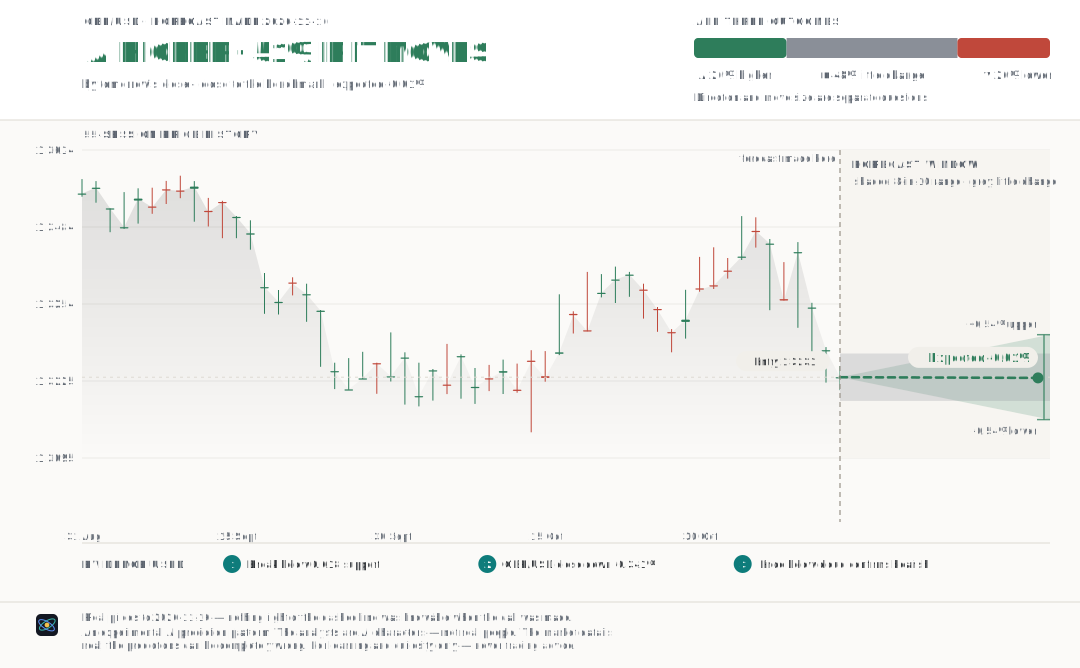
Price context

What the market looked like when this forecast was made.

Price chart for GBP/USD up to the moment the forecast was made

Published record

The locked forecasts and their grading status.

What we said would happen tomorrow

Overall odds by tomorrow’s close: 26% higher · 48% quiet / little changed · 26% lower. Directional call: Higher (51% if it clearly moves; 49% lower).

Benchmark-protected forecastThe registered benchmark remains the published forecast while the AI challenger is still being tested.

barely moved The market moved -0.11%; we'd said about -0.01%.

A move smaller than ±0.30% counts as "little changed" — that threshold was locked in before we published, so we can't move the goalposts afterwards. We also said the move would most likely land between -0.54% and 0.54% (right about 8 times in 10 if we're honestly calibrated).

Evidence and publication timing

Evidence cutoff: 2026-11-14T06:38:31.260Z
Decision started: 2026-11-14T06:38:53.036Z
Decision finished: 2026-11-14T06:39:09.858Z
Ledger written: 2026-11-14T06:39:18.088Z
Timestamp status: forecast hash submitted for independent timestamping.

Grading series: level. Configuration epoch 20; fingerprint b30268869f6f9ddf.

Check this forecast wasn't edited →

What we said would happen next week

Overall odds by next week’s close: 31% higher · 37% quiet / little changed · 32% lower. Directional call: Lower (51% if it clearly moves; 49% higher).

Benchmark-protected forecastThe registered benchmark remains the published forecast while the AI challenger is still being tested.

we were right The market moved -1.10%; we'd said about -0.01%.

A move smaller than ±0.46% counts as "little changed" — that threshold was locked in before we published, so we can't move the goalposts afterwards. We also said the move would most likely land between -1.08% and 1.01% (right about 8 times in 10 if we're honestly calibrated).

Evidence and publication timing

Evidence cutoff: 2026-11-14T06:38:31.260Z
Decision started: 2026-11-14T06:39:09.858Z
Decision finished: 2026-11-14T06:39:18.077Z
Ledger written: 2026-11-14T06:39:20.530Z
Timestamp status: forecast hash submitted for independent timestamping.

Grading series: level. Configuration epoch 20; fingerprint b30268869f6f9ddf.

Check this forecast wasn't edited →

Analyst views

The key point from each specialist; open a card’s reasoning only when you want more detail. Next-session and next-week views are kept separate.

About the percentages: they show each fictional AI analyst’s own conviction, not the market forecast and not measured accuracy.

Next session
Leaning lower8
Leaning higher0
Stayed quiet4

Leaning lower · 8

Evidence points toward a lower price.

Breadth & Intermarket · deepseek · fictional AI analyst · Profile
▼ Lower — 65% confidence
Key view

A close below 1.3231 would confirm the breakdown below the 0.618 support arc, targeting further dollar-strength driven declines.

Why this analyst thinks that
  • Dollar basket strengthened to 102.67 with rising Treasury yields (5.1% vs prev 4.98%), creating sustained USD momentum.
  • Price sits -1.49 ATRs below its 20-day average, indicating persistent bearish pressure.
  • MACD histogram at -0.0014 shows weakening momentum beneath the signal line.
Central-Bank Watcher · gemini · fictional AI analyst · Profile
▼ Lower — 60% confidence
Key view

GBP/USD will continue to decline if the US dollar basket holds above 102.66513616745401, as the strengthening dollar transmits directly to this pair; this would be falsified if the dollar basket reverses its recent gains.

Why this analyst thinks that
  • The US dollar basket strengthened, rising to 102.66513616745401 from 102.34209634020253.
  • The 10-year Treasury yield increased to 5.1% from 4.98%, and the 10-year TIPS real yield rose to 2.86% from 2.78%, suggesting a hawkish tilt in US rates.
  • The market-implied fed funds rate (front contract) increased to 4.165000915527344% from 3.8799972534179688%, indicating higher expectations for future Fed policy.
  • GBP/USD closed down -0.341%, which is just outside the historical flat band of ±0.30%, suggesting a directional move.
Geopolitical Risk Hawk · deepseek · fictional AI analyst · Profile
▼ Lower — 60% confidence
Key view

Market is underpricing continued dollar momentum; a close above 1.3277 (previous close) would signal the breakdown was false and risk-off flows are reversing.

Why this analyst thinks that
  • Technical breakdown below key support suggests momentum favors further GBP weakness.
  • USD basket strength at 102.665 reflects broad defensive flows supporting dollar.
  • Strong inverse correlation with equities indicates risk-off sentiment persisting.
Ichimoku · gpt · fictional AI analyst · Profile
▼ Lower — 55% confidence
Key view

A close below the cloud lower boundary at 1.3338 would confirm continuation of bearish momentum for the next session.

Why this analyst thinks that
  • Price is below the cloud (1.3338–1.3354), which signals bearish equilibrium.
  • The recent daily change was down -0.341%, a move already beyond half the typical daily move of 0.696%.
  • Tenkan-Kijun cross is bullish but price remains below both, weakening the bullish signal.
  • Strong positive correlation with EUR/USD (0.892) suggests confirmation if EUR/USD remains weak.
  • Market news indicates confirmed breakdown below support, reinforcing downside bias.
Dove Economist · grok · fictional AI analyst · Profile
▼ Lower — 55% confidence
Key view

A higher 10-year real yield holding above 2.86 percent combined with the dollar basket above 102.34 would push GBP/USD lower; this would be falsified by a close back above 1.3277.

Why this analyst thinks that
  • GBP/USD already broke below 0.618 support arc on the 4h chart.
  • strong UK data failing to lift the pound despite BoE hike pressure.
  • real yield climbing to 2.86 percent and dollar basket rising to 102.67 both transmit downside.
Hawk Economist · gpt · fictional AI analyst · Profile
▼ Lower — 60% confidence
Key view

GBP/USD will test lower if the 10-year Treasury yield remains above 5.0% and the US dollar basket stays above 102.3, which would confirm hawkish US policy transmission; a reversal above 1.3277 would challenge this view.

Why this analyst thinks that
  • The US front-end fed funds rate expectation rose notably to 4.165%, supporting a stronger dollar.
  • GBP/USD declined by 0.341%, near half the typical daily move of 0.696%, showing active downside pressure.
  • The US dollar basket advanced to 102.67, reinforcing US dollar strength over the last session.
Risk Manager · gpt · fictional AI analyst · Profile
▼ Lower — 50% confidence
Key view

Short GBP/USD traders are crowded near 1.3231; a drop below 1.31 would accelerate their positions, while a bounce above 1.33 would force short-covering.

Why this analyst thinks that
  • The recent 0.341% decline is about half the typical daily move of 0.696%, suggesting room for mean reversion or continuation.
  • Strong positive correlation with EUR/USD at 0.892 implies GBP/USD moves are not isolated and may track EUR/USD sentiment.
  • The volatility term ratio below 1 (0.864) suggests no immediate volatility stress that would trigger big directional moves.
  • Position in the low 18% percentile of 60-day range signals a bearish bias but not an extreme that forces immediate panic.
Volatility · gemini · fictional AI analyst · Profile
▼ Lower — 40% confidence
Key view

The price closing below the Bollinger Band lower at 1.3246 suggests continued downward pressure for the next session.

Why this analyst thinks that
  • The market closed below its lower Bollinger Band, with the price at -0.059 relative to the bands, which indicates a move outside the typical range.
  • The daily price change was -0.341%, which is just outside the flat band of ±0.30%.
Next week
Leaning lower8
Leaning higher0
Stayed quiet4

Leaning lower · 8

Evidence points toward a lower price.

Breadth & Intermarket · deepseek · fictional AI analyst · Profile
▼ Lower — 60% confidence
Key view

Failure to reclaim the 20-day SMA at 1.3369 within the week would maintain pressure toward the 1.32 handle amid broad dollar strength.

Why this analyst thinks that
  • Strong dollar basket (102.67) and elevated real yields (2.86%) create structural headwinds for GBP.
  • Death cross configuration (price below both 50-day and 200-day averages) suggests medium-term bearish bias.
  • High yield credit spreads tightening to 3.2% indicates improved risk sentiment, but weak GBP-equity correlations limit supportive impact.
Central-Bank Watcher · gemini · fictional AI analyst · Profile
▼ Lower — 50% confidence
Key view

GBP/USD will likely trend lower over the next week if the 10-year Treasury yield maintains its current upward trajectory above 5.1%, driven by higher US rate expectations; this would be falsified if the market-implied fed funds rate reverses its recent increase.

Why this analyst thinks that
  • The increase in the 10-year Treasury yield to 5.1% and the 10-year TIPS real yield to 2.86% suggests sustained upward pressure on US rates.
  • The rise in the market-implied fed funds rate (front contract) to 4.165000915527344% indicates a market pricing in higher future Fed rates, which is typically dollar-supportive.
  • Net liquidity provided by the Fed decreased to $5825.49 billion from $5846.483 billion, potentially tightening financial conditions.
  • There are no major scheduled events for the next week that would significantly alter this rate trajectory, apart from import/export prices.
Geopolitical Risk Hawk · deepseek · fictional AI analyst · Profile
▼ Lower — 55% confidence
Key view

Market is underpricing structural dollar strength; a sustained move above 1.3350 would indicate risk-on reversal and invalidate the bearish setup.

Why this analyst thinks that
  • Upcoming US import/export price data could reinforce dollar strength if inflationary.
  • GBP trading at only 18% of its 60-day range leaves room for further downside.
  • Persistent inverse correlation with risk assets suggests sustained defensive positioning.
Ichimoku · gpt · fictional AI analyst · Profile
▼ Lower — 50% confidence
Key view

A weekly close above the cloud upper boundary at 1.3354 would be needed to signal a shift toward bullish equilibrium.

Why this analyst thinks that
  • Price remains below a declining cloud (1.3338–1.3354), signaling bearish equilibrium over the week.
  • Tenkan-Kijun bullish cross above price is contradicted by price position; cross is too weak inside this bearish context.
  • Market news shows strong UK fundamentals but GBP/USD reversed sharply, indicating market skepticism on strength.
  • Correlations with USD/JPY and US equity indices are weakly inverse, adding some complexity but not enough to offset bearish cloud signal.
Dove Economist · grok · fictional AI analyst · Profile
▼ Lower — 45% confidence
Key view

Rising real yields at 2.86 percent and a dollar basket at 102.67 would transmit lower to GBP/USD over the week; this would be falsified by a close above 1.3277.

Why this analyst thinks that
  • real rates well above neutral continue to do compounding damage.
  • net liquidity contracting to 5825.49 billion dollars.
  • strong UK data fails to lift the pound and correlation with EUR/USD at 0.892 reinforces the move.
Hawk Economist · gpt · fictional AI analyst · Profile
▼ Lower — 65% confidence
Key view

GBP/USD will likely trend lower over the week if the US 10-year real yield stays above 2.8% and the Fed front rate remains near 4.2%, signaling persistent hawkish policy; a sustained break above 1.3330 would falsify this scenario.

Why this analyst thinks that
  • Persistent inflation risks and a firm US policy outlook, evidenced by rising real yields at 2.86%, argue for a stronger US dollar bias.
  • Despite strong UK economic data, GBP/USD reversed sharply, indicating market doubts about the pound’s rally sustainability.
  • Correlations show GBP/USD moves strongly in line with EUR/USD (0.89), which also reflects dollar strength pressures.
Risk Manager · gpt · fictional AI analyst · Profile
▼ Lower — 60% confidence
Key view

GBP/USD crowd remains short and pressured near 1.32; a close below 1.31 over the week would force further liquidation and extend losses.

Why this analyst thinks that
  • GBP/USD trading well below its 200-day average by 1.38% and near the bottom of its 60-day range suggests sustained bearish pressure.
  • Strong positive correlation with EUR/USD (0.892) supports a broad dollar strength / GBP weakness theme.
  • UK data strength has not lifted the pound, implying market skepticism and potential for further downside.
  • Upcoming US Producer Price Index and Import/Export Price Indexes may influence USD strength, impacting GBP/USD.
Volatility · gemini · fictional AI analyst · Profile
▼ Lower — 40% confidence
Key view

Given the Bollinger Band width is in its lowest decile, a continued move below the current price of 1.3231 would confirm a volatility expansion to the downside over the next week.

Why this analyst thinks that
  • The Bollinger Band width percentile is at 0.22, in its lowest decile, which often precedes an expansion in volatility.
  • The current daily move of -0.341% is outside the 1-week flat band, suggesting a break from a calm regime.
  • Volatility clusters, meaning that after a quiet regime breaks, movement tends to continue, rather than returning to calm.
4 analysts stayed quiet
Silence is recorded rather than hidden.
  • Dmitri Volkov — the volume and money-flow measures he reads were too close to neutral to argue either way
  • Jonas Weiss — the candle patterns he reads were too close to neutral to argue either way
  • Elena Vasquez — the chart structure she reads were too close to neutral to argue either way
  • Owen Clarke — the value-area measures he reads were too close to neutral to argue either way

Outcome review and lessons

The Master and each participating Persona revisit the result after grading. Correct calls are reviewed too, because being right once does not prove the reasoning.

barely moved

The forecast for 'up' on gbpusd over a 1d horizon was incorrect; the market was flat.

The market moved -0.11% against a locked quiet band of ±0.3%.

Why this result

The market moved -0.11%, which was within the 0.3% no-change band, resulting in a 'flat' verdict.

What was overlooked

All contributing personas predicted 'down', indicating a collective misjudgment of market direction.

Lesson from the outcome

A provisional lesson is that the model's collective 'up' prediction was not supported by market action.

What changes next

No immediate changes are indicated, as the model's performance is still collecting evidence against the benchmark.

Best-scoring Persona views on this result: Vera Stroud, Tomas Lindqvist, Hana Sato. This ordering uses proper probability score, not hindsight confidence.

Read all 8 Persona reviews
Theo Brandt view was incorrect

Predicted lower; market outcome little changed · proper score 0.2266 (lower is better). View profile →

Why this result

The market moved -0.11%, which was within the 0.3% no-change band, resulting in a 'flat' verdict.

What was overlooked

The breakdown below the 0.618 support arc at 1.3231 did not lead to further declines.

Lesson from the outcome

A provisional lesson is that the specified support level did not confirm the expected breakdown.

What changes next

Theo Brandt should review the efficacy of the 0.618 support arc in similar market states.

Priya Nair view was incorrect

Predicted lower; market outcome little changed · proper score 0.2 (lower is better). View profile →

Why this result

The market moved -0.11%, which was within the 0.3% no-change band, resulting in a 'flat' verdict.

What was overlooked

The US dollar basket holding above 102.66513616745401 did not lead to a decline in GBP/USD.

Lesson from the outcome

A provisional lesson is that the direct transmission of dollar strength to this pair was not observed.

What changes next

Priya Nair should re-evaluate the correlation between the dollar basket and GBP/USD in range-bound conditions.

Viktor Ronen view was incorrect

Predicted lower; market outcome little changed · proper score 0.2 (lower is better). View profile →

Why this result

The market moved -0.11%, which was within the 0.3% no-change band, resulting in a 'flat' verdict.

What was overlooked

The market did not underprice continued dollar momentum, as GBP/USD did not decline.

Lesson from the outcome

A provisional lesson is that the expected risk-off flows and dollar momentum did not materialize.

What changes next

Viktor Ronen should review the indicators used to assess market underpricing of dollar momentum.

Hana Sato view was incorrect

Predicted lower; market outcome little changed · proper score 0.1766 (lower is better). View profile →

Why this result

The market moved -0.11%, which was within the 0.3% no-change band, resulting in a 'flat' verdict.

What was overlooked

A close below the cloud lower boundary at 1.3338 did not confirm continuation of bearish momentum.

Lesson from the outcome

A provisional lesson is that the Ichimoku cloud signal for bearish momentum was not effective.

What changes next

Hana Sato should reassess the reliability of the cloud lower boundary signal in current market states.

Marcus Bell view was incorrect

Predicted lower; market outcome little changed · proper score 0.1766 (lower is better). View profile →

Why this result

The market moved -0.11%, which was within the 0.3% no-change band, resulting in a 'flat' verdict.

What was overlooked

The combination of higher 10-year real yield and dollar basket strength did not push GBP/USD lower.

Lesson from the outcome

A provisional lesson is that the expected macro drivers did not influence GBP/USD as anticipated.

What changes next

Marcus Bell should review the combined impact of real yields and dollar strength on GBP/USD.

Ingrid Halvorsen view was incorrect

Predicted lower; market outcome little changed · proper score 0.2 (lower is better). View profile →

Why this result

The market moved -0.11%, which was within the 0.3% no-change band, resulting in a 'flat' verdict.

What was overlooked

The 10-year Treasury yield and dollar basket strength did not lead to GBP/USD testing lower.

Lesson from the outcome

A provisional lesson is that the expected hawkish US policy transmission did not occur.

What changes next

Ingrid Halvorsen should re-evaluate the transmission mechanism of US policy to GBP/USD.

Tomas Lindqvist view was incorrect

Predicted lower; market outcome little changed · proper score 0.1563 (lower is better). View profile →

Why this result

The market moved -0.11%, which was within the 0.3% no-change band, resulting in a 'flat' verdict.

What was overlooked

The crowding of short GBP/USD traders near 1.3231 did not lead to a drop below 1.31.

Lesson from the outcome

A provisional lesson is that the expected acceleration of short positions did not occur.

What changes next

Tomas Lindqvist should review the thresholds for short-covering and acceleration of positions.

Vera Stroud view was incorrect

Predicted lower; market outcome little changed · proper score 0.125 (lower is better). View profile →

Why this result

The market moved -0.11%, which was within the 0.3% no-change band, resulting in a 'flat' verdict.

What was overlooked

The price closing below the Bollinger Band lower at 1.3246 did not suggest continued downward pressure.

Lesson from the outcome

A provisional lesson is that the Bollinger Band signal for downward pressure was not effective.

What changes next

Vera Stroud should reassess the reliability of Bollinger Band signals in current market states.

These reviews are transparent commentary. They affect no past score. A proposed lesson changes future knowledge only after the same weakness is confirmed across enough independent graded forecasts.

we were right

The forecast for GBPUSD to move down over a 1-week horizon was correct.

The market moved -1.1% against a locked quiet band of ±0.46%.

Why this result

The market moved down by -1.1%, exceeding the no-change band of 0.46%.

What was overlooked

The magnitude band was not hit, indicating the extent of the move was not fully captured.

Lesson from the outcome

A correct directional forecast does not guarantee an accurate magnitude prediction.

What changes next

The system should aim to improve magnitude prediction accuracy in future forecasts.

Best-scoring Persona views on this result: Ingrid Halvorsen, Theo Brandt, Tomas Lindqvist. This ordering uses proper probability score, not hindsight confidence.

Read all 8 Persona reviews
Theo Brandt view was correct

Predicted lower; market outcome lower · proper score 0.1 (lower is better). View profile →

Why this result

The market moved down by -1.1%, aligning with the predicted direction.

What was overlooked

The reasoning focused on reclaiming the 20-day SMA, which did not occur.

Lesson from the outcome

A correct outcome does not validate the specific technical trigger cited in the reasoning.

What changes next

Theo Brandt should review if the 20-day SMA threshold was the primary driver of the move.

Priya Nair view was correct

Predicted lower; market outcome lower · proper score 0.1563 (lower is better). View profile →

Why this result

The market moved down by -1.1%, consistent with the predicted direction.

What was overlooked

The reasoning cited the 10-year Treasury yield and market-implied fed funds rate, but their specific impact is not detailed.

Lesson from the outcome

The connection between the stated macro factors and the market outcome needs clearer articulation.

What changes next

Priya Nair should provide more direct evidence linking macro factors to currency movements.

Viktor Ronen view was correct

Predicted lower; market outcome lower · proper score 0.1266 (lower is better). View profile →

Why this result

The market moved down by -1.1%, aligning with the predicted direction.

What was overlooked

The reasoning mentioned underpricing structural dollar strength, but specific evidence for this is not provided.

Lesson from the outcome

The forecast was correct, but the underlying geopolitical risk assessment lacks explicit supporting evidence.

What changes next

Viktor Ronen should include more direct evidence for geopolitical factors influencing currency strength.

Hana Sato view was correct

Predicted lower; market outcome lower · proper score 0.1563 (lower is better). View profile →

Why this result

The market moved down by -1.1%, consistent with the predicted direction.

What was overlooked

The reasoning focused on a weekly close above the cloud upper boundary, which did not happen.

Lesson from the outcome

A correct outcome does not validate the specific Ichimoku trigger cited in the reasoning.

What changes next

Hana Sato should review if the Ichimoku cloud boundary was the primary driver of the move.

Marcus Bell view was correct

Predicted lower; market outcome lower · proper score 0.1891 (lower is better). View profile →

Why this result

The market moved down by -1.1%, aligning with the predicted direction.

What was overlooked

The reasoning cited rising real yields and a dollar basket, but their precise impact on GBP/USD is not detailed.

Lesson from the outcome

The connection between the stated macro factors and the market outcome needs clearer articulation.

What changes next

Marcus Bell should provide more direct evidence linking macro factors to currency movements.

Ingrid Halvorsen view was correct

Predicted lower; market outcome lower · proper score 0.0766 (lower is better). View profile →

Why this result

The market moved down by -1.1%, consistent with the predicted direction.

What was overlooked

The reasoning cited US 10-year real yield and Fed front rate, but their specific impact is not detailed.

Lesson from the outcome

The connection between the stated macro factors and the market outcome needs clearer articulation.

What changes next

Ingrid Halvorsen should provide more direct evidence linking macro factors to currency movements.

Tomas Lindqvist view was correct

Predicted lower; market outcome lower · proper score 0.1 (lower is better). View profile →

Why this result

The market moved down by -1.1%, aligning with the predicted direction.

What was overlooked

The reasoning mentioned crowd positioning and liquidation, but direct evidence for this impact is not provided.

Lesson from the outcome

A correct outcome does not validate the specific behavioral trigger cited in the reasoning.

What changes next

Tomas Lindqvist should provide more direct evidence of crowd behavior influencing market moves.

Vera Stroud view was correct

Predicted lower; market outcome lower · proper score 0.225 (lower is better). View profile →

Why this result

The market moved down by -1.1%, consistent with the predicted direction.

What was overlooked

The reasoning cited Bollinger Band width, but the direct confirmation of volatility expansion to the downside is not detailed.

Lesson from the outcome

A correct outcome does not validate the specific technical trigger cited in the reasoning.

What changes next

Vera Stroud should provide more direct evidence of volatility expansion confirming the downside move.

These reviews are transparent commentary. They affect no past score. A proposed lesson changes future knowledge only after the same weakness is confirmed across enough independent graded forecasts.