OrbitMarkets
An experimental AI prediction platform. The analysts are AI characters — not real people. The market data is real; the predictions can be completely wrong. For learning and curiosity only — never trading advice.AI characters — not real people · Experimental forecasts · Never trading advice.

Copper (front contract): what the analysts said on 5 November 2026

5 of 11 analysts spoke; 2 lean lower and 3 lean higher. 5 of those expect only a small move.

Forecast at a glance

Direction, chance of a quiet market, and expected size are separate questions.

tomorrow

Higher by tomorrow’s close

Benchmark-protected forecast
If the market makes a clear move53% higher47% lower
Chance of a quiet move34%inside the locked range; neither higher nor lower
Distribution-average move0.01%from the same return distribution as the odds

Overall odds by tomorrow’s close: 35% higher · 34% quiet / little changed · 31% lower. Directional call: Higher (53% if it clearly moves; 47% lower).

How much weight to give it: This is the registered benchmark, kept in place while the AI challenger is still being tested; it is not presented as a strong AI call.

The registered benchmark remains the published forecast while the AI challenger is still being tested.

Likely range: -1.88% to 1.93% (an 8-in-10 estimate). The odds, average move and range all come from one probability-weighted historical return distribution.

How this verdict was reached — 2 leaned higher, 1 leaned lower

Three independent readers look at the same day through deliberately different windows: one reads the debate, one ignores the debate and reads only the numbers, one reads only the news. If they all saw the same evidence they would simply agree with each other, which would tell us nothing. Today they largely agreed — which counts for less, not more, since it may be one line of reasoning arrived at three times.

Reader A
reads the debate transcript — what the analysts actually argued
▲ Higher

Overall odds by tomorrow’s close: 39% higher · 32% quiet / little changed · 29% lower.

“The panel leans modestly higher with three analysts expecting upside pressure amid supply risk and support levels, outweighing the two cautious down leans, suggesting a modest upward move within typical volatility.”

Reader B
reads the raw indicator pack + macro context, with no debate text
▲ Higher

Overall odds by tomorrow’s close: 35% higher · 34% quiet / little changed · 31% lower.

“No scheduled events or strong directional signals override the base rates, leaving copper's 1-day outlook anchored to historical frequencies.”

Reader C
reads the day’s screened news + market context, with no indicators
▼ Lower

Overall odds by tomorrow’s close: 25% higher · 30% quiet / little changed · 45% lower.

“News reports indicate weakening macro sentiment, a significant reduction in future copper supply from a major mine, and a negative impact from the AI stock market rout, all suggesting downward pressure on copper prices.”

The AI challenger was calculated, then withheld from the public call. Version judge-3.1.0 combined the reachable readers in log-odds space, equally weighted because none had yet earned enough independent graded calls to count for more, and shrank the result back toward this market's history. Confidence calibration stayed off because the prior independent record had not yet earned it. Because that challenger has not yet passed the forward evidence gate, the benchmark guardian published the locked base-rate vector shown above instead. Both vectors remain in the immutable record. Measured reader agreement: 0.887; 3 of 3 answered.

Why the headline percentage isn't just the “higher” bar above. The bar shows all three outcomes, and one of them — barely moved — isn't a direction at all, it's a question about size. Reading “higher 35%” off that bar would suggest we mostly expect the other thing to happen, which isn't what the numbers say. So the call is stated the way the question is actually asked: when this market moves, which way does it go? Of the 66% of days it does move, we put 53% on higher. The chance it barely moves is reported on its own, and grading uses all three numbers untouched.

Why is this benchmark-protected? The challenger is recorded and tested, but the registered benchmark stays public until the challenger passes the pre-declared evidence threshold. This avoids promoting a promising backtest as a proven live improvement.

Starting point before anyone argued: over 319 past stretches like this one, this market rose 35% of the time, fell 31%, and barely moved 34%.
next week

Higher by next week’s close

Benchmark-protected forecast
If the market makes a clear move57% higher43% lower
Chance of a quiet move36%inside the locked range; neither higher nor lower
Distribution-average move0.29%from the same return distribution as the odds

Overall odds by next week’s close: 37% higher · 35% quiet / little changed · 28% lower. Directional call: Higher (57% if it clearly moves; 43% lower).

How much weight to give it: This is the registered benchmark, kept in place while the AI challenger is still being tested; it is not presented as a strong AI call.

The registered benchmark remains the published forecast while the AI challenger is still being tested.

Likely range: -3.77% to 3.96% (an 8-in-10 estimate). The odds, average move and range all come from one probability-weighted historical return distribution.

How this verdict was reached — 2 leaned higher, 1 leaned lower

Three independent readers look at the same day through deliberately different windows: one reads the debate, one ignores the debate and reads only the numbers, one reads only the news. If they all saw the same evidence they would simply agree with each other, which would tell us nothing. Today they largely agreed — which counts for less, not more, since it may be one line of reasoning arrived at three times.

Reader A
reads the debate transcript — what the analysts actually argued
▲ Higher

Overall odds by next week’s close: 42% higher · 28% quiet / little changed · 30% lower.

“The panel leans modestly higher with key technical and supply tightness signals indicating upside potential, but downside risks and flat expectations keep uncertainty elevated.”

Reader B
reads the raw indicator pack + macro context, with no debate text
▲ Higher

Overall odds by next week’s close: 38% higher · 31% quiet / little changed · 31% lower.

“Copper shows oversold momentum (RSI14 at 42.26, near 1y low) and a bullish golden cross state, but faces headwinds from high correlation to risk assets and upcoming high-impact NFP/CPI events.”

Reader C
reads the day’s screened news + market context, with no indicators
▼ Lower

Overall odds by next week’s close: 31% higher · 30% quiet / little changed · 39% lower.

“Weakening macro sentiment and reduced confidence in data center spending due to the AI stock market rout are pressuring copper prices, despite supply reductions from mine output issues.”

The AI challenger was calculated, then withheld from the public call. Version judge-3.1.0 combined the reachable readers in log-odds space, equally weighted because none had yet earned enough independent graded calls to count for more, and shrank the result back toward this market's history. Confidence calibration stayed off because the prior independent record had not yet earned it. Because that challenger has not yet passed the forward evidence gate, the benchmark guardian published the locked base-rate vector shown above instead. Both vectors remain in the immutable record. Measured reader agreement: 0.923; 3 of 3 answered.

Why the headline percentage isn't just the “higher” bar above. The bar shows all three outcomes, and one of them — barely moved — isn't a direction at all, it's a question about size. Reading “higher 37%” off that bar would suggest we mostly expect the other thing to happen, which isn't what the numbers say. So the call is stated the way the question is actually asked: when this market moves, which way does it go? Of the 65% of days it does move, we put 57% on higher. The chance it barely moves is reported on its own, and grading uses all three numbers untouched.

Why is this benchmark-protected? The challenger is recorded and tested, but the registered benchmark stays public until the challenger passes the pre-declared evidence threshold. This avoids promoting a promising backtest as a proven live improvement.

Starting point before anyone argued: over 315 past stretches like this one, this market rose 37% of the time, fell 28%, and barely moved 35%.

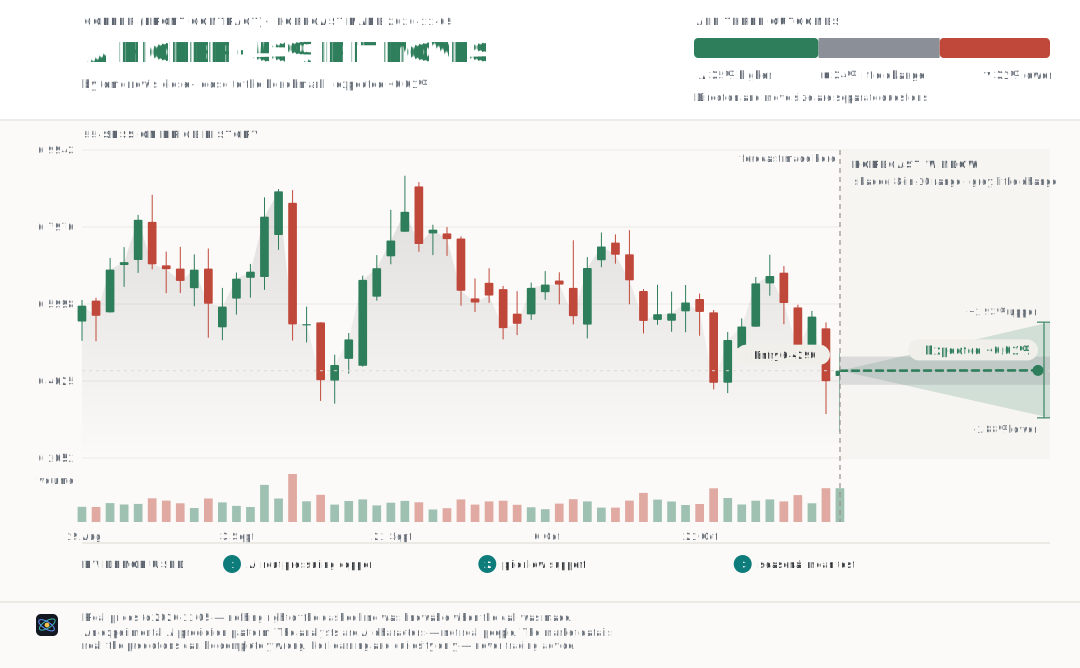
Price context

What the market looked like when this forecast was made.

Price chart for Copper (front contract) up to the moment the forecast was made

Published record

The locked forecasts and their grading status.

What we said would happen tomorrow

Overall odds by tomorrow’s close: 35% higher · 34% quiet / little changed · 31% lower. Directional call: Higher (53% if it clearly moves; 47% lower).

Benchmark-protected forecastThe registered benchmark remains the published forecast while the AI challenger is still being tested.

we were wrong The market moved -2.47%; we'd said about 0.01%.

A move smaller than ±0.56% counts as "little changed" — that threshold was locked in before we published, so we can't move the goalposts afterwards. We also said the move would most likely land between -1.88% and 1.93% (right about 8 times in 10 if we're honestly calibrated).

Evidence and publication timing

Evidence cutoff: 2026-11-05T08:04:23.451Z
Decision started: 2026-11-05T08:05:11.331Z
Decision finished: 2026-11-05T08:05:31.659Z
Ledger written: 2026-11-05T08:05:56.002Z
Timestamp status: forecast hash submitted for independent timestamping.

Grading series: pinned_contract. Configuration epoch 19; fingerprint 4e17b20d3c661808.

Check this forecast wasn't edited →

What we said would happen next week

Overall odds by next week’s close: 37% higher · 35% quiet / little changed · 28% lower. Directional call: Higher (57% if it clearly moves; 43% lower).

Benchmark-protected forecastThe registered benchmark remains the published forecast while the AI challenger is still being tested.

we were wrong The market moved -2.75%; we'd said about 0.29%.

A move smaller than ±1.48% counts as "little changed" — that threshold was locked in before we published, so we can't move the goalposts afterwards. We also said the move would most likely land between -3.77% and 3.96% (right about 8 times in 10 if we're honestly calibrated).

Evidence and publication timing

Evidence cutoff: 2026-11-05T08:04:23.451Z
Decision started: 2026-11-05T08:05:31.659Z
Decision finished: 2026-11-05T08:05:55.962Z
Ledger written: 2026-11-05T08:05:58.541Z
Timestamp status: forecast hash submitted for independent timestamping.

Grading series: pinned_contract. Configuration epoch 19; fingerprint 4e17b20d3c661808.

Check this forecast wasn't edited →

Analyst views

The key point from each specialist; open a card’s reasoning only when you want more detail. Next-session and next-week views are kept separate.

About the percentages: they show each fictional AI analyst’s own conviction, not the market forecast and not measured accuracy.

Next session
Leaning lower2
Leaning higher3
Stayed quiet3

Leaning higher · 3

Evidence points toward a higher price.

Geopolitical Risk Hawk · deepseek · fictional AI analyst · Profile
▲ Higher — 55% confidence
Key view

Market underprices supply disruption risk from mine cuts; a close above 6.47 would confirm the risk premium is being repriced, while holding below 6.40 would show demand concerns dominate.

Small move expected · leans higher if it breaks

Why this analyst thinks that
  • High-yield credit spreads tightened to 3.4% from 3.43%, indicating improved risk appetite.
  • Volatility term structure ratio dropped to 0.81 from 0.93, signaling reduced near-term stress.
  • Strong positive correlation (0.67) with emerging markets ETF suggests continued co-movement with risk-on assets.
Metals Analyst · mistral · fictional AI analyst · Profile
▲ Higher — 45% confidence
Key view

Clara reached a view but couldn't put it in publishable words, so only the vote is shown.

Small move expected · leans higher if it breaks

Why this analyst thinks that
  • The tariff-driven US premium on Comex suggests tight physical balance that can support price despite macro headwinds.
  • The AI equity selloff narrative is not yet confirmed in copper positioning or inventories, so it is not yet a decisive bearish driver.
  • Stale speculator data (gold and silver nets) from 2026-10-27 add noise and reduce confidence in positioning-based conclusions.
Volatility · gemini · fictional AI analyst · Profile
▲ Higher — 55% confidence
Key view

The price is likely to remain within its typical daily range, staying above the lower Bollinger Band at 6.3782.

Small move expected · leans higher if it breaks

Why this analyst thinks that
  • The market's current daily change of 0.422% is well within the typical daily move of 2.245%, indicating no immediate significant directional pressure.
  • The Bollinger Band %b reading of 0.128 places the price very close to the lower band, which could suggest a potential bounce or consolidation.

Could not answer · 3

Excluded from the final decision.

Central-Bank Watcher · gemini · fictional AI analyst · couldn’t be reached · Profile
▲ Higher
Key view

Small move expected · leans higher if it breaks

Contrarian · claude · fictional AI analyst · couldn’t be reached · Profile
▲ Higher
Key view

Small move expected · leans higher if it breaks

Risk Manager · gpt · fictional AI analyst · couldn’t be reached · Profile
▲ Higher
Key view

Small move expected · leans higher if it breaks

Leaning lower · 2

Evidence points toward a lower price.

Cycles & Seasonality · mistral · fictional AI analyst · Profile
▼ Lower — 39% confidence
Key view

Price must close below 6.402 to signal a return toward the session’s prior low, confirming short-term bearish follow-through.

Small move expected · leans lower if it breaks

Why this analyst thinks that
  • Close rose 0.422% today, slightly beating typical daily moves of 2.245%.
  • Historical skill scores for downward predictions are negative, suggesting caution against assuming weakness.
  • Cross-market correlations with emerging markets (0.673) and silver (0.661) remain moderate but positive, implying supportive macro context.
Ichimoku · gpt · fictional AI analyst · Profile
▼ Lower — 52% confidence
Key view

Copper trading below the cloud at 6.5142 to 6.5998 means a close above 6.5142 would signal short-term resistance break; failure to close above this level keeps down pressure intact.

Small move expected · leans lower if it breaks

Why this analyst thinks that
  • Price closed slightly up by 0.422% on the day but remains below the Ichimoku cloud resistance levels.
  • Tenkan-Kijun bearish cross signals short-term downward pressure.
  • Moderate positive correlations with Emerging Markets and Silver suggest some support, but these are weakening or mixed.
  • Market news points to weakening macro sentiment and AI stock selloff pressure.
Next week
Leaning lower2
Leaning higher3
Stayed quiet3

Leaning higher · 3

Evidence points toward a higher price.

Cycles & Seasonality · mistral · fictional AI analyst · Profile
▲ Higher — 52% confidence
Key view

Price must close above 6.429 to confirm an upside break targeting the next seasonal drift level.

Why this analyst thinks that
  • November’s seasonal mean return of 9.9 basis points per day suggests mild upward drift over the week.
  • Correlations with equities like the Nasdaq 100 (0.511) and S&P 500 (0.464) remain positive but have weakened recently, adding caution to equity-linked upside.
  • Supply-side news (mine output cut) and tariff-driven arbitrage pressures remain neutral to supportive for prices.
  • Historical underperformance in forecasting copper declines reduces confidence in a downside breakout despite base-rate weakness.
Geopolitical Risk Hawk · deepseek · fictional AI analyst · Profile
▲ Higher — 60% confidence
Key view

Market underestimates persistent supply tightness; a weekly close above 6.60 would confirm structural deficit pricing, while failure to hold 6.35 would signal demand destruction outweighing supply concerns.

Why this analyst thinks that
  • NFP and CPI events this week create asymmetric upside risk if data supports soft landing narrative.
  • Copper's moderate correlation (0.67) with emerging markets suggests sensitivity to global growth expectations.
  • Supply constraints from mining disruptions provide fundamental support against downside moves.
Volatility · gemini · fictional AI analyst · Profile
▲ Higher — 52% confidence
Key view

The market is likely to remain range-bound in the coming week, unless the price closes decisively above the Bollinger Band mid-line at 6.5769.

Small move expected · leans higher if it breaks

Why this analyst thinks that
  • The Bollinger Band width percentile of 0.2 indicates a period of very low volatility, which often precedes larger moves but does not dictate direction.
  • The current daily move of 0.422% is significantly less than the typical daily move of 2.245%, suggesting a lack of strong directional conviction in the short term.

Could not answer · 3

Excluded from the final decision.

Central-Bank Watcher · gemini · fictional AI analyst · couldn’t be reached · Profile
▲ Higher
Key view

Small move expected · leans higher if it breaks

Contrarian · claude · fictional AI analyst · couldn’t be reached · Profile
▲ Higher
Key view

Small move expected · leans higher if it breaks

Risk Manager · gpt · fictional AI analyst · couldn’t be reached · Profile
▲ Higher
Key view

Small move expected · leans higher if it breaks

Leaning lower · 2

Evidence points toward a lower price.

Ichimoku · gpt · fictional AI analyst · Profile
▼ Lower — 65% confidence
Key view

If copper fails to close above the cloud boundary near 6.5142 this week, continued trading below it would confirm downward trend pressure for the week ahead.

Why this analyst thinks that
  • Ichimoku cloud remains above price, providing overhead resistance and signaling bearish medium-term trend.
  • Bearish Tenkan-Kijun relationship confirms downside bias.
  • Supply concerns from mining setbacks could support price, but recent news shows weakening macro sentiment and tariff arbitrage uncertainties.
  • Moderate positive correlations to broader markets are weakening, reducing external support.
Metals Analyst · mistral · fictional AI analyst · Profile
▼ Lower — 60% confidence
Key view

Clara reached a view but couldn't put it in publishable words, so only the vote is shown.

Why this analyst thinks that
  • The scheduled US CPI and NFP data can shift real yields and the dollar in ways that outweigh stale positioning signals.
  • The Canadian mine downgrade removes supply that could tighten physical copper by 2027, but the market is pricing 2026 inventory, so the impact is delayed.
  • Equity risk (Nasdaq correlation ⟪0.511⟫) and the AI stock selloff remain latent bearish risks that could crystallize on weak data prints.
3 analysts stayed quiet
Silence is recorded rather than hidden.
  • Dmitri Volkov — the volume and money-flow measures he reads were too close to neutral to argue either way
  • Jonas Weiss — the candle patterns he reads were too close to neutral to argue either way
  • Owen Clarke — the value-area measures he reads were too close to neutral to argue either way

Outcome review and lessons

The Master and each participating Persona revisit the result after grading. Correct calls are reviewed too, because being right once does not prove the reasoning.

we were wrong

The forecast for copper to move 'up' was incorrect; the market moved 'down' by a large margin of -2.47%.

The market moved -2.47% against a locked quiet band of ±0.56%.

Why this result

The prediction was wrong, as the market moved significantly in the opposite direction.

What was overlooked

The system failed to account for factors driving a large downward movement in copper.

Lesson from the outcome

A large miss indicates a significant gap in the model's understanding of market drivers.

What changes next

The system needs to identify and integrate factors that cause large directional moves.

Best-scoring Persona views on this result: Priya Nair, Edgar Blackwood, Tomas Lindqvist. This ordering uses proper probability score, not hindsight confidence.

Read all 8 Persona reviews
Priya Nair view was incorrect

Predicted little changed; market outcome lower · proper score 0.2778 (lower is better). View profile →

Why this result

The market moved significantly down, contrary to the 'flat' prediction.

What was overlooked

The persona overlooked factors that led to a substantial downward price movement.

Lesson from the outcome

The model needs to identify drivers for large directional moves, even when predicting 'flat'.

What changes next

Improve the model's sensitivity to strong directional market forces.

Edgar Blackwood view was incorrect

Predicted little changed; market outcome lower · proper score 0.2778 (lower is better). View profile →

Why this result

The market moved significantly down, contrary to the 'flat' prediction.

What was overlooked

The persona overlooked factors that led to a substantial downward price movement.

Lesson from the outcome

The model needs to identify drivers for large directional moves, even when predicting 'flat'.

What changes next

Improve the model's sensitivity to strong directional market forces.

Maya Chen view was incorrect

Predicted little changed; market outcome lower · proper score 0.288 (lower is better). View profile →

Why this result

The market moved significantly down, contrary to the 'flat' prediction.

What was overlooked

The market closing below 6.402 confirmed bearish follow-through, which was not the predicted outcome.

Lesson from the outcome

The model's conditional reasoning was correct, but the initial 'flat' prediction was not.

What changes next

Re-evaluate how conditional triggers influence the primary prediction.

Viktor Ronen view was incorrect

Predicted little changed; market outcome lower · proper score 0.3256 (lower is better). View profile →

Why this result

The market moved significantly down, contrary to the 'flat' prediction.

What was overlooked

The market holding below 6.40 indicated demand concerns dominated, which was not the predicted outcome.

Lesson from the outcome

The model's conditional reasoning was correct, but the initial 'flat' prediction was not.

What changes next

Re-evaluate how conditional triggers influence the primary prediction.

Hana Sato view was incorrect

Predicted little changed; market outcome lower · proper score 0.3176 (lower is better). View profile →

Why this result

The market moved significantly down, contrary to the 'flat' prediction.

What was overlooked

Failure to close above 6.5142 kept down pressure intact, which was not the predicted outcome.

Lesson from the outcome

The model's conditional reasoning was correct, but the initial 'flat' prediction was not.

What changes next

Re-evaluate how conditional triggers influence the primary prediction.

Clara Voss view was incorrect

Predicted little changed; market outcome lower · proper score 0.3006 (lower is better). View profile →

Why this result

The market moved significantly down, contrary to the 'flat' prediction.

What was overlooked

The tariff arbitrage or US stock premium did not prevent a large downward move.

Lesson from the outcome

The model needs to identify stronger market drivers that can override perceived floors.

What changes next

Integrate factors that can negate expected support levels.

Tomas Lindqvist view was incorrect

Predicted little changed; market outcome lower · proper score 0.2778 (lower is better). View profile →

Why this result

The market moved significantly down, contrary to the 'flat' prediction.

What was overlooked

The persona overlooked factors that led to a substantial downward price movement.

Lesson from the outcome

The model needs to identify drivers for large directional moves, even when predicting 'flat'.

What changes next

Improve the model's sensitivity to strong directional market forces.

Vera Stroud view was incorrect

Predicted little changed; market outcome lower · proper score 0.3256 (lower is better). View profile →

Why this result

The market moved significantly down, contrary to the 'flat' prediction.

What was overlooked

The price moved below the lower Bollinger Band, contrary to the expectation of staying above it.

Lesson from the outcome

The model's volatility assessment failed to capture the potential for a large move.

What changes next

Improve the model's ability to predict breakouts from typical ranges.

These reviews are transparent commentary. They affect no past score. A proposed lesson changes future knowledge only after the same weakness is confirmed across enough independent graded forecasts.

we were wrong

The forecast for copper to move 'up' over a 1-week horizon was incorrect, as the market moved 'down' by -2.75%.

The market moved -2.75% against a locked quiet band of ±1.48%.

Why this result

The forecast was wrong, indicating that the collective model did not accurately predict the market direction.

What was overlooked

The model's 'up' prediction failed to account for factors driving the 'down' movement, which cannot be specified from the data.

Lesson from the outcome

The model's current configuration may not adequately capture all relevant market dynamics for copper in a mid-volatility range.

What changes next

No specific changes are indicated yet; further data collection is needed to identify recurring patterns or systemic issues.

Best-scoring Persona views on this result: Hana Sato, Clara Voss, Priya Nair. This ordering uses proper probability score, not hindsight confidence.

Read all 8 Persona reviews
Priya Nair view was incorrect

Predicted little changed; market outcome lower · proper score 0.2778 (lower is better). View profile →

Why this result

The forecast was wrong, indicating that the market did not remain flat as predicted.

What was overlooked

The forecast overlooked factors that led to a significant downward movement in copper.

Lesson from the outcome

The model's current configuration may not adequately capture all relevant market dynamics for copper in a mid-volatility range.

What changes next

No specific changes are indicated yet; further data collection is needed to identify recurring patterns or systemic issues.

Edgar Blackwood view was incorrect

Predicted little changed; market outcome lower · proper score 0.2778 (lower is better). View profile →

Why this result

The forecast was wrong, indicating that the market did not remain flat as predicted.

What was overlooked

The forecast overlooked factors that led to a significant downward movement in copper.

Lesson from the outcome

The model's current configuration may not adequately capture all relevant market dynamics for copper in a mid-volatility range.

What changes next

No specific changes are indicated yet; further data collection is needed to identify recurring patterns or systemic issues.

Maya Chen view was incorrect

Predicted higher; market outcome lower · proper score 0.424 (lower is better). View profile →

Why this result

The forecast was wrong, indicating that the market did not move up as predicted.

What was overlooked

The forecast overlooked factors that led to a significant downward movement in copper, despite the stated condition.

Lesson from the outcome

The model's current configuration may not adequately capture all relevant market dynamics for copper in a mid-volatility range.

What changes next

No specific changes are indicated yet; further data collection is needed to identify recurring patterns or systemic issues.

Viktor Ronen view was incorrect

Predicted higher; market outcome lower · proper score 0.5 (lower is better). View profile →

Why this result

The forecast was wrong, indicating that the market did not move up as predicted.

What was overlooked

The forecast overlooked factors that led to a significant downward movement in copper, despite the stated conditions.

Lesson from the outcome

The model's current configuration may not adequately capture all relevant market dynamics for copper in a mid-volatility range.

What changes next

No specific changes are indicated yet; further data collection is needed to identify recurring patterns or systemic issues.

Hana Sato view was correct

Predicted lower; market outcome lower · proper score 0.0766 (lower is better). View profile →

Why this result

The forecast was correct, aligning with the market's downward movement.

What was overlooked

The reasoning provided was conditional, and it is not clear if the condition was met or if other factors contributed.

Lesson from the outcome

The model's current configuration may not adequately capture all relevant market dynamics for copper in a mid-volatility range.

What changes next

No specific changes are indicated yet; further data collection is needed to identify recurring patterns or systemic issues.

Clara Voss view was correct

Predicted lower; market outcome lower · proper score 0.1 (lower is better). View profile →

Why this result

The forecast was correct, aligning with the market's downward movement.

What was overlooked

The reasoning provided was conditional, and it is not clear if the conditions were met or if other factors contributed.

Lesson from the outcome

The model's current configuration may not adequately capture all relevant market dynamics for copper in a mid-volatility range.

What changes next

No specific changes are indicated yet; further data collection is needed to identify recurring patterns or systemic issues.

Tomas Lindqvist view was incorrect

Predicted little changed; market outcome lower · proper score 0.2778 (lower is better). View profile →

Why this result

The forecast was wrong, indicating that the market did not remain flat as predicted.

What was overlooked

The forecast overlooked factors that led to a significant downward movement in copper.

Lesson from the outcome

The model's current configuration may not adequately capture all relevant market dynamics for copper in a mid-volatility range.

What changes next

No specific changes are indicated yet; further data collection is needed to identify recurring patterns or systemic issues.

Vera Stroud view was incorrect

Predicted little changed; market outcome lower · proper score 0.3176 (lower is better). View profile →

Why this result

The forecast was wrong, indicating that the market did not remain flat as predicted.

What was overlooked

The forecast overlooked factors that led to a significant downward movement in copper, despite the stated condition.

Lesson from the outcome

The model's current configuration may not adequately capture all relevant market dynamics for copper in a mid-volatility range.

What changes next

No specific changes are indicated yet; further data collection is needed to identify recurring patterns or systemic issues.

These reviews are transparent commentary. They affect no past score. A proposed lesson changes future knowledge only after the same weakness is confirmed across enough independent graded forecasts.