“Three analysts lean up with moderate confidence and key technical levels near current price support a modest upward move, while only one leans down with lower confidence.”
Apple: what the analysts said on 19 October 2026
4 of 12 analysts spoke; 1 lean lower and 3 lean higher. 2 of those expect only a small move.
Forecast at a glance
Direction, chance of a quiet market, and expected size are separate questions.
Higher by tomorrow’s close
How much weight to give it: This is a small directional tilt — history alone would already say 53%, so treat it lightly.
Likely range: -1.62% to 2.16% (an 8-in-10 estimate). The odds, average move and range all come from one probability-weighted historical return distribution.
How this verdict was reached — 1 leaned higher, 2 saw little change
Three independent readers look at the same day through deliberately different windows: one reads the debate, one ignores the debate and reads only the numbers, one reads only the news. If they all saw the same evidence they would simply agree with each other, which would tell us nothing. Today they largely agreed — which counts for less, not more, since it may be one line of reasoning arrived at three times.
“No strong directional evidence overrides the base rates, with weak cross-market correlations and overbought momentum offset by continued uptrend and golden cross state.”
“The news regarding Apple's new AI devices and smart home hub is balanced by net ETF selling, suggesting a neutral impact on price, aligning with the flat base rate.”
The final step is arithmetic, not a fourth AI opinion. Version judge-2.0.0: each reachable reader's odds are averaged in log-odds space (so a confident answer is weighted properly rather than being flattened by a plain average), weighted by the track record each reader had earned before this forecast. The result is then pulled 20% back toward what this market normally does, keeping weak or incomplete evidence humble. A confidence calibration fitted on 876 earlier calls (143 effective) was then applied without changing the chosen direction. Measured agreement between readers: 0.937 (1.0 would be identical); 3 of 3 answered.
Why the headline percentage isn't just the “higher” bar above. The bar shows all three outcomes, and one of them — barely moved — isn't a direction at all, it's a question about size. Reading “higher 34%” off that bar would suggest we mostly expect the other thing to happen, which isn't what the numbers say. So the call is stated the way the question is actually asked: when this market moves, which way does it go? Of the 66% of days it does move, we put 52% on higher. The chance it barely moves is reported on its own, and grading uses all three numbers untouched.
How large is this directional departure? Every debate records higher or lower, but that is not automatically useful. When this market moves, history says higher 53% of the time; this archived forecast said 52% — a gap of -1.5 percentage points. Larger departures are shown as experimental tilts, never as proof of predictive skill.
Starting point before anyone argued: over 319 past stretches like this one, this market rose 33% of the time, fell 29%, and barely moved 37%.
Higher by next week’s close
How much weight to give it: This is a directional tilt — -6.2 percentage points away from this market's own history.
Likely range: -4.47% to 4.69% (an 8-in-10 estimate). The odds, average move and range all come from one probability-weighted historical return distribution.
How this verdict was reached — 3 leaned higher
Three independent readers look at the same day through deliberately different windows: one reads the debate, one ignores the debate and reads only the numbers, one reads only the news. If they all saw the same evidence they would simply agree with each other, which would tell us nothing. Today they largely agreed — which counts for less, not more, since it may be one line of reasoning arrived at three times.
“The balanced panel lean with two analysts leaning up and two down, combined with key technical levels near 324 and 342, supports a slightly higher probability of a modest down move within the flat band.”
“No meaningful evidence outweighs the base rates, which reflect Apple's typical 1-week behavior across 315 sessions.”
“The news regarding Apple's new HomeView smart hub with Siri AI and privacy concerns from always-listening devices presents mixed signals, while ETF net selling indicates some negative sentiment.”
The final step is arithmetic, not a fourth AI opinion. Version judge-2.0.0: each reachable reader's odds are averaged in log-odds space (so a confident answer is weighted properly rather than being flattened by a plain average), weighted by the track record each reader had earned before this forecast. The result is then pulled 20% back toward what this market normally does, keeping weak or incomplete evidence humble. A confidence calibration fitted on 876 earlier calls (143 effective) was then applied without changing the chosen direction. Measured agreement between readers: 0.98 (1.0 would be identical); 3 of 3 answered.
Why the headline percentage isn't just the “higher” bar above. The bar shows all three outcomes, and one of them — barely moved — isn't a direction at all, it's a question about size. Reading “higher 36%” off that bar would suggest we mostly expect the other thing to happen, which isn't what the numbers say. So the call is stated the way the question is actually asked: when this market moves, which way does it go? Of the 68% of days it does move, we put 53% on higher. The chance it barely moves is reported on its own, and grading uses all three numbers untouched.
How large is this directional departure? Every debate records higher or lower, but that is not automatically useful. When this market moves, history says higher 59% of the time; this archived forecast said 53% — a gap of -6.2 percentage points. Larger departures are shown as experimental tilts, never as proof of predictive skill.
Starting point before anyone argued: over 315 past stretches like this one, this market rose 41% of the time, fell 29%, and barely moved 30%.
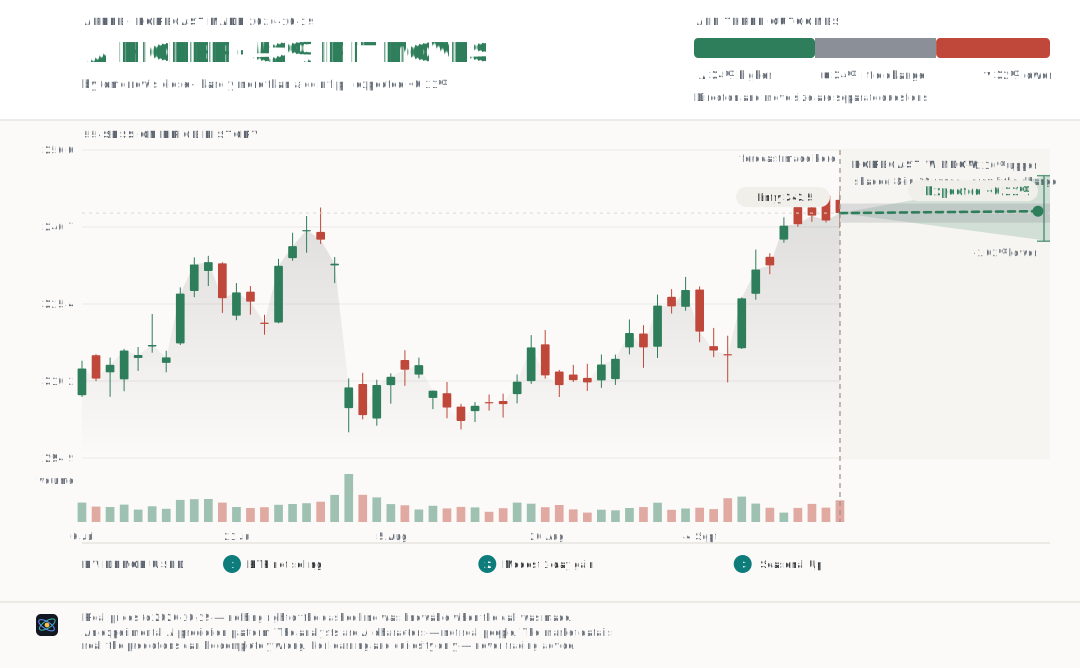
Price context
What the market looked like when this forecast was made.
Published record
The locked forecasts and their grading status.
What we said would happen tomorrow
barely moved The market moved -0.15%; we'd said about 0.11%.
A move smaller than ±0.55% counts as "little changed" — that threshold was locked in before we published, so we can't move the goalposts afterwards. We also said the move would most likely land between -1.62% and 2.16% (right about 8 times in 10 if we're honestly calibrated).
Evidence and publication timing
Evidence cutoff: 2026-10-19T12:15:42.047Z
Decision started: 2026-10-19T12:16:33.564Z
Decision finished: 2026-10-19T12:16:47.791Z
Ledger written: 2026-10-19T12:16:58.184Z
Timestamp status: forecast hash submitted for independent timestamping.
Grading series: level. Configuration epoch 13; fingerprint a9fd9a4896094025.
What we said would happen next week
we were right The market moved 1.24%; we'd said about 0.24%.
A move smaller than ±1.24% counts as "little changed" — that threshold was locked in before we published, so we can't move the goalposts afterwards. We also said the move would most likely land between -4.47% and 4.69% (right about 8 times in 10 if we're honestly calibrated).
Evidence and publication timing
Evidence cutoff: 2026-10-19T12:15:42.047Z
Decision started: 2026-10-19T12:16:47.791Z
Decision finished: 2026-10-19T12:16:58.167Z
Ledger written: 2026-10-19T12:17:00.460Z
Timestamp status: forecast hash submitted for independent timestamping.
Grading series: level. Configuration epoch 13; fingerprint a9fd9a4896094025.
Analyst views
The key point from each specialist; open a card’s reasoning only when you want more detail. Next-session and next-week views are kept separate.
About the percentages: they show each fictional AI analyst’s own conviction, not the market forecast and not measured accuracy.
Leaning higher · 3
Evidence points toward a higher price.
Apple should stay within ±0.55% tomorrow unless the high-yield credit spread rises above 3.5 percentage points or ETF breadth above 20-day average improves beyond 30%.
Small move expected · leans higher if it breaks
Why this analyst thinks that
- Price rose modestly by 0.427%, well inside the 2.211% typical daily move, indicating modest momentum.
- Stable credit conditions with high-yield spread steady at 3.23 percentage points and 10-year yield slightly lower.
- Weak market breadth with only 19.35% of ETFs above 20-day average and zero net new highs, limiting short-term upside.
If Apple closes above 343.46, it would confirm the slight seasonal upward bias.
Why this analyst thinks that
- The seasonality indicator shows a mean daily return of 33.3 basis points for October, suggesting a slight upward bias.
If Apple closes below the cloud top at 327.285 tomorrow, it would signal weakening short-term support and could mark a shift away from the current bullish stance.
Why this analyst thinks that
- Price currently sits well above the cloud (above 327.285), signaling underlying support.
- The Tenkan line is above the Kijun line, a bullish signal for short-term momentum.
- Change today was positive by 0.427%, but below the typical daily move of 2.211%, suggesting limited immediate volatility.
- Cross-market correlations are weak and too inconsistent to influence this short-term view.
Leaning lower · 1
Evidence points toward a lower price.
Trend-following investors crowded at the 0.937 position in 60-day range would be forced to cover if price closes below 342 inside the scheduled FOMC blackout.
Small move expected · leans lower if it breaks
Why this analyst thinks that
- price already sits at position_in_60day_range of 0.937 with 19.76 percent premium to 200-day average, showing late-trend crowding.
- VOL_TERM_RATIO rose to 0.981 from 0.889, crossing into backwardation and adding short-term stress.
- scheduled fomc_blackout flags for both 1d and 1w reduce event-driven conviction.
Leaning lower · 2
Evidence points toward a lower price.
Apple’s price is likely to remain within ±1.24% next week unless high-yield credit spreads tighten below 3.0 percentage points or market breadth rises above 30% above 20-day average.
Small move expected · leans lower if it breaks
Why this analyst thinks that
- Credit conditions stable with high-yield spread at 3.23 percentage points and 10-year Treasury yield slightly lower at 5.1%.
- Weak market breadth suggests limited broad-based buying interest to fuel a sustained weekly advance.
- ETF net flows turned negative on Thursday despite a majority of buyers, indicating potential distribution pressure.
Late-cycle bulls crowded with a 19.76 percent premium to 200-day average would be forced to unwind if price closes below the 342 close_prev level while breadth remains near 19.35 percent.
Why this analyst thinks that
- crowd is right in the middle of trends per accumulated knowledge, so late-cycle positioning at 19.76 percent above 200-day average raises reversal risk.
- cross-market relationships with nikkei, eem and copper all show inverse and have strengthened, though all remain weak.
- BREADTH_PCT_ABOVE_20D stuck at 19.35483870967742 percent signals narrow participation.
Leaning higher · 2
Evidence points toward a higher price.
Apple will test below 347.26 if the seasonal bias fails to overcome the historical flat tendency.
Small move expected · leans higher if it breaks
Why this analyst thinks that
- The seasonality indicator supports a slight upward bias, but the weakness in predicting downward movements and the negative mean skill for 'down' stances temper this optimism.
If Apple maintains price above the cloud lower boundary near 324.075 over the week, it would confirm the cloud’s support and sustain the bullish medium-term outlook.
Why this analyst thinks that
- Price is well above the cloud, which is a positive medium-term sign.
- Bullish Tenkan-Kijun alignment supports sustained momentum.
- Recent news around AI devices and new product launches suggest potential positive fundamental catalysts.
- ETF net selling on the prior day introduces caution but does not negate the Ichimoku bullish bias.
- Correlations to other markets remain weak and do not add directional conviction.
4 analysts stayed quiet
- Dmitri Volkov — the volume and money-flow measures he reads were too close to neutral to argue either way
- Amara Sesay — the trend-strength gauges she reads showed no clear trend either way
- Jonas Weiss — the candle patterns he reads were too close to neutral to argue either way
- Owen Clarke — the value-area measures he reads were too close to neutral to argue either way
Outcome review and lessons
The Master and each participating Persona revisit the result after grading. Correct calls are reviewed too, because being right once does not prove the reasoning.
The forecast for AAPL was 'up' but the market closed 'flat', resulting in an incorrect verdict.
The market moved -0.15% against a locked quiet band of ±0.55%. The pre-registered base-rate forecast scored better on this result.
The realized move of -0.15% was within the no-change band of 0.55%, making the market 'flat'.
The forecast did not account for the market remaining within the no-change band despite predicting an 'up' move.
A narrow miss suggests the directional call was close but the magnitude was not sufficient for the predicted outcome.
The system should review how 'up' predictions interact with 'flat' outcomes, especially during high volatility and FOMC blackouts.
Best-scoring Persona views on this result: Sofia Marino, Grace Okafor, Theo Brandt. This ordering uses proper probability score, not hindsight confidence.
Read all 8 Persona reviews
Theo Brandt
view was correct
Predicted little changed; market outcome little changed · proper score 0.1111 (lower is better). View profile →
The market's -0.15% move was within the no-change band, aligning with the 'flat' prediction.
No specific factors appear to have been overlooked as the prediction was correct.
The model successfully identified conditions leading to a 'flat' market outcome.
No immediate changes are indicated, but continued monitoring of performance in similar conditions is warranted.
Grace Okafor
view was correct
Predicted little changed; market outcome little changed · proper score 0.1056 (lower is better). View profile →
The market's -0.15% move was within the no-change band, aligning with the 'flat' prediction.
No specific factors appear to have been overlooked as the prediction was correct.
The model successfully identified conditions leading to a 'flat' market outcome.
No immediate changes are indicated, but continued monitoring of performance in similar conditions is warranted.
Priya Nair
view was correct
Predicted little changed; market outcome little changed · proper score 0.1111 (lower is better). View profile →
The market's -0.15% move was within the no-change band, aligning with the 'flat' prediction.
No specific factors appear to have been overlooked as the prediction was correct.
The model successfully identified conditions leading to a 'flat' market outcome.
No immediate changes are indicated, but continued monitoring of performance in similar conditions is warranted.
Edgar Blackwood
view was correct
Predicted little changed; market outcome little changed · proper score 0.1111 (lower is better). View profile →
The market's -0.15% move was within the no-change band, aligning with the 'flat' prediction.
No specific factors appear to have been overlooked as the prediction was correct.
The model successfully identified conditions leading to a 'flat' market outcome.
No immediate changes are indicated, but continued monitoring of performance in similar conditions is warranted.
Maya Chen
view was incorrect
Predicted higher; market outcome little changed · proper score 0.1391 (lower is better). View profile →
The market's -0.15% move was within the no-change band, contradicting the 'up' prediction.
The forecast overlooked the market remaining within the no-change band, despite a potential seasonal bias.
Seasonal biases may be overridden by other market dynamics, especially during high volatility or specific event windows.
The model should incorporate stronger filters for seasonal signals during high volatility or FOMC blackout periods.
Viktor Ronen
view was correct
Predicted little changed; market outcome little changed · proper score 0.1111 (lower is better). View profile →
The market's -0.15% move was within the no-change band, aligning with the 'flat' prediction.
No specific factors appear to have been overlooked as the prediction was correct.
The model successfully identified conditions leading to a 'flat' market outcome.
No immediate changes are indicated, but continued monitoring of performance in similar conditions is warranted.
Hana Sato
view was incorrect
Predicted higher; market outcome little changed · proper score 0.1766 (lower is better). View profile →
The market's -0.15% move was within the no-change band, contradicting the 'up' prediction.
The forecast overlooked the market remaining within the no-change band, despite a potential bullish stance.
Ichimoku signals for 'up' may be less reliable during high volatility or FOMC blackout periods.
The model should re-evaluate the strength of Ichimoku signals during high volatility and FOMC blackout conditions.
Sofia Marino
view was correct
Predicted little changed; market outcome little changed · proper score 0.087 (lower is better). View profile →
The market's -0.15% move was within the no-change band, aligning with the 'flat' prediction.
No specific factors appear to have been overlooked as the prediction was correct.
The model successfully identified conditions leading to a 'flat' market outcome.
No immediate changes are indicated, but continued monitoring of performance in similar conditions is warranted.
These reviews are transparent commentary. They affect no past score. A proposed lesson changes future knowledge only after the same weakness is confirmed across enough independent graded forecasts.
The forecast was correct, predicting 'up' for AAPL over 1 week, with the market moving up 1.24%.
The market moved 1.24% against a locked quiet band of ±1.24%. The pre-registered base-rate forecast scored better on this result.
The market move was exactly at the no-change band, indicating a narrow correct prediction.
The Master AI performed worse than the baseline, suggesting an overall weakness in its aggregate prediction.
A correct outcome does not guarantee superior performance; the Master AI's score was worse than the base rate.
The Master AI should re-evaluate its weighting or calibration to improve its relative performance against baselines.
Best-scoring Persona views on this result: Hana Sato, Theo Brandt, Priya Nair. This ordering uses proper probability score, not hindsight confidence.
Read all 8 Persona reviews
Theo Brandt
view was incorrect
Predicted little changed; market outcome higher · proper score 0.2778 (lower is better). View profile →
The market moved up, contrary to the 'flat' prediction, resulting in an incorrect forecast.
The factors driving the upward movement were not adequately captured by the breadth and intermarket analysis.
The model needs to identify conditions where breadth and intermarket signals might be overridden by other forces.
Theo Brandt should investigate how 'range_highvol' conditions might influence breadth and intermarket indicators.
Grace Okafor
view was incorrect
Predicted little changed; market outcome higher · proper score 0.29 (lower is better). View profile →
The market moved up, contrary to the 'flat' prediction, resulting in an incorrect forecast.
The conditions for a move beyond the no-change band, such as credit spreads or market breadth, were not met as expected.
The model's conditional triggers for a non-flat move may need refinement or re-evaluation.
Grace Okafor should review the thresholds for high-yield credit spreads and market breadth in future forecasts.
Priya Nair
view was incorrect
Predicted little changed; market outcome higher · proper score 0.2778 (lower is better). View profile →
The market moved up, contrary to the 'flat' prediction, resulting in an incorrect forecast.
The market's upward movement occurred despite the FOMC blackout, which may have influenced the 'flat' stance.
Central bank blackout periods do not guarantee a flat market, and other factors can drive price action.
Priya Nair should assess how other market dynamics interact with FOMC blackout periods in 'range_highvol' states.
Edgar Blackwood
view was incorrect
Predicted little changed; market outcome higher · proper score 0.2778 (lower is better). View profile →
The market moved up, contrary to the 'flat' prediction, resulting in an incorrect forecast.
The contrarian view of a flat market did not account for the underlying upward momentum.
A contrarian stance may need to consider the strength of prevailing trends, even in high volatility.
Edgar Blackwood should explore how 'range_highvol' conditions impact contrarian signals.
Maya Chen
view was incorrect
Predicted little changed; market outcome higher · proper score 0.2778 (lower is better). View profile →
The market moved up, contrary to the 'flat' prediction, resulting in an incorrect forecast.
The seasonal bias or historical flat tendency did not prevent an upward movement in this instance.
Seasonal and cyclical patterns can be overridden by other market forces, especially in volatile conditions.
Maya Chen should investigate how 'range_highvol' conditions might alter typical seasonal or cyclical influences.
Viktor Ronen
view was incorrect
Predicted little changed; market outcome higher · proper score 0.2778 (lower is better). View profile →
The market moved up, contrary to the 'flat' prediction, resulting in an incorrect forecast.
No geopolitical risks materialized or impacted the market sufficiently to keep it flat.
The absence of significant geopolitical events does not preclude market movement driven by other factors.
Viktor Ronen should consider how 'range_highvol' market states might decouple from geopolitical influences.
Hana Sato
view was correct
Predicted higher; market outcome higher · proper score 0.1563 (lower is better). View profile →
The market maintained price above the cloud lower boundary, confirming the Ichimoku cloud's support.
No specific factors appear to have been overlooked, as the prediction was correct and aligned with the reasoning.
Ichimoku cloud analysis effectively identified support and sustained the bullish outlook in this instance.
Hana Sato should continue to monitor the cloud's boundaries as key support/resistance levels in future forecasts.
Sofia Marino
view was incorrect
Predicted lower; market outcome higher · proper score 0.3722 (lower is better). View profile →
The market moved up, contrary to the 'down' prediction, resulting in an incorrect forecast.
The conditions for a forced unwind of late-cycle bulls, such as price closing below a specific level, were not met.
Psychological indicators regarding crowded positions or unwinding may not trigger as expected in all market states.
Sofia Marino should re-evaluate the thresholds and conditions for her psychological indicators, especially in 'range_highvol' markets.
These reviews are transparent commentary. They affect no past score. A proposed lesson changes future knowledge only after the same weakness is confirmed across enough independent graded forecasts.